
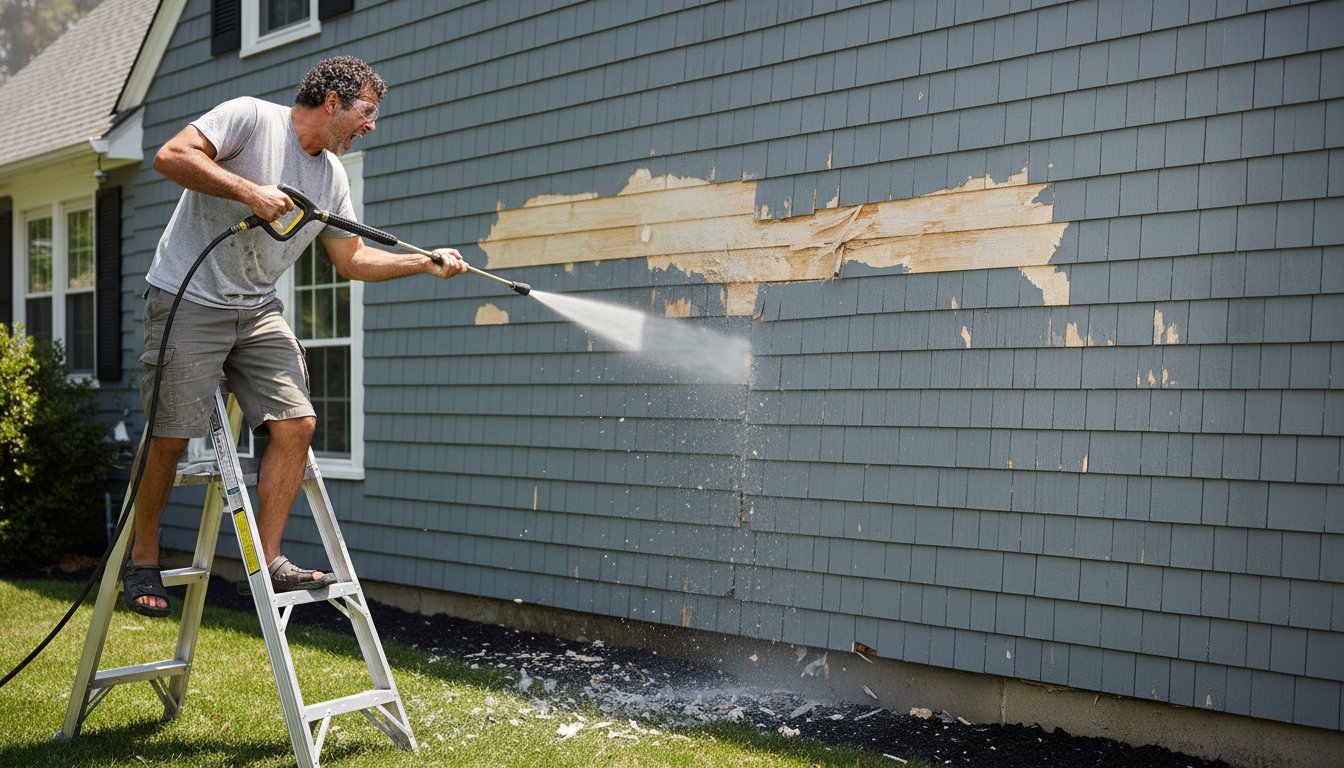
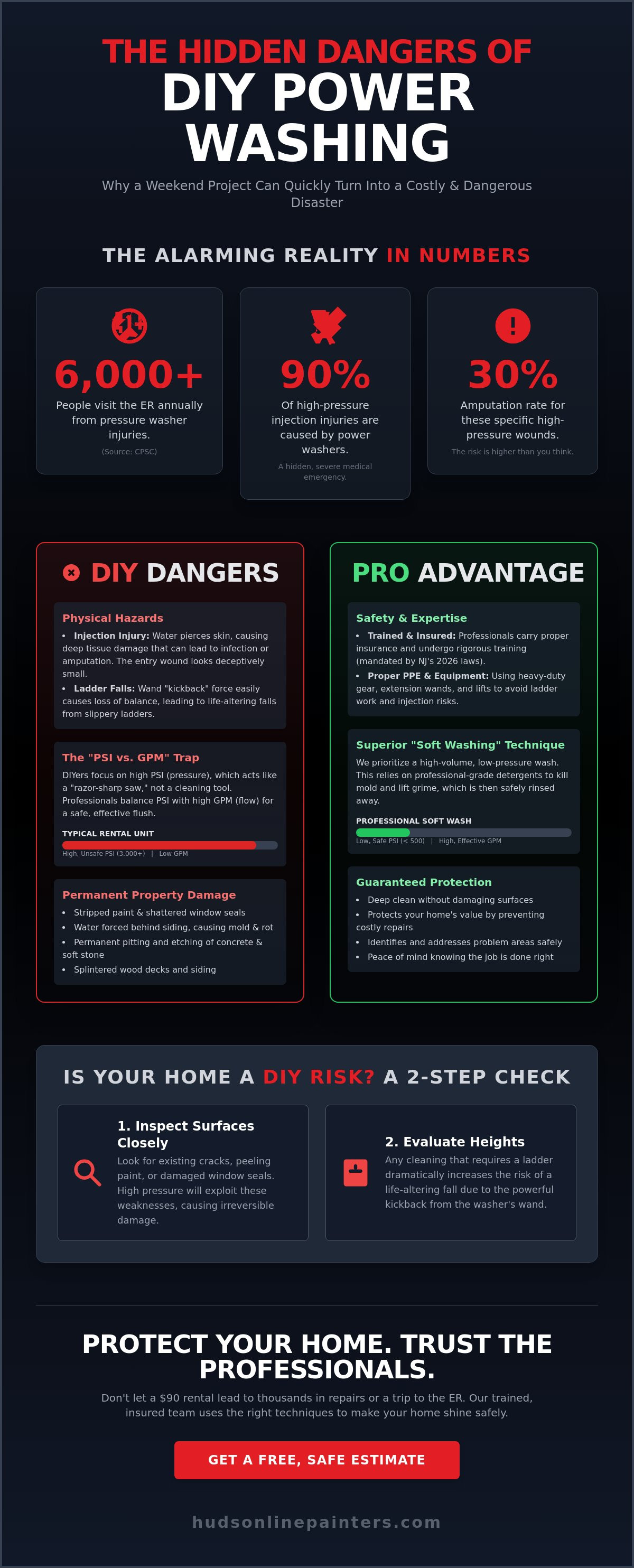
Did you know that 90 percent of high-pressure injection injuries are caused by power washers, with some studies showing an amputation rate as high as 30 percent for these specific wounds? According to the Consumer Product Safety Commission, over 6,000 people visit the emergency room annually for injuries related to these machines. It's easy to see why you might be tempted to tackle the grime yourself to restore your home's curb appeal. You want your property to look its best, and a DIY approach often feels like the most direct path to a clean exterior.
However, the reality of diy power washing risks often involves much more than a simple weekend chore. Beyond the physical dangers, improper technique can lead to shattered window seals, stripped paint, and moisture forced behind your siding. With New Jersey's 2026 licensing laws now requiring rigorous training and insurance for professionals, the technical gap between a rental unit and expert service is significant. We want to provide you with the professional insight needed to protect your home's value and your personal safety. This article explores the hidden hazards of high-pressure equipment, explains the science behind soft washing, and provides a clear checklist to help you evaluate if your project requires a specialist's touch.
Key Takeaways
- Understand the difference between water velocity and volume to avoid the common mistake of over-pressurizing delicate surfaces.
- Learn why the kickback force of a high-pressure wand makes ladder work dangerous and how to avoid life-altering falls.
- Discover how to identify diy power washing risks specific to New Jersey exteriors, including the permanent pitting of concrete and water intrusion in cedar shake siding.
- Follow our two-step evaluation process to inspect your home’s substrates for existing damage that high-pressure water could easily exploit.
- See how professional-grade detergents and proper insurance coverage provide a safer result than a standard rental machine.
The Hidden Dangers of DIY Power Washing
Homeowners often underestimate diy power washing risks, viewing the task as a simple extension of garden hose cleaning. In reality, these machines transform water into a high-velocity projectile capable of causing deep tissue injury or permanent property damage in a fraction of a second. This isn't just about getting wet; it's about managing a tool that can strip the finish off a deck or force water into your home's electrical system before you can react. A professional approach treats power washing as a disciplined craft where safety and material science are prioritized over raw force.
PSI vs. GPM: The Math of Destruction
Many DIYers fall into the trap of believing that higher pressure always equals a better clean. This misconception leads people to choose the highest PSI (Pounds per Square Inch) setting available on their equipment. To understand pressure washing basics, you must look at GPM (Gallons per Minute). While PSI provides the "punch" to break a bond, GPM provides the "flush" to move the debris away safely. A typical rental unit might offer 3,000 PSI but only a low GPM flow. This creates a thin, razor-sharp stream of water. At 3,000 PSI, water behaves less like a cleaning agent and more like a physical saw. It can easily slice through skin, composite decking, or even soft stone without any warning.
Why Rental Units are Often More Dangerous Than Pro Gear
Rental machines are frequently poorly maintained or lack the adjustable unloader valves found on professional equipment. Most consumer-grade rentals operate at a fixed, high pressure between 2,500 and 4,000 PSI. This "one size fits all" approach significantly increases diy power washing risks for New Jersey homes with diverse materials. While a professional might use a technique called soft washing, which utilizes low pressure under 500 PSI and specialized cleaners, a DIYer often relies on brute force. Spending $90 a day on a rental might seem like a bargain. However, that savings disappears instantly if the high-pressure stream cracks your vinyl siding or forces water behind your home's vapor barrier. This moisture intrusion often leads to mold and wood rot that stays hidden for months. Choosing a professional service ensures you are paying for technical precision rather than just a machine rental.
Physical Hazards: Why Water Pressure Can Be Lethal
While property damage is a significant concern, the most critical diy power washing risks involve your personal safety. These machines are not merely high-powered garden hoses; they are industrial tools that require respect and technical knowledge. According to Consumer Reports testing, more than 6,000 people end up in the emergency room every year due to pressure washer related injuries. Many of these accidents happen because homeowners underestimate the raw physical force required to operate the equipment safely for hours at a time.
Understanding Injection Injuries: A Medical Emergency
The most dangerous physical hazard is a high-pressure injection injury. This occurs when the water stream is powerful enough to break the skin and drive water, debris, or cleaning chemicals deep into your underlying tissue. The entry wound often looks like a minor pinprick or a small cut. This deceptive appearance leads many to delay treatment. Inside the body, however, the water can cause rapid tissue death or enter the bloodstream, leading to severe infections or even amputation. If the nozzle passes over a hand or foot, the damage happens faster than the human eye can track. This is why professional crews never operate equipment in shorts or flip-flops; we prioritize heavy-duty boots and protective gear to mitigate these risks.
The Kickback Effect: Ladder Safety and DIY Power Washing
New Jersey homes often feature multiple stories or high gables that require a ladder to reach. Operating a power washing wand from a ladder is one of the most common causes of serious falls. When you pull the trigger, the machine generates a sudden "kickback" force. If you aren't prepared for that backward thrust, it can easily knock you off balance. Combined with wet, slippery ladder rungs and a heavy hose pulling at your feet, the environment becomes a recipe for a traumatic fall. Professionals often use extension wands or specialized lift equipment to keep their feet on solid ground, ensuring a safe and thorough clean for those hard-to-reach peaks. If your project involves heights, it is often safer to hire a professional team with the right safety rigging.
Electrical safety is another major concern for NJ homeowners. Many local properties have exterior utility lines, older outlets, or exposed lighting fixtures that are not fully waterproof. Spraying a high-pressure stream into an outdoor outlet or a frayed wire can cause immediate electrocution or trigger a house fire. A professional technician is trained to identify these electrical hazards and protect your home's infrastructure before the water starts flowing. By respecting the physics of the machine and the layout of your property, we provide a transformation that is as safe as it is beautiful.
Property Damage: How DIY Mistakes Ruin NJ Exteriors
While physical safety is the most immediate concern, the financial fallout of property damage is often what homeowners regret most after a weekend project. Many diy power washing risks stem from the fact that residential building materials are designed to shed rain, not withstand a concentrated blast of water at 3,000 PSI. When you use excessive pressure on surfaces like concrete or wood, you aren't just cleaning them; you are fundamentally altering their structural integrity. Professional technicians understand that every surface has a "breaking point" where cleaning ends and demolition begins.
Concrete seems indestructible, but it's actually quite delicate. Standard driveway concrete has a thin, smooth top layer known as the "cream." Using a high-pressure nozzle too close to the surface can strip this layer away, leading to permanent pitting and a rough, sandy texture. Once this cream is gone, the concrete becomes more porous, making it even more susceptible to oil stains and winter freeze-thaw damage. Similarly, wood decks are easily ruined by "etching." This happens when the water pressure is high enough to tear the soft wood fibers, leaving behind "zebra stripes" or deep splinters that ruin the grain and make the surface painful to walk on. Restoring an etched deck often requires professional sanding and deck & fence staining to hide the scars.
Siding Risks: Vinyl, Stucco, and Historic Wood
New Jersey is home to a beautiful variety of architecture, from modern vinyl-sided developments to historic cedar shake homes. Each material requires a specific approach. High pressure can easily crack vinyl siding, especially in older homes where the plastic has become brittle from sun exposure. Stucco and EIFS (Synthetic Stucco) are even more vulnerable; they are highly porous and can be blasted right off the wall by an inexperienced operator. For historic cedar shake, the danger is even more subtle. High pressure can force water up and under the lap of the wood, saturating the felt paper and plywood sheathing underneath. This creates a moisture trap that the sun can't reach, leading to warped boards and structural rot.
The Hidden Danger of Mold and Mildew Migration
One of the most overlooked diy power washing risks is the accidental migration of organic growth. When you blast mold or mildew with high pressure, you often just spread the spores around or force them into the soffits and wall cavities. Without the use of professional-grade detergents to actually kill the roots of the algae, the green stains will return faster and thicker than before. Even worse, water forced behind window seals can cause double-pane glass to "fog" as the internal desiccant becomes overwhelmed. These seals are not designed to withstand lateral pressure, and once they fail, the window must usually be replaced rather than repaired. A professional soft wash avoids these issues by using chemistry, not force, to achieve a deep and lasting clean.
How to Evaluate Your Home for Power Washing Risks
Before you head to the local rental shop, you need a clear strategy to identify potential vulnerabilities. Every home in New Jersey presents a unique set of challenges based on its age, architecture, and previous maintenance history. A systematic evaluation helps you understand the specific diy power washing risks associated with your property before any water starts flowing. We recommend a structured walkthrough to ensure you aren't walking into a project that could cause more harm than good.
The 5-Point Homeowner Safety Audit
A professional approach begins with a meticulous assessment. Use this framework to decide if a DIY approach is truly viable for your space:
- Identify Substrates: Distinguish between hard surfaces like poured concrete and soft substrates like vinyl siding, stucco, or cedar. Soft materials require significantly less pressure and often benefit more from specialized chemical cleaning than raw mechanical force.
- Structural Inspection: Walk the perimeter to find loose mortar joints, cracked siding panels, or failing window caulk. These gaps act as entry points for high-pressure water to infiltrate your wall cavities, leading to hidden rot.
- The 1978 Rule: If your NJ home was built before 1978, check for lead paint. High-pressure water can pulverize lead-based coatings into a fine mist, creating a significant health hazard on your lawn and for your family.
- Peripheral Audit: Locate your electrical meter, outdoor lighting, and delicate landscaping. A single misdirected blast can shatter a glass fixture or drown expensive ornamental plants.
- The True Cost Calculation: Factor in the $90 daily rental fee, the cost of specialized detergents, and the value of your entire Saturday. Compare this total to a professional power washing quote to see which choice offers better long-term value.
When to Put the Wand Down: Red Flags for DIYers
There are moments when the risk profile of a project exceeds the capabilities of consumer-grade equipment. If you discover extensive organic growth like black mold or thick moss, a simple blast of water won't solve the root problem. These biological issues require professional algaecides that are often not available in standard retail kits. Additionally, if your project requires working from a ladder or reaching third-story peaks, the physical risk increases exponentially. Recognizing these red flags early can save you from a costly repair or a trip to the emergency room. If your audit reveals complex substrates or structural vulnerabilities, it's time to request a professional evaluation from a local expert who understands the nuances of New Jersey home maintenance.
Why Professional Service Beats the 'Two Dudes Painting' Approach
Many homeowners believe that hiring a couple of people with a rented machine is a savvy way to save money while refreshing their home. It's a gamble that often invites the very diy power washing risks we've analyzed. These informal "two dudes" arrangements typically lack the technical training, specialized equipment, and legal protections required to handle high-velocity water on a complex residential structure. A professional crew doesn't just blast away at surface grime; they follow a disciplined protocol designed to preserve your home's structural integrity and aesthetic value.
Insurance and Liability: Protecting Your NJ Investment
The legal landscape for home maintenance in New Jersey has shifted significantly. As of February 2026, state law requires home improvement contractors to maintain a minimum of $500,000 in general liability insurance and provide a compliance bond of at least $100,000. When you hire unskilled labor or attempt the project yourself, you're assuming 100 percent of the liability for property damage or personal injury. If a rented machine's kickback causes a traumatic fall or shatters an expensive window seal, you're the one left with the bill. Choosing a licensed professional shifts this burden away from your family, providing a safe and guaranteed transformation without the financial stress of a potential lawsuit or costly repair.
The Hudson Line Painters Standard: Soft Wash vs. Power Wash
Our approach relies on chemistry rather than brute force. While a DIYer might try to overcome stubborn black mold by turning up the PSI to dangerous levels, we utilize professional-grade, biodegradable detergents. These solutions neutralize organic growth at the root, which allows us to use a gentle "soft wash" technique. This method virtually eliminates the diy power washing risks of cracked siding and water intrusion behind your home's vapor barrier. Understanding these top benefits of power washing your house ensures your property stays cleaner for a longer period without the risk of etched wood or pitted concrete.
For those planning a larger aesthetic update, professional washing is the essential cornerstone of a successful exterior painting service. We treat the cleaning phase as a meticulous preparation step, ensuring the new coating adheres perfectly to a sterilized, undamaged surface. Don't settle for a "good enough" clean from a rental machine that might cause permanent damage. Trust the craftsmen who view every project as a disciplined trade that adds genuine value and comfort to your space. Contact Hudson Line Painters today to experience a professional standard that protects your home and your peace of mind.
Protect Your Home’s Value with Professional Care
Maintaining your home's exterior should bring satisfaction, not the threat of physical injury or permanent structural damage. We have examined the significant diy power washing risks that occur when high-velocity equipment meets delicate siding or historic masonry. While a rental machine offers raw power, it lacks the precision and safety of a professional soft wash system that uses chemistry instead of brute force. Choosing a disciplined approach ensures your property remains a source of pride rather than a list of expensive repairs.
Hudson Line Painters provides the local expertise you need to ensure a deep, safe clean. We are fully insured and licensed in New Jersey, specializing in historic home preservation with 5-star local reviews across Hudson, Union, and Bergen Counties. Our meticulous approach protects your property from water intrusion and surface etching, giving you a transformation that lasts. Don't risk your investment on a weekend gamble when you can rely on a craftsman's standard of care.
Get a Professional Power Washing Quote from Hudson Line Painters
Let's work together to give your home the meticulous attention and beautiful results it deserves.
Frequently Asked Questions
Can power washing a house cause leaks inside the walls?
Yes, high pressure can definitely cause interior leaks by forcing water behind siding or through window seals. When water is driven into wall cavities, it saturates insulation and creates a breeding ground for mold that stays hidden for months. This is one of the most common diy power washing risks for older New Jersey properties. We recommend using a professional soft wash technique to ensure water sheds naturally rather than being driven into your home's structural framing.
What is the difference between pressure washing and soft washing?
Pressure washing relies on mechanical force, often 2,500 to 4,000 PSI, to blast away dirt, while soft washing uses low pressure combined with specialized detergents. Professional soft washing usually operates under 500 PSI, making it much safer for delicate materials like vinyl siding or cedar shake. By using chemistry to kill mold and algae at the root, soft washing provides a deeper, longer lasting clean without the physical risks of high velocity water.
Is it safe to power wash my own roof?
It's not safe to power wash your own roof, particularly if you have asphalt shingles. High pressure water can strip away the protective granules that shield your roof from UV rays, significantly shortening its lifespan. Walking on a wet, sloped roof while managing a high pressure wand also creates an extreme fall hazard. Professionals use a dedicated soft wash process to treat roof moss and algae without damaging the shingles or risking a traumatic fall.
What should I do if I accidentally spray my skin with a power washer?
You should seek medical attention immediately, even if the wound looks like a minor pinprick. High pressure injection injuries are deceptive because the internal damage is often far worse than the surface entry point. Since 90 percent of these hand injuries are caused by power washers, doctors treat them as emergencies. Delaying treatment can lead to rapid tissue death or infection, making it vital to visit an emergency room as soon as an accident occurs.
How often should a house in New Jersey be professionally power washed?
Most homes in New Jersey benefit from a professional cleaning every one to two years. Our local climate, with its high humidity and seasonal temperature swings, encourages the rapid growth of mold, mildew, and algae on north facing walls. Regular maintenance prevents these organic growths from permanently staining your siding or etching your deck. A consistent cleaning schedule preserves your property's curb appeal and protects the longevity of your exterior finishes.
Will power washing remove lead paint from an old NJ home?
Power washing should never be used to remove lead paint from a home built before 1978. The high pressure stream can pulverize lead coatings into a fine, toxic mist that settles into your soil and landscaping. This creates a significant health hazard for your family and neighbors. If you suspect your home has lead based paint, you should consult with a certified professional to determine the safest method for preparation and painting before starting any project.
Can I use a power washer to clean my windows?
You should avoid using a standard power washer on windows because the pressure can easily shatter the glass or ruin the seals. Once a window seal is compromised, moisture gets trapped between the panes, leading to permanent fogging. A professional technician uses a low pressure rinse to safely clean window frames and glass. This approach protects your home's energy efficiency and ensures you won't need to pay for expensive window replacements after a cleaning project.
How much does professional power washing cost in Hudson County?
The cost of professional power washing depends on your home's square footage, the number of stories, and the specific materials involved. For example, cleaning a multi story historic home requires different equipment and detergents than a single level vinyl sided property. We recommend requesting a personalized quote to get an accurate assessment for your specific project. This ensures you receive a fair price and a cleaning plan tailored to the unique needs of your residence while avoiding diy power washing risks.


