

The most expensive Sherwin-Williams paint isn’t automatically the right choice for your room. The best fit depends on the surface, its condition, and how much wear it needs to handle, not just the brand name or color on the can. If you’re searching for sherwin williams paint, it’s easy to focus on the shade and overlook the decisions that shape the finished result.
Choosing a color and choosing paint for drywall, wood, cabinets, or exterior siding are separate steps. Samples can look different in changing light, and poor surface preparation can undermine even a well-matched product. First identify what you’re painting and how the surface is used, then compare the product’s intended use, finish, preparation requirements, and application directions.
This guide explains how to compare Sherwin-Williams paint options by surface, finish, project needs, and maintenance expectations. You’ll also learn what to ask before buying paint or hiring a painter, and why preparation matters as much as product choice. With a clear plan, you can make a practical decision for your home and set realistic expectations for the result.
Key Takeaways
- Match paint to the surface and how the space is used, rather than choosing by color or brand alone.
- Compare interior walls, trim, cabinets, and exterior surfaces by checking finish and project requirements.
- View color samples in your actual lighting, and use digital previews to narrow choices rather than predict the exact final color.
- Before choosing sherwin williams paint, identify the surface, assess its condition, and confirm the product specifications for your project.
- A painter’s assessment can help clarify repairs, preparation, scope, and finish preferences before work begins.
What Is Sherwin-Williams, and What Should Homeowners Know Before Choosing Its Paint?
Sherwin-Williams is a paint and coatings company with products for a range of settings and surfaces. That selection gives homeowners options, but it doesn’t mean every paint is suitable for every room or project. A wall, wooden door, kitchen cabinet, and exterior surface can have different requirements. The company’s history and corporate overview offers background on the brand. Choosing a paint still calls for project-specific checks.
A paint brand identifies the manufacturer; it doesn’t, by itself, identify the right coating for your surface. Before buying, check current product documentation for intended use, finish, surface preparation, and application instructions. This article offers selection guidance, not a current product specification sheet. Product details can change, so confirm them with the manufacturer before deciding.
What does the Sherwin-Williams name tell you about a paint?
The name tells you who makes the paint, not whether it suits your project. Start by identifying the surface and how it will be used: an interior wall, trim, cabinet, or outdoor surface may call for different product categories and application steps. Read the current label and technical documentation to confirm that the product is intended for the surface and setting. If the surface has existing coatings or visible damage, include its condition in your decision.
Why does paint selection involve more than color?
Color is only one part of the finished appearance. A shade can look different as natural and artificial light, nearby colors, and materials change. A small sample or screen preview can help you narrow choices, but it can’t guarantee an exact match across a larger area.
Finish matters, too. Flat, eggshell, satin, and glossier finishes reflect light differently and can affect both appearance and cleaning. The surface matters as much: drywall, wood, and previously coated surfaces may need different preparation or paint guidance. A carefully chosen color won’t compensate for a surface that wasn’t properly assessed or for product instructions that weren’t followed. When comparing sherwin williams paint, consider the color, finish, surface suitability, preparation, and application directions together.
How to Compare Sherwin-Williams Paint Options for Your Project
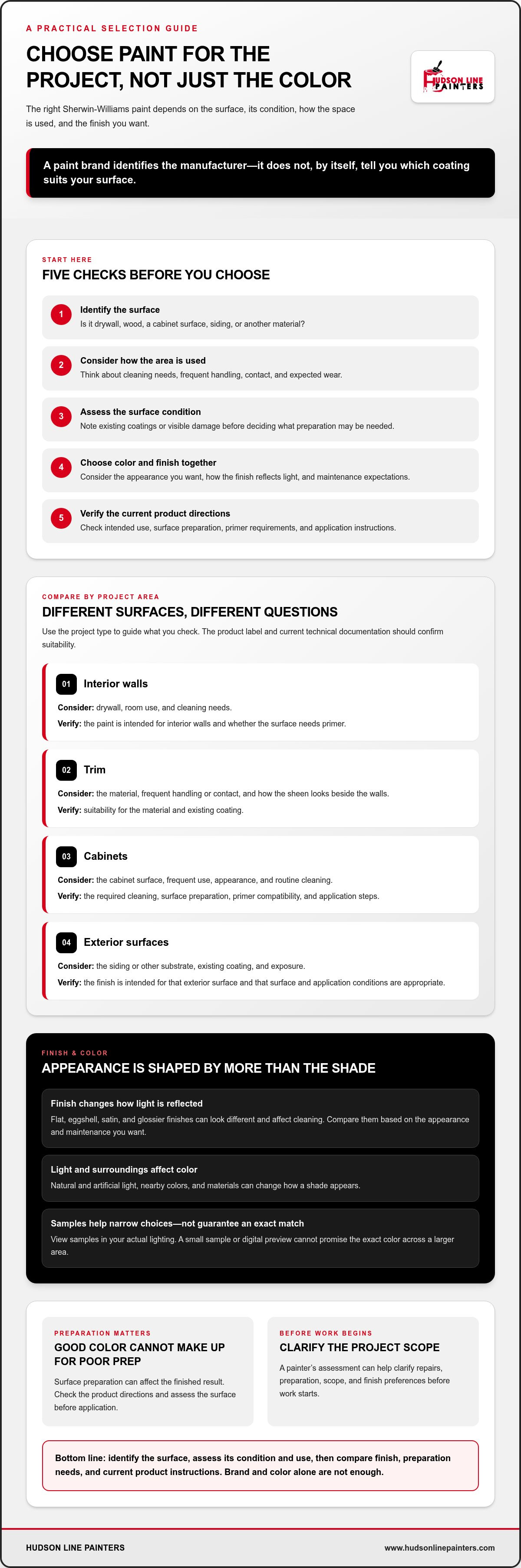
Compare paint by the work it needs to do, not just by shade or price tier. Before choosing among sherwin williams options, note the surface material, how the area is used, its current condition, and the finish you want. Then check the manufacturer’s current documentation for intended use, application directions, and any primer requirements. For another perspective on interior paint selection, see Bob Vila’s review of best interior paints.
| Project area | Surface and use | Finish to consider | Questions to verify |
|---|---|---|---|
| Interior walls | Drywall; consider room use and cleaning needs | Choose based on appearance and maintenance | Is the paint intended for interior walls? Does the surface need primer? |
| Trim | Often wood; consider frequent handling and contact | Think about the desired sheen and how it looks beside the walls | Is the product suitable for this material and existing coating? |
| Cabinets | Wood or another cabinet surface; frequent use | Consider appearance and routine cleaning | What preparation, primer, and application steps does the product require? |
| Exterior | Assess siding or other substrate, existing coating, and exposure | Confirm the finish is intended for the specific exterior surface | Are the surface condition and application conditions appropriate? |
Which paint considerations matter for interior walls, trim, and cabinets?
Walls, trim, and cabinets don’t face the same wear. In a busy room, consider how often walls need cleaning; trim is more likely to be handled or bumped. The material and existing coating matter, too. Cabinet refinishing is not simply a matter of applying wall paint to doors. Check the product’s instructions for cleaning, surface preparation, primer compatibility, and application. Hudson Line Painters offers professional cabinet painting, with project needs assessed separately from paint-brand choice.
What changes when the project is exterior painting?
For exterior work, identify the substrate and inspect the existing coating and surface condition. Exposure and application conditions also matter. For homes in Hudson, Union, and Bergen counties, the right approach depends on the specific property and conditions at the time of work, so avoid relying on a blanket recommendation. Confirm product directions and consider a project-specific assessment. Hudson Line Painters provides professional exterior painting.
Once you’ve identified the surface, use, finish, and product requirements, you’ll have a clearer basis for comparing options. If you’re planning an interior project, you can also explore professional interior painting services and discuss the project scope and surface needs.
Does Sherwin-Williams Paint Guarantee a Better Result? Color, Finish, and Prep Compared
A familiar brand name can help you narrow your options, but it can’t make every paint the right match or correct mistakes in the work. The finished result depends on several factors working together: the selected color and finish, the surface underneath, its condition, and how the coating is applied.
Product selection determines what you’re applying; preparation and application determine how the work comes together. Even a suitable sherwin williams paint choice can disappoint if the surface isn’t ready or the finish doesn’t suit the space. Treat product, color, and workmanship as related decisions, not substitutes for one another.
How can you test a Sherwin-Williams color before committing?
Start with a physical sample in the room where the paint will go. View it beside fixed elements such as flooring, countertops, tile, and large furnishings, since surrounding colors can affect how a shade appears. Check it in morning, afternoon, and evening light. A color that looks balanced in daylight may appear different under lamps after dark.
Digital visualizers are useful for comparing ideas and narrowing a shortlist, but they’re planning tools, not exact previews. Screens vary, and a digital image can’t fully reproduce the room’s lighting, wall texture, or finish. Use a sample to judge the color in context, then consider how the chosen sheen may reflect light across the surface.
How much do preparation and application affect the result?
Preparation should respond to the surface, not follow a one-size-fits-all checklist. Depending on its condition, work may involve cleaning, repairing damage, sanding, priming, and protecting nearby areas. Confirm which steps the project needs and check the paint manufacturer’s current instructions for preparation, primer compatibility, and application.
Skipping a necessary step can leave imperfections visible, make the finish look uneven, or affect how the coating performs. Applying paint over dirt or a poorly repaired area won’t hide the underlying issue simply because the paint is from a recognized brand. The surface, existing coating, and product directions all matter.
To judge the likely outcome, look beyond the paint can: view samples in real room conditions, choose a finish suited to the surface and use, and make sure the preparation plan addresses the existing condition. This helps set realistic expectations and gives the final color a better chance of looking the way you intended.
What Should New Jersey Homeowners Check Before Buying or Applying Sherwin-Williams Paint?
A clear project plan helps you compare paint options without overlooking what the surface needs. Follow this order: identify the surface, assess its condition, define how the area will be used, then confirm the paint’s current specifications and application directions. Don’t assume the same Sherwin-Williams product suits every surface or setting.
- Identify the surface: Is it plaster, drywall, wood, or another material?
- Assess its condition: Look for peeling coatings, damage, or areas that may need repair.
- Define the project: Consider room use, exposure, desired appearance, and finish.
- Confirm requirements: Check the product documentation for intended use, preparation, primer compatibility, and application conditions.
For exterior work, weather and application conditions can affect whether a project should proceed as planned. A project-specific professional assessment is more useful than a blanket recommendation, especially if the existing coating or substrate needs attention.
What should you ask before selecting paint for an older home?
Ask what the existing surface is, whether its coating is intact, and what repairs or preparation may be needed. Plaster, drywall, wood, and previously painted surfaces can call for different approaches. If you have concerns about possible lead paint, seek assessment from a qualified professional before disturbing the coating. Hudson Line Painters provides painting and repair services, but not lead paint abatement.
How can local homeowners plan a painting project responsibly?
Before work begins, discuss access to the area, ventilation for interior work, surface condition, project timing, and how nearby spaces will be protected. Write down questions about preparation, product selection, finish, cleanup, and scope so everyone has the same expectations. Hudson Line Painters serves communities in Hudson County, Union County, and Bergen County, including Hoboken, Edgewater, Fort Lee, Teaneck, Hackensack, Englewood, Cliffside Park, Leonia, Palisades Park, and Ridgefield.
Hudson Line Painters can assess project needs for interior and exterior painting, along with drywall and plaster repair. A conversation about the surface can help clarify what it requires before you settle on a paint choice.
Discuss your painting project
How Hudson Line Painters Can Help You Plan a Sherwin-Williams Painting Project
Choosing paint is one part of planning a successful project. Hudson Line Painters provides painting services, not paint retail or Sherwin-Williams representation. A project assessment can help clarify what the property needs, whether you’re considering a specific product or still comparing options. The aim is to connect the surface, its condition, and its intended use with a practical scope of work.
For homeowners weighing sherwin williams paint options, a painter can discuss project requirements without suggesting that one product suits every home. Check final product decisions against the manufacturer’s current guidance for the surface and application.
What can a professional painter help you decide?
A painter can assess existing surfaces, note visible damage or coating concerns, and identify where repairs or preparation may be needed. That assessment helps define the work before application begins. A wall that needs repair, for example, may require a different scope than one in sound condition. A frequently used area may also call for a different finish discussion than a low-traffic room.
Hudson Line Painters offers residential painting services, as well as interior and exterior painting. A project discussion can clarify which surfaces are included, what preparation is anticipated, and what finish preferences to consider. Confirm product suitability and application instructions using current manufacturer documentation.
What information should you bring to a painting consultation?
A few details can make the conversation more focused. Gather photos of the area, note the surface material and room or exterior location, and share concerns such as peeling paint, previous repairs, or uncertainty about the existing coating. Bring preferred colors or sample results if you have them.
Write down questions before work begins. Ask what preparation and repairs are included, how nearby areas will be protected, what application approach is planned, what the project schedule depends on, and how cleanup will be handled. Confirm the agreed scope so you understand which surfaces are included and which are not.
Hudson Line Painters serves parts of northern New Jersey, including Hudson, Union, and Bergen counties and the listed communities of Hoboken, Edgewater, Fort Lee, Teaneck, Hackensack, Englewood, Cliffside Park, Leonia, Palisades Park, and Ridgefield. Local homeowners can share project details with the team to discuss whether the requested painting work fits the company’s services.
Discuss your painting project with Hudson Line Painters
Choose the Right Paint Plan for Your Home
The best sherwin williams option is the one suited to your surface, how the space is used, and the finish you want. Color samples can guide your choice, but view them in your home’s lighting before deciding. Then confirm the product’s current instructions for the surface and application.
Keep the full project in view. Surface condition, needed repairs, preparation, and application all contribute to the finished result, so don’t rely on the brand name alone. Hudson Line Painters is a painting service provider, not a paint retailer or Sherwin-Williams representative. The company offers residential and commercial interior and exterior painting in parts of Hudson, Union, and Bergen counties.
For a clearer plan, share your project details and discuss the surfaces, scope, preparation, and finish preferences with the team. A well-considered starting point can make the next decisions feel more manageable.
With the right information and a practical plan, you can move forward with confidence in your choices for the home.
Frequently Asked Questions
Is Sherwin-Williams paint good for residential projects?
Sherwin-Williams offers paints and coatings for a range of applications, but the brand name alone can’t tell you whether a particular option suits your home. Consider the surface, room use or exterior exposure, desired finish, existing coating, and preparation needs. Check current product documentation for approved uses and application directions. A painting professional can assess the property and help clarify what to verify before you buy.
Which Sherwin-Williams paint should I use for interior walls?
Choose interior wall paint based on the room’s use, wall material and condition, and how often the surface needs cleaning. Compare finish options and product directions for that specific application instead of assuming one paint suits every room. Test physical color samples in the space and review them under different lighting. Before work begins, confirm the selected product’s current label and technical guidance for the surface.
Can Sherwin-Williams paint be used on cabinets?
Whether a paint is suitable for cabinets depends on the exact product, cabinet material, existing coating, and preparation process. Check current manufacturer instructions rather than assuming wall paint is appropriate for cabinetry. Depending on the surface, preparation may involve cleaning, sanding, repairs, or primer. Consider asking a cabinet-painting professional to assess the doors and boxes before selecting a product.
How do I choose a Sherwin-Williams paint color for my home?
Start by considering natural and artificial light, fixed furnishings, nearby rooms, and the mood you want to create. A digital visualizer can help you compare ideas, but it can’t guarantee how paint will look on your walls. Review physical samples in the room and beside fixed materials, then check them at different times of day. This helps you judge the color in the conditions where it will actually be seen.
Does Sherwin-Williams paint need primer?
Primer needs depend on the surface, its condition, existing coating, repairs, and the paint system selected. Some projects may call for primer or specific preparation, while others may have different instructions. Read the current product label and technical documentation rather than applying one rule to every surface in your home. If the surface is damaged, stained, or unfamiliar, have it assessed before painting.
Is Sherwin-Williams paint suitable for New Jersey exterior projects?
It depends on the exterior material, existing coating, exposure, surface condition, and application conditions. New Jersey weather makes project timing and surface assessment important, but no single recommendation fits every property. Check current manufacturer directions for the intended surface and conditions. A local painter can assess repairs and preparation needs. Hudson Line Painters serves parts of Hudson County, Union County, and Bergen County, including Hoboken, Edgewater, Fort Lee, Teaneck, Hackensack, Englewood, Cliffside Park, Leonia, Palisades Park, and Ridgefield.


