
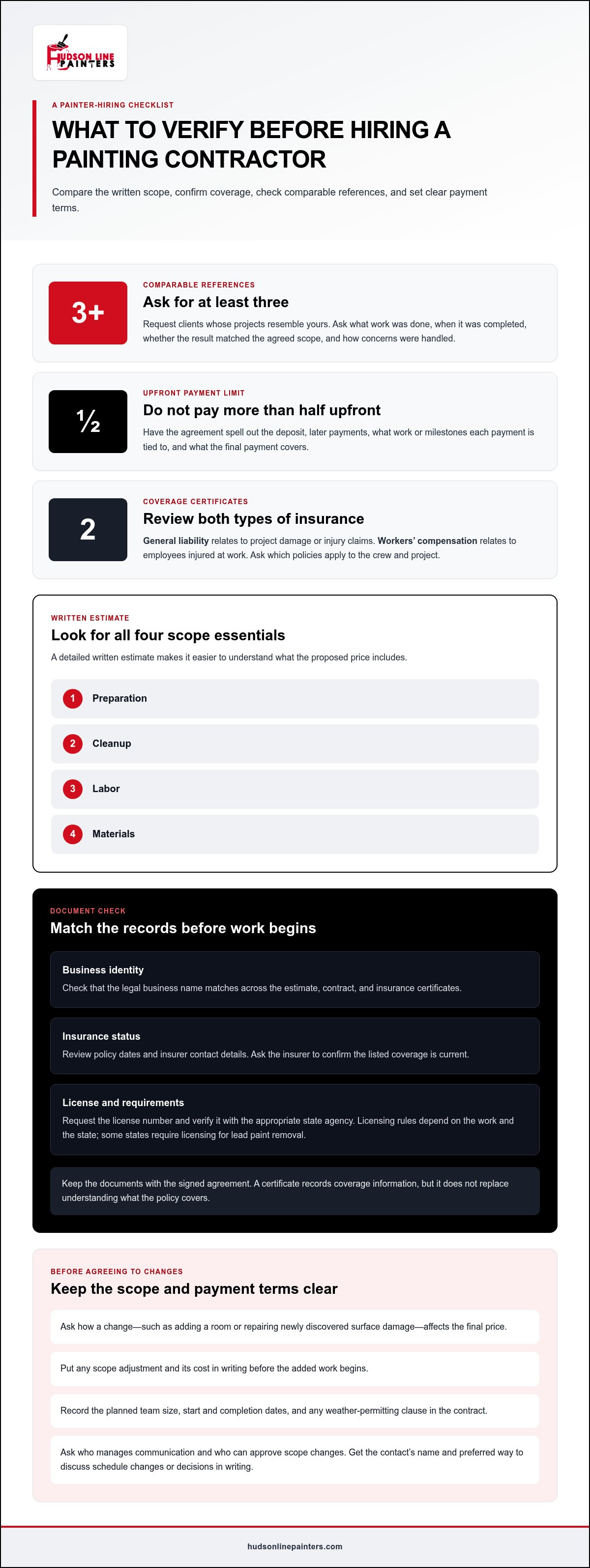
A low estimate can leave out the details that determine the finished job. Knowing what to ask a painting contractor before hiring means asking for a written estimate that covers preparation, cleanup, labor, and materials, along with current certificates for general liability and workers’ compensation insurance. According to the Federal Trade Commission, you should also ask for references from at least three clients with projects like yours.
It’s reasonable to want a clear cost and a durable finish, without surprises once work begins. Asking the right questions helps you understand what’s included, how surfaces will be prepared, and which paint and primer are planned before you hire a painting contractor.
This guide covers estimates, insurance, references, primer, finish coats, and paint quality. It also explains why the paint line matters: estimates may describe similar work but include different materials. Ask which specific products are included and how they suit your project.
Key Takeaways
- Compare written estimates by what they include, not just by the final total.
- Review current insurance certificates and ask for references from customers with similar projects.
- Clarify how surfaces will be prepared and when primer is needed before agreeing on the paint coats.
- Ask for the paint line and product quality in writing so you can understand what the estimate covers.
- Use clear project details to set expectations for the work, materials, and final finish.
1. Do you carry Workman’s Compensation Insurance for your employees?
To verify a painting contractor’s license, insurance, and references, ask for the license number and current certificates for general liability and workers’ compensation. Verify the license with the relevant state agency, and request references from at least three clients with similar projects, as the Federal Trade Commission recommends.
Ask what the written proposal includes before work begins. Check that the business name matches the name on the proposal and contract, and review the dates on any insurance documents. Hudson Line Painters provides written proposals with a detailed scope, premium paint recommendations, timeline, and flat-rate price.
General liability and workers’ compensation serve different purposes. General liability coverage relates to damage or injury claims involving the project, while workers’ compensation relates to employees injured at work. When reviewing a contractor’s documents, ask which policies apply to the crew and project. A certificate documents coverage information, but it is not a substitute for understanding what the policy covers.
Use a simple verification process:
- Match the contractor’s legal business name across the estimate, contract, and insurance certificates.
- Review the policy dates and the insurer’s contact details on each certificate.
- Ask the insurer to confirm that the listed coverage is current.
- Request the state license number, then verify it with the appropriate state licensing agency.
- Contact at least three references about comparable work, as recommended by the Federal Trade Commission.
Keep the documents with your signed agreement. If a crew changes before the job starts, ask whether the insurance information still applies to the people doing the work. Clear records make it easier to understand who is responsible if property damage or a workplace injury occurs. They also help distinguish a documented policy from a verbal assurance.
Licensing rules can depend on the work and the state. Some states require licensing for lead paint removal, according to the U.S. Bureau of Labor Statistics. That requirement concerns lead paint removal, not every standard painting project. Ask which requirements apply to the work in your agreement, and check the relevant state rules rather than assuming one rule applies everywhere.
2. What is the estimated cost of the project?
Ask for a written estimate that clearly describes preparation, cleanup, labor, and materials. A detailed scope shows what the proposed work includes and makes it easier to compare estimates. An on-site estimate lets the contractor assess the space, measure surfaces, and note details that photos can miss. Hudson Line Painters provides free on-site estimates and flat-rate pricing in a written proposal.
The project price depends on the measured area, surface condition, access, paint selection, preparation, labor, and cleanup; the price is provided after a quote request. Ask how changes to the project affect the final price. For example, adding a room or repairing newly discovered surface damage can change the agreed scope. Put any adjustment and its cost in writing before the added work begins.
What payment schedule and deposit are reasonable for a painting contractor? Don’t pay more than half of the project cost upfront. Have the written agreement set out the deposit, later payments, and the work or milestones associated with each payment, along with what the final payment covers.
Ask who will manage communication and serve as your main point of contact. A project manager who regularly visits the job site and has office staff support can help keep questions and updates organized. Get the contact’s name and the preferred way to discuss schedule changes or decisions in writing. Clarify who can approve changes to the scope, so instructions don’t get lost between the homeowner and painting crew.
Project history should match your job, not just sound impressive. Ask about comparable work, such as interior rooms with similar surfaces or exterior areas with similar preparation needs. A claim of “42 years” working with every crew member is a reason to ask what that experience refers to and who will actually be assigned. Record the planned team size, start and completion dates, and any weather-permitting clause in the contract.
What red flags should you watch for when hiring a painting contractor? Treat an estimate without preparation, materials, labor, or cleanup details as incomplete. Pressure to pay more than half upfront, vague answers about who manages the work, and dates or change terms left out of the agreement also deserve attention. For work on a home built before 1978, ask whether the project will disturb old paint and how lead-safe practices will be handled. Some states require licensing for lead paint removal, according to the U.S. Bureau of Labor Statistics.
For interior work, a defined scope helps connect the estimate to the rooms, surfaces, and finish you expect. Review the details of interior painting projects as you organize the questions and decisions for your own project.
3. Can you provide references from recent customers?
Ask for references from at least three clients whose projects resemble yours, as the Federal Trade Commission recommends. Similarity matters: a homeowner who hired someone to paint interior rooms can speak to room preparation and finish quality, while an exterior customer can describe weather delays and outdoor surface work. Recent examples can also show how the contractor’s current crew communicates and completes projects.
Before speaking with a reference, ask what work they hired the contractor to do and when it was completed. Keep your questions specific: Did the finished work match the agreed scope? Did the crew protect nearby areas? How did the contractor handle concerns? A clear example, such as how a missed detail was resolved, tells you more than a general statement of satisfaction.
- Did the crew arrive and work according to the agreed schedule?
- Were preparation, cleanup, and changes handled as expected?
- Did the finished surfaces look consistent in different lighting?
- How did the contractor respond when you raised a concern?
- Would you hire the same contractor for a similar project?
References, online reviews, and personal referrals offer different perspectives. A direct reference can describe one project in detail. Reviews may reveal recurring themes, such as communication or cleanup. A neighbor’s experience may be relevant to a similar home, but ask what they observed firsthand.
Look for details, not just a high rating or enthusiastic praise. A useful review explains the project, the preparation involved, and whether the finished work met expectations. Compare those details with your plans. A review about a small bedroom repaint, for example, may say little about coordinating several rooms or working around occupied spaces.
Notice how feedback describes challenges as well as results. Painting projects can involve choices about color, surface preparation, access, and scheduling. Ask a reference whether the contractor explained decisions clearly and documented agreed changes. Their answer can help you understand how communication works when a project needs adjustment.
Take notes and compare the answers with your priorities. If references consistently mention careful protection but have different experiences with scheduling, discuss timing before signing. Patterns across feedback are more informative than one isolated comment. Consider that feedback alongside the written scope, so both the work and the customer experience inform your decision.
4. Primer and number of paint coats
Ask which surfaces need primer, why it’s needed, and how many finish coats the estimate includes. Primer can help create a suitable base in specific situations, including new drywall, patched areas, strong existing colors, or an old oil-based finish. Surface condition and the existing coating influence the preparation plan. Ask for a clear approach for each area instead of leaving “prime as needed” undefined.
For new construction, the recommended approach is one coat of primer and at least two coats of paint. For existing drywall or remodeling, two coats of paint are recommended, with primer before painting as needed for patches or strong colors. Ask the contractor to list the planned coat count and the areas covered in the written scope.
Primer and finish paint have different jobs. Primer prepares the surface, while finish coats provide the visible color and coverage. A strong color change may need primer, and patched drywall can absorb paint differently from the surrounding wall. Ask how these conditions affect the materials and application plan. The contractor should follow the paint manufacturer’s specifications for surface preparation and application.
- For new drywall, ask whether the scope includes one primer coat and at least two paint coats.
- For remodeling, identify patched areas and strong colors that may need primer beneath two finish coats.
- For cabinets, ask whether cleaning, sanding, a second cleaning, and high-adhesion primer are included.
Cabinet surfaces need a preparation plan suited to their use and finish. The recommended process is to clean and sand the cabinets, clean them again, then apply high-adhesion primer before painting. The cabinet specification recommends one primer coat and at least two paint coats. Ask the contractor to list those steps and coats separately, so the estimate describes the full sequence.
Paint grade also matters. Ask for the paint line and product quality in writing, then compare the stated product across estimates. A lower grade and a higher grade may differ in the product being applied, so the coat count alone doesn’t describe the entire finish. Avoid treating a 2-in-1 paint product as a substitute for separate primer and finish coats when the surface calls for primer.
Before work begins, review the final written specification: surface preparation, primer locations, paint product, and number of finish coats. If an existing oil-based finish, fresh patch, or strong color changes the plan, document the revised application before painting starts. This keeps the agreed finish clear.
5. Paint line and quality in the estimate
A paint estimate should identify the product, not just say “quality paint.” Ask for the manufacturer, product line, and intended use for each surface. Interior walls and exterior surfaces face different conditions, so a product selected for one shouldn’t automatically be assumed suitable for the other. Specific product details help you compare materials, not just totals.
Look for the paint line in the written scope, alongside the rooms or surfaces it covers. For example, an estimate might identify one product for walls and another for trim. If the document only names a broad category, ask which product the contractor plans to apply and whether substitutions require your approval. Record the answer in the agreement so the purchased material matches the discussed specification.
Ask how the selected product suits your project. A contractor can explain how it fits the surface, the room’s expected use, and the manufacturer’s application instructions. A busy hallway, for example, may have different practical needs from a guest room. The goal isn’t to choose the most expensive label by default, but to understand the product’s intended role and why it fits your surfaces.
Compare estimates line by line. Check that each names the paint manufacturer and product line, identifies where each product will be used, and accounts for the same preparation and application work. If one estimate specifies a product while another says only “paint,” ask for equivalent detail before comparing. Otherwise, the totals may reflect different materials, making a lower figure difficult to assess fairly.
Ask how the contractor will follow the manufacturer’s specifications for surface preparation and product application. A coating’s performance depends on applying it to a properly prepared surface and following its instructions. Even quality paint can’t compensate for dust, residue, or an unsuitable base. Ask how the chosen product fits the surface and preparation plan.
Get clear answers to these paint-quality questions:
- Which manufacturer and product line will be used on each surface?
- What product finish is included, and where will it be applied?
- How does the selected paint suit the room or exterior conditions?
- Will a product substitution be discussed and documented before application?
Check that the product details remain consistent across the estimate and final agreement. If a sample or color selection changes, confirm whether that affects the specified paint line. A written product description gives both parties a clear reference during the project and shows what the estimate covers.
Hudson Line Painters: Interior Painting
Hudson Line Painters provides interior painting for homeowners ready to turn a clear project scope into refreshed rooms. If your plans involve exterior surfaces, kitchen cabinets, or a deck or fence, the company also handles exterior painting, kitchen cabinet refinishing, and deck and fence staining. Your estimate questions can help define the work, materials, and finish you want before the project begins. Share which surfaces need attention and what you’d like the finished space to look like. That gives you a practical starting point for discussing the work and clarifying project details. If you’re ready to discuss your painting project, contact Hudson Line Painters.
Turn your project questions into a clear plan
Use what you’ve learned about what to ask a painting contractor before hiring to shape a project brief that reflects how you want your home to feel and function. Note the rooms or surfaces you want refreshed, the finish you’re aiming for, and household needs, such as keeping a work area usable. A focused brief makes the next conversation more productive and connects the desired result with the work involved.
Hudson Line Painters offers Interior Painting, Exterior Painting, and Cabinet Painting, along with drywall repair, power washing, deck staining, and wallpaper removal. These services give homeowners practical options for refreshing indoor spaces, outdoor surfaces, and kitchen cabinetry. Discuss your priorities and the service that fits your project.
A thoughtful plan is a strong start. Take the next step with confidence and move closer to a refreshed space that feels right for your home.
Frequently Asked Questions
Can Your Painting Contractor Answer These Questions?
A contractor should explain the scope, materials, and project decisions clearly, then put the agreed details in writing. Knowing what to ask a painting contractor before hiring helps you judge whether answers are specific to your home or just general assurances. For example, an explanation of how a patched wall will be primed is more useful than “we’ll handle it.”
Are you a licensed contractor?
Hudson Line Painters is licensed, insured, and holds comprehensive liability insurance. The company is also an EPA Lead-Safe Certified firm. Licensing requirements can depend on the state and the work involved, so homeowners should understand which rules apply to their project. Hudson Line Painters serves homeowners in Hudson County NJ, Union County NJ, Bergen County NJ, Hoboken NJ, Edgewater NJ, Fort Lee NJ, Teaneck NJ, Hackensack NJ, Englewood NJ, Cliffside Park NJ, Leonia NJ, Palisades Park NJ, and Ridgefield NJ.
Can you provide references from recent customers?
References can help you understand how a contractor handled a project similar to yours. Ask what surfaces were painted, whether the work matched the agreed scope, and how the finished rooms looked after furnishings were returned. A reference for an occupied home, for example, may describe how the crew worked around daily routines. Compare those details with your priorities, not just the overall recommendation.
Do you carry Workman’s Compensation Insurance for your employees?
Hudson Line Painters is licensed, insured, and holds comprehensive liability insurance. General liability and workers’ compensation are different types of coverage, so distinguish them when reviewing contractor documents. Check that the business name matches the written proposal and review the coverage information. Clear documentation helps you understand which policies apply to the work and crew involved.
Do you offer a warranty on your work?
Hudson Line Painters provides a 1-year workmanship warranty covering peeling, blistering, and chipping caused by defective workmanship. Report workmanship issues within 14 days of project completion. If a concern arises during the final walkthrough, raise it then so it can be addressed before the project closes. Read the written warranty terms carefully, including what it covers and the required reporting window, and keep them with your project documents.
How will my home be prepped before painting?
Hudson Line Painters’ written proposal includes surface preparation such as covering furniture, protecting floors, wall repair, sanding, and priming. Before the crew starts, move small personal items from work areas and point out fragile pieces that need special attention. Mention a cracked section of plaster or an old wall repair, for example, so the preparation tasks are clear in the project scope.
Is There a Discount?
Hudson Line Painters provides a written flat-rate proposal, with the price fixed when the service contract is signed. Focus on whether the proposal clearly defines the work and materials, rather than judging it by a discount alone. If the project scope changes after signing, additional work may add charges. The initial estimate is free and valid for 30 days, giving you time to review the written details.
What cleanup is included after the job?
Hudson Line Painters includes daily site cleanup and a final walkthrough inspection. Before work begins, clarify how the crew will leave each work area at the end of the day and what materials will be removed when the project ends. For example, discuss drop cloths, empty paint containers, and preparation debris. A defined cleanup plan helps you know what to expect before rooms return to regular use.


