

Tearing out your kitchen cabinets is often the most disruptive and unnecessary mistake in home remodeling. The solid wood frames tucked behind those dated drawer fronts routinely outlast their cosmetic finishes by decades. If you dread the thought of losing your kitchen to weeks of chaotic demolition, dust, and disrupted family routines, exploring viable alternatives to replacing kitchen cabinets is the smartest move you can make.
Nobody wants their daily routine upended by a multi-week tear-out, nor should you have to guess which budget-friendly update will actually hold up to daily life. You deserve a clear path to a durable, modernized space without the stress of an invasive renovation. In this guide, we break down every proven option, comparing professional spray refinishing, refacing, and door replacement. You'll learn how to inspect your cabinet boxes for structural integrity and pinpoint the right solution to balance aesthetic appeal, durability, and turnaround time.
Key Takeaways
- Explore how proven alternatives to replacing kitchen cabinets allow you to bypass disruptive multi-week demolitions while preserving your functional layout.
- Learn how to evaluate your existing cabinet boxes for structural integrity, water damage, and squareness before deciding on a remodeling path.
- Compare the distinct advantages of professional spray refinishing, cabinet refacing, door replacement, and open shelving across durability and project speed.
- Understand why industrial spray coatings outperform standard retail latex paints to deliver a smooth, factory-grade finish that resists everyday wear.
- Discover the meticulous containment and masking protocols that protect your countertops, flooring, and living areas throughout the renewal process.
Why Homeowners Are Choosing Alternatives to Replacing Kitchen Cabinets
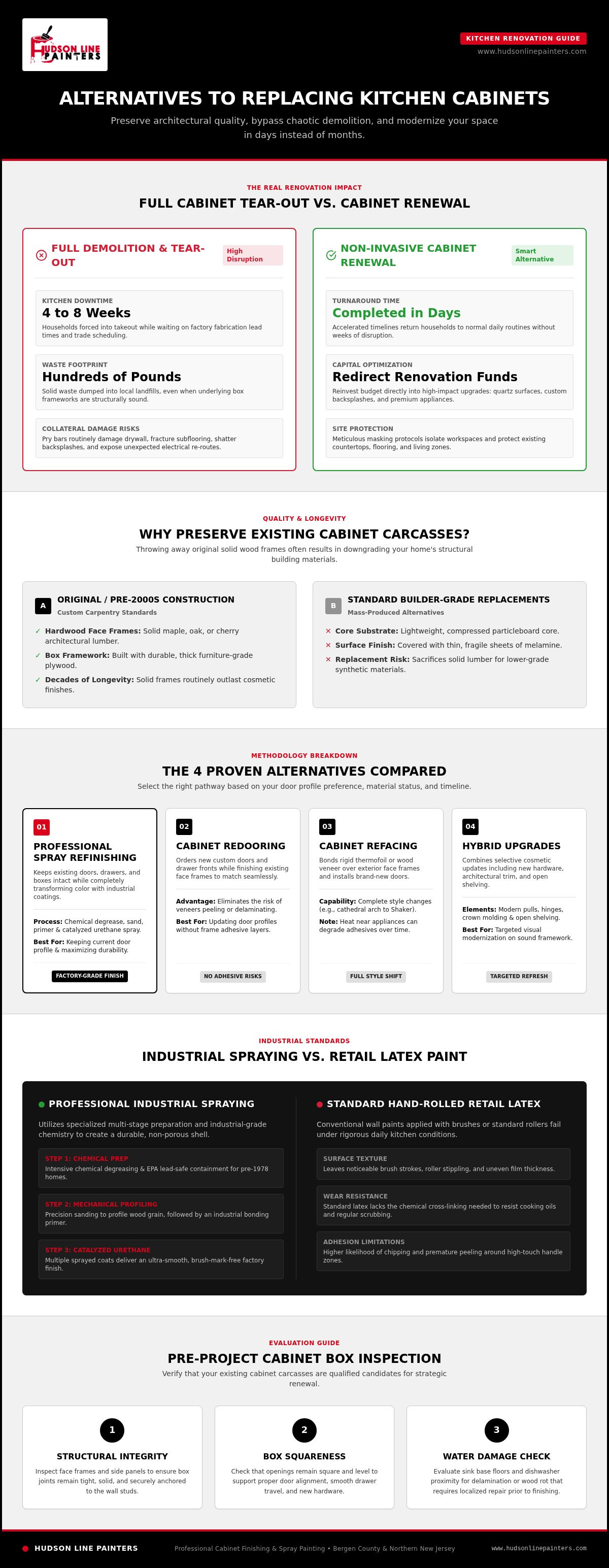
Homeowners across Bergen County are rethinking the traditional full kitchen gut. Ripping out an entire bank of cabinetry is messy, loud, and often completely unnecessary. In fact, a full demolition generates hundreds of pounds of solid waste that ends up in local landfills, even when the underlying framework remains structurally sound. By exploring smart alternatives to replacing kitchen cabinets, property owners retain the durable structure of their existing space while redirecting significant renovation capital toward high-impact upgrades like quartz surfaces, custom backsplashes, and commercial-grade appliances.
The True Cost of Demolition and Kitchen Downtime
Full-scale tear-outs create an immediate domino effect behind your walls. Pry bars frequently damage drywall, fracture subflooring, and shatter perfectly good backsplashes. This invasive process leaves households ordering takeout for four to eight weeks while waiting on factory fabrication lead times and trade scheduling.
- Living disruptions: Daily routines grind to a halt without functional sinks, dishwashers, and food preparation areas.
- Hidden repairs: Removing nailed-in base cabinets often exposes electrical re-routes and floor patching needs that delay the project.
- Accelerated timelines: Non-invasive alternatives get your household back to normal living within days instead of months.
Assessing the Value of Existing Solid Wood Cabinetry
Before throwing old boxes in a dumpster, examine how they were built. Many pre-2000s homes throughout Northern New Jersey feature custom carpentry crafted from thick hardwood face frames and furniture-grade plywood. Standard modern builder-grade replacements, by comparison, often utilize lightweight, pressed particleboard covered in paper-thin melamine. Understanding the fundamentals of traditional kitchen cabinet construction and finishes reveals why preserving these original architectural carcasses makes superior structural sense.
Throwing away solid maple, oak, or cherry frames to install mass-produced alternatives downgrades the actual building material in your home. Keeping structurally intact carcasses preserves valuable lumber that can easily anchor a modernized aesthetic for decades to come.
The 4 Best Alternatives to Replacing Kitchen Cabinets Compared
Homeowners evaluating alternatives to replacing kitchen cabinets often encounter conflicting advice. Contractors who only sell refacing will dismiss painting, while supply companies push self-assembled parts. In reality, the best choice depends directly on your door style preference, existing materials, and timeline. Comparing these four distinct pathways side by side gives you the objective clarity needed to choose wisely.
Professional Cabinet Refinishing and Spray Painting
Refinishing keeps your current doors, drawers, and cabinet boxes intact while completely transforming their color and finish. The process involves intensive chemical degreasing, mechanical sanding to profile the wood grain, an industrial bonding primer, and multiple coats of catalyzed urethane. In historic Bergen County homes built before 1978, testing and following established EPA lead-safe renovation guidelines ensures that surface preparation remains safe and contained.
Unlike standard house paint rolled on by hand, dedicated spray applications create an ultra-smooth, factory-level shell free of brush marks or texture. For a deep look into this multi-step process, consult the complete guide to cabinet refinishing.
Cabinet Refacing vs. Redooring
Refacing changes both the exterior doors and the visible frame surfaces. Installers bond a rigid thermofoil or thin real-wood veneer across the exterior box frames, then hang brand-new doors and drawer fronts. This allows you to switch from an ornate arched cathedral panel to a crisp Shaker style.
Redooring simplifies this equation. Instead of wrapping the face frames in veneer, which can peel or delaminate near high-heat appliances over time, you order new custom doors and drawer fronts while finishing the face frames to match. This technique gives you fresh profiles without the structural risks associated with aging adhesives.
Hybrid Cosmetic Upgrades: Hardware, Trim, and Open Shelving
You can also achieve a dramatic update through targeted modifications. Combining open floating shelving with selective carpentry upgrades breathes new life into tired layouts:
- Open displays: Removing a few upper doors and finishing the cabinet interiors creates an airy, modern coffee bar or dish display.
- Hardware conversions: Upgrading to soft-close concealed European hinges and modern bar pulls eliminates slamming and updates everyday touchpoints.
- Architectural millwork: Adding substantial crown molding to the top edges or light rails beneath upper cabinets adds tailored elegance.
If your cabinet framework is solid and you want to revitalize your kitchen without construction headaches, exploring specialized kitchen cabinet refinishing provides the cleanest balance between lasting durability and project turnaround.
How to Choose the Right Cabinet Renewal Method for Your Home
Selecting the best path forward requires an honest diagnostic assessment of your kitchen. Not every space qualifies for a purely cosmetic update. To ensure your investment yields lasting value, follow this straightforward framework to evaluate your millwork before committing to specific alternatives to replacing kitchen cabinets.
Step 1: Evaluating the Structural Integrity of Your Cabinet Carcasses
Start by grabbing a flashlight and opening the cabinet doors. The carcass is the foundational box that carries the load of your heavy stone counters and daily cookware.
- Water intrusion: Inspect the bottom panel beneath the kitchen sink and around the dishwasher. Look for bubbling, swollen particleboard, or black mold. Severe moisture rot cannot be primed or veneered away.
- Plumb and level: Place a torpedo level along the face frames and interior base floors. Racking boxes with cracked corner braces signal structural fatigue that paint cannot fix.
- Joint tightness: Check whether face frames are separating from the side panels. Solid wood boxes with tight mortise-and-tenon or doweled joints are prime candidates for renewal.
Step 2: Assessing Kitchen Layout and Workflow Satisfaction
Consider whether your current work triangle serves your everyday routine. If your refrigerator door blocks the main entry path, or your range sits awkwardly far from prep surfaces, you have a layout flaw. Restructuring interior walls requires a major rebuild. However, if your traffic flow feels natural, alternatives to replacing kitchen cabinets make total sense. You can easily optimize interior functionality by adding soft-close pull-out trash bins, deep roll-out trays, or spice drawer inserts without disturbing a single base footprint.
Step 3: Determining Long-Term Durability and Lifestyle Demands
Your household dynamics directly determine the coating and material specifications you need. High-traffic homes with young children, energetic pets, and daily home-cooked meals demand industrial-strength durability. Cooking oils, steam, and frequent chemical wiping quickly degrade standard wall paints and low-tack adhesive veneers.
Establish your timeline expectations as well. Refinishing requires just three to five days of on-site containment, while custom door manufacturing can take several weeks of fabrication before installation day. Matching your daily lifestyle needs with the right surface protection ensures your renewed cabinetry looks exceptional and performs reliably for years.
Why Professional Cabinet Refinishing Delivers Unmatched Value
Among the practical alternatives to replacing kitchen cabinets, professional refinishing stands out by pairing factory-grade durability with complete design freedom. Many homeowners hesitate because they picture sticky latex paint applied with a brush, or brittle chalk finishes that chip within months. In contrast, modern industrial coatings create a chemical bond with the substrate, forming a resilient shield that withstands moisture, cooking heat, and heavy daily handling.
Industrial Spray Application vs. Amateur DIY Painting
The gap between DIY painting and commercial refinishing comes down to chemistry and equipment. Retail wall paints dry through simple evaporation, leaving a soft surface prone to peeling near sinks and ovens. Professional refinishers use catalyzed industrial urethanes and conversion coatings that cure through a chemical reaction, producing an ultra-hard, non-porous shell.
Precision HVLP (high-volume, low-pressure) spray systems atomize these coatings into a fine mist, establishing a uniform film thickness without roller stipple or brush strokes. Removable components, such as doors and drawer fronts, are taken off-site to be prepped and sprayed inside controlled spray booths. This controlled environment prevents dust nibs and maintains optimal cure temperatures. To see how these factory finishes come together step by step, explore dedicated cabinet painting services.
Custom Color Strategies to Modernize Outdated Kitchens
Refinishing unlocks unlimited color customization, letting you match modern interior trends without purchasing brand-new millwork. You can tailor your palette precisely to your flooring, stone countertops, and natural lighting conditions.
- Two-tone designs: Grounding the space with deep charcoal, forest green, or navy base cabinets while keeping uppers soft and neutral creates visual depth and architectural balance.
- Warm neutral transitions: Moving away from stark cool whites in favor of warm creams, greige, or soft mushroom tones makes compact suburban kitchens feel inviting and expansive.
- Sheen selection: Applying a satin or low-luster sheen diffuses light evenly, hides subtle grain irregularities, and cleans effortlessly without burnishing.
By transforming your current woodwork with high-performance spray coatings, you achieve a bespoke aesthetic that rivals custom installations in days rather than months, proving why refinishing remains one of the top alternatives to replacing kitchen cabinets.
Schedule your kitchen cabinet refinishing consultation today
Executing Your Kitchen Cabinet Transformation Without the Chaos
The primary appeal of choosing alternatives to replacing kitchen cabinets is skipping the prolonged chaos of construction. However, a smooth experience depends entirely on clean execution and site discipline. When you invite craftsmen into your home, technical precision must extend beyond coating chemistry into total property protection. A structured, transparent workflow guarantees your living space remains clean, contained, and respected from start to finish.
What to Expect During a Professional Refinishing Project
A professional turnaround follows a disciplined operational sequence designed to minimize household disruption:
- Systematic disassembly: Every door, drawer face, and hinge is numbered and mapped. This methodical labeling guarantees that every piece returns to its exact original location with micro-millimeter alignment.
- Full containment masking: Heavy builder paper and multi-layer drop cloths seal your floors. Counters, backsplashes, and appliances are taped under heavy plastic sheeting, while floor-to-ceiling plastic zipper-doors isolate the kitchen from adjacent rooms.
- Negative pressure ventilation: Industrial exhaust systems vent atomized spray vapors directly out adjacent windows. This step keeps lingering odors and airborne dust from entering surrounding living spaces.
- Reassembly and tuning: Once doors return from the off-site spray facility, technicians remount hardware, adjust hinges to square every reveal line, and install fresh silicone dampeners for silent operation.
Planning Your Renovation with Hudson Line Painters
As a local owner-operated specialist serving homeowners across Hudson, Bergen, and Union counties, Hudson Line Painters approaches every residential update with meticulous care. Whether updating a historic brownstone, an urban high-rise, or a classic suburban split-level, our team executes factory-grade spray finishes that dramatically revive your kitchen without structural demolition.
Many homeowners choose to refresh adjacent spaces at the same time. You can easily coordinate your cabinet upgrade alongside premium interior painting to unify open-concept living rooms, breakfast nooks, and dining halls. Taking advantage of high-impact alternatives to replacing kitchen cabinets keeps your project timeline measured in days, protecting your home routine while delivering exceptional lasting results. Visit our contact page to schedule your on-site assessment and plan your kitchen renewal.
Transform Your Kitchen with Confidence and Precision
Modernizing your home doesn't require tearing out walls or enduring weeks of invasive construction downtime. By selecting smart alternatives to replacing kitchen cabinets, you preserve structurally sound hardwood frames, eliminate unnecessary landfill waste, and maintain your family's daily routines. Specialized spray-applied cabinet finishes deliver factory-grade durability that easily resists cooking heat, moisture, and everyday handling. Combined with disciplined site containment and negative-air dust control, your home stays clean from the initial masking to the final hardware reveal.
As local Northern New Jersey residential painting and refinishing specialists, we pair dependable technical precision with neighborly care across Hudson, Bergen, and Union counties. You don't have to endure months of disruption to create a bright, contemporary culinary space you love coming home to every day.
Frequently Asked Questions
Is it worth painting or refinishing older kitchen cabinets?
Yes, painting or refinishing older cabinets is highly worthwhile if the underlying frames are structurally sound. Older homes across Bergen County often boast solid maple or plywood boxes that easily outclass today's builder-grade particleboard. Professionally refinishing them revitalizes your kitchen's entire appearance while keeping durable architectural lumber in place. You avoid messy tear-outs, save weeks of disruption, and protect valuable countertops and tilework from construction damage.
Can you change the style of cabinet doors without replacing the boxes?
You can completely change your door style without touching the cabinet carcasses through redooring or refacing. If you have dated arched cathedral panels, you can order brand-new Shaker or slab doors while preserving your original framework. Installers mount the new fronts directly onto the existing frames using modern concealed hinges. When paired with professional spray finishing on the visible face frames, the entire installation looks custom-built from scratch.
How long do alternatives to replacing kitchen cabinets usually last?
Professional alternatives to replacing kitchen cabinets typically last 10 to 15 years or longer when completed with commercial-grade coatings. Unlike retail latex paints that peel quickly under kitchen steam, industrial catalyzed urethanes create an impenetrable chemical bond. They resist cooking grease, moisture vapor, and regular scrubbing. Daily care requires only simple wiping with mild soap and water, ensuring the factory-smooth finish maintains its lustrous depth over years of heavy family use.
What is the difference between cabinet refacing and cabinet refinishing?
Cabinet refinishing restores and recoats your existing doors and frames, while cabinet refacing covers the frames in veneer and replaces all exterior doors. Refinishing preserves your current woodwork by sanding, priming, and spray-applying industrial finishes in a new color. Refacing involves adhering a thin wood or laminate veneer skin over the existing box exteriors, then hanging entirely new doors and drawer fronts. Refinishing offers the fastest turnaround, while refacing allows you to alter door profiles.
Can thermofoil cabinets be painted or refaced effectively?
Thermofoil cabinets can be successfully updated if the underlying substrate remains completely dry and uncompromised. If the vinyl coating is peeling, technicians can heat-strip the loose plastic layer down to the bare medium-density fiberboard core. Once thoroughly cleaned and sealed with specialized bonding primers, the surfaces accept catalyzed spray finishes beautifully. However, if water has swollen the underlying core around the sink base, replacing that individual component is necessary before coating.
How messy is the process compared to a full kitchen replacement?
Cabinet renewal is vastly cleaner than a full replacement because it eliminates heavy structural demolition and drywall tear-outs. During professional refinishing, doors and drawer faces are prepped and sprayed off-site in dedicated spray booths. Inside your home, crews isolate the kitchen using floor-to-ceiling plastic containment barriers and negative-pressure exhaust systems. Your countertops, appliances, and adjacent living rooms remain fully protected from overspray and airborne sanding dust throughout the brief project window.
Will refacing or painting kitchen cabinets increase home resale value?
Upgrading your kitchen cabinets through refacing or professional painting provides one of the highest returns on investment in residential remodeling. Prospective homebuyers in Northern New Jersey prioritize updated kitchens, but major tear-outs rarely recoup their total installation costs. Choosing smart alternatives to replacing kitchen cabinets modernizes dated oak or cherry finishes instantly. This delivers the sleek visual impact of a brand-new kitchen, helping your property show exceptionally well on the local market without overcapitalizing.


