

What if the most effective way to modernize your kitchen doesn't require tearing out your layout or enduring weeks of disruptive construction? If your existing cabinetry is structurally sound, smart budget kitchen cabinet refinishing lets you preserve your sturdy cabinet boxes while achieving a clean, factory-smooth look. We understand the hesitation. A full gut renovation displaces family routines for weeks, while the fear of a messy weekend paint job plagued by roller stippling, brush marks, and chipping paint creates understandable anxiety.
You shouldn't have to settle for compromised craftsmanship to keep project costs practical. In this guide, you will discover how to transform dated woodwork affordably without sacrificing factory-grade durability or daily comfort. We'll examine the real differences between refinishing, painting, and refacing, highlight moisture-resistant finishes tailored to Hudson and Bergen County homes, and outline the exact preparation framework needed to elevate your kitchen's aesthetic and long-term property value.
Key Takeaways
- Preserving structurally sound cabinet boxes protects your kitchen equity and eliminates the expense of a full tear-out.
- Strategic budget kitchen cabinet refinishing relies heavily on rigorous surface decontamination and sanding to guarantee long-term coating adhesion.
- Spray-applied finishing techniques deliver an ultra-smooth, factory-grade look that avoids the brush marks and roller textures common in amateur work.
- Thoughtful color combinations and two-tone cabinet styling can dramatically modernize your space without inflating material expenses.
- Evaluating true tool costs and dust-containment demands helps you determine whether a DIY approach or professional execution offers the best return on investment.
Understanding Budget Kitchen Cabinet Refinishing: Refinish vs Replace
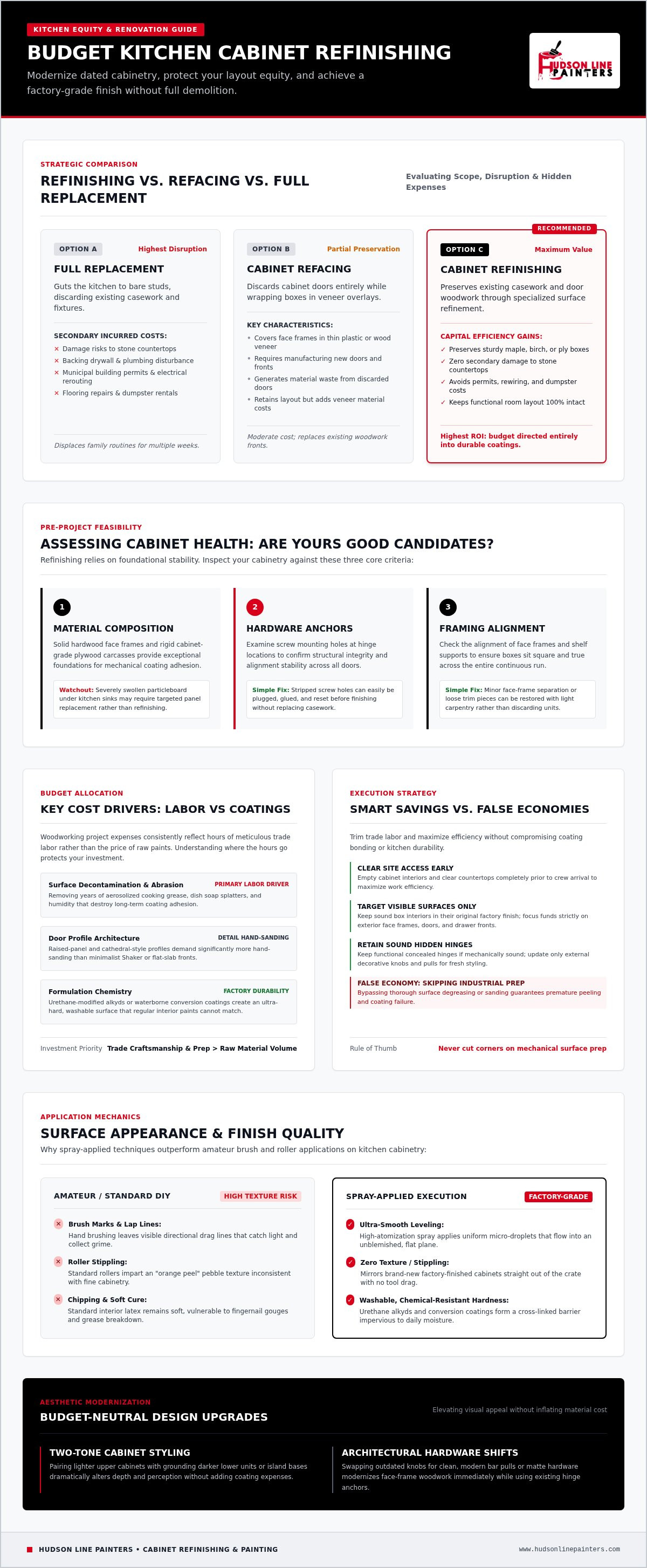
Homeowners planning a kitchen update often confront the same crossroads: the choice to buy new, reface existing, or to strip and refinish the woodwork they already own. Full replacement guts everything to bare studs, while refacing discards existing doors and covers face frames in thin plastic or wood veneer. In contrast, budget kitchen cabinet refinishing preserves your existing casework, applying high-durability coatings to achieve a factory-smooth aesthetic without altering your room's footprint.
Your existing cabinet boxes represent significant hidden equity. Older homes throughout Hudson and Bergen counties frequently feature solid maple, birch, or multi-ply construction that outperforms the lightweight composite materials found in today's entry-level cabinets. Discarding sturdy carcasses generates unnecessary landfill waste and throws away authentic craftsmanship. Choosing professional cabinet painting and refinishing delivers a massive return on investment, modernizing your space while sparing you weeks of household disruption.
The True Cost Comparison of Kitchen Remodel Options
Demolition rarely stays confined to the cabinetry. Ripping out lower boxes routinely damages delicate stone countertops, tears backing drywall, and disturbs plumbing connections. Changing an existing layout also triggers municipal building permits, complex electrical rerouting, and flooring repairs. Refinishing sidesteps these secondary expenses completely. By keeping your functional layout intact, you bypass the expense of extra trades, eliminate dumpster rentals, and focus your budget entirely on durable surface refinement.
Assessing Cabinet Health: Are Your Cabinets Good Candidates?
Determining whether your casework qualifies for refinishing comes down to foundational stability. Solid hardwood face frames, rigid plywood carcasses, and sound shelf supports make ideal candidates. Inspect your setup using these three criteria:
- Material composition: Solid hardwood and cabinet-grade plywood provide exceptional foundations for mechanical adhesion, whereas severely swollen particleboard under kitchen sinks may require targeted panel replacement.
- Hardware anchors: Check screw holes at hinge mounts; stripped holes can easily be plugged, glued, and reset.
- Framing alignment: Minor face-frame separation or loose trim can be restored with light carpentry rather than discarding the unit.
Key Drivers of Cabinet Refinishing Costs and How to Save
Labor commands the vast majority of any woodworking budget. When national home improvement guides examine the average cost to refinish cabinets, the numbers consistently reflect hours of meticulous trade labor rather than the price of raw coatings. Achieving successful budget kitchen cabinet refinishing means understanding where that effort goes, allowing you to make smart project decisions that protect your wallet without compromising the durability of your kitchen's new finish.
Labor, Preparation, and Paint Product Variables
Surface decontamination and abrasion require the most hands-on time. Kitchen cabinetry collects years of aerosolized cooking grease, dish soap splatters, and moisture, all of which destroy paint adhesion if left behind. Door architecture also influences prep labor; raised-panel, cathedral-style doors demand significantly more detailed hand-sanding than simple Shaker or flat-slab fronts. Selecting premium urethane-modified alkyds or waterborne conversion coatings delivers an ultra-hard, washable surface that standard interior paints simply cannot match.
Smart Cost-Saving Strategies for Budget-Conscious Homeowners
Homeowners can trim project labor without compromising final quality by tackling non-technical tasks ahead of time:
- Clear site access: Empty cabinet interiors and clear countertops completely before prep work begins to maximize crew efficiency.
- Target visible surfaces: Keep sound box interiors in their factory finish and direct your investment strictly toward exterior face frames, doors, and drawer fronts.
- Retain sound hardware: Keep functional hidden hinges if they remain in good mechanical health, updating only the exterior decorative pulls and knobs.
False Economies to Avoid on a Tight Kitchen Budget
Cutting the wrong corners guarantees premature coating failure. Skipping an industrial-grade bonding primer over slick factory topcoats or open-grain oak causes paint to flake around handles within months. Similarly, using standard latex wall paint produces a rubbery, soft film that gums up and traps dirt. Another frequent misstep is failing to label every hinge and door during disassembly, leading to crooked reveals and binding doors. If you want peace of mind throughout the entire process, you can explore professional cabinet painting solutions designed to deliver factory-level results that hold up under heavy daily use.
Step-by-Step Professional Refinishing Process for Lasting Value
Achieving factory-grade durability during budget kitchen cabinet refinishing doesn't happen by accident. It relies on a controlled, systematic framework that treats cabinetry like fine furniture rather than ordinary drywall. By taking doors and drawer fronts off-site for spray application while shielding your home with sealed poly containment zones, professional refinishers protect your living space from airborne overspray while delivering an ultra-smooth finish that brushes and rollers can't replicate.
Phase 1: Deep Cleaning, De-Glossing, and Substrate Repair
Grease and cooking oils are the primary culprits behind peeling paint. Before a single abrasive touches the wood, surfaces undergo heavy decontamination using commercial degreasers to dissolve grease around handles and ranges. Craftsmen then scuff-sand the factory clear coat to establish a mechanical profile for new coatings. During this stage, performing light carpentry fixes stripped hinge pockets, repairs chipped edge profiles, and fills nail holes so the underlying woodwork is structurally sound.
Phase 2: Priming and Grain Filling for Smooth Surfaces
Raw substrates and worn finishes require high-adhesion bonding primers engineered to lock in stubborn wood tannins. When updating deep-grained woods like red oak, technicians can apply specialty grain-filling compounds across the face panels. This extra smoothing step levels out porous grooves to deliver a modern, furniture-grade texture. Sanding thoroughly between each primer coat removes dust nibs, guaranteeing a glass-smooth surface for the color coats.
Phase 3: Precision Spray Application and Final Curing
Doors and drawer faces receive multiple spray-applied coats of industrial urethane enamel in a dedicated, dust-controlled environment. These coatings cross-link as they dry, creating a durable shell that resists heat, kitchen humidity, and frequent cleanings. Proper cure management is vital; while the finish dries to the touch within hours, allowing the film several days to fully harden prevents dings and pressure marks when reinstalling hardware and returning the kitchen to active family use.
Design Choices That Elevate Budget Cabinets on a Dime
Smart aesthetic decisions turn dated woodwork into a tailored focal point without expanding your project budget. Many homeowners assume that traditional arched or raised-panel cabinet doors look permanently dated. In reality, applying modern design principles during a budget kitchen cabinet refinishing project immediately changes the room's entire personality. Clean lines, strategic color blocking, and purposeful accent choices do the heavy lifting.
Timeless and Trending Paint Colors for North Jersey Kitchens
Selecting the right palette depends heavily on your floor plan and natural light exposure. For compact brownstones and urban rowhouses across Hoboken and Jersey City, warm whites, soft mushrooms, and balanced greiges bounce ambient daylight through narrow galley kitchens, making tight quarters feel noticeably wider. In suburban homes across Bergen County with spacious open-concept layouts, two-tone schemes create immediate designer appeal without inflating coating expenses.
- Contrasting base units: Coating an island or base perimeter in rich navy, slate charcoal, or muted olive green grounds the layout, while creamy off-white uppers keep sightlines airy.
- Countertop harmony: Match paint undertones directly to flecks and veining in your existing quartz or granite surfaces, unifying the entire room without replacing countertops.
Affordable Hardware and Visual Accent Upgrades
Cabinet pulls act as functional jewelry for your woodwork. Trading out tarnished brass knobs for sleek matte black handles or brushed champagne bronze pulls modernizes traditional profiles instantly. Installing inexpensive soft-close hinge adapters onto existing face frames adds quiet, luxury tactile performance to older units.
Refreshing the surrounding envelope completes the look. Coordinating your newly finished woodwork with durable interior painting across adjacent kitchen walls, soffits, and trim eliminates outdated yellow tones and frames your cabinetry with crisp, balanced contrast.
Connect with our local team to plan your kitchen cabinet transformation
Hiring a Professional vs DIY: Choosing the Right Route
Deciding between handling the work yourself or hiring a seasoned contractor comes down to balancing sweat equity against predictable results. While tackling budget kitchen cabinet refinishing independently looks tempting on paper, cabinetry demands surgical precision that regular room painting never requires. Cabinets take constant abuse from boiling steam, dirty hands, and slamming doors. Choosing dedicated cabinet painting services gives homeowners access to industrial equipment and controlled drying spaces that standard residential setups cannot duplicate.
The Reality of DIY Cabinet Painting: Time and Tool Demands
A standard kitchen easily demands 40 to 60 hours of intense manual labor. You'll spend evenings and weekends labeling hardware, de-greasing wood, sanding tight profiles, and waiting out lengthy drying cycles while doors clutter your living areas. Sourcing high-grade HVLP spray rigs, organic vapor respirators, dust-extracting sanders, and premium bonding primers also chips away at your expected cost savings. Reviewing the hidden DIY cabinet painting tradeoffs often reveals that an amateur paint job risks drips, flashing, and premature peeling around drawer pulls.
What to Expect from a Licensed Local Painting Contractor
A dependable contractor handles the technical heavy lifting while providing absolute peace of mind. Established professionals transfer doors and drawer fronts to controlled off-site spray booths, eliminating airborne dust contamination and keeping chemical fumes away from your family. When reviewing proposals from local specialists, look beyond the bottom line and confirm these essentials:
- Written protocols: Detailed scopes itemizing chemical degreasing, mechanical abrasion, and specific bonding primers formulated for slick substrates.
- Industrial coatings: Dedicated cabinet enamels and conversion coatings rather than standard trim paints.
- Site etiquette: Floor-to-ceiling zip-wall containment and air scrubbers to safeguard your living quarters.
Connecting with a proven regional team like Hudson Line Painters ensures your kitchen refresh delivers factory-grade durability, crisp lines, and lasting value across your North Jersey property.
Transform Your Kitchen with Lasting Factory Quality
Upgrading your culinary space doesn't require enduring weeks of chaotic demolition or draining your home equity. Choosing budget kitchen cabinet refinishing allows you to keep structurally sound woodwork while securing a clean, brush-free aesthetic. Combining disciplined degreasing and mechanical profiling with controlled off-site spray applications ensures your newly finished cabinetry withstands daily steam, moisture, and family wear.
Hudson Line Painters serves homeowners throughout Hudson, Bergen, and Union counties with dedicated craftsmanship and transparent, itemized project proposals. As a fully insured local contractor, our team takes pride in offering an organized, dust-controlled process that provides genuine peace of mind and showroom-level results.
You can achieve a fresh, modern aesthetic without the expense and disruption of a gut renovation. Smart updates make all the difference in your home.
Frequently Asked Questions
How long does a budget kitchen cabinet refinishing project usually take to complete?
A typical project takes approximately four to seven business days from initial masking to final reinstallation. On-site work inside your home, which focuses on prepping and coating the fixed cabinet frames, usually wraps up in just two to three days. Removable doors and drawer faces undergo cleaning, spray finishing, and proper curing off-site. This split workflow keeps kitchen downtime to a minimum while ensuring every coat hardens properly.
Will budget cabinet refinishing hold up against daily cooking heat and steam?
Yes, professional budget kitchen cabinet refinishing easily withstands everyday kitchen moisture and heat when executed with industrial-grade coatings. Standard wall paints soften near dishwashers and stovetops, but specialized urethane alkyds and waterborne conversion enamels chemically cross-link as they cure. This forms an impermeable barrier that resists cooking oils, steam, and frequent wipe-downs, preventing peeling and blistering over years of heavy kitchen use.
Can oak cabinets be refinished smoothly without visible wood grain showing through?
Yes, oak cabinets can achieve a sleek, non-porous finish through meticulous grain filling. Oak features open, deep vascular pores that regular primer coats won't hide on their own. By applying specialized paste grain fillers or high-build sandable bonding primers between sanding stages, technicians level out the rough texture before spraying. The result is an ultra-smooth, uniform profile that looks just like modern painted maple or factory Shaker doors.
Is it cheaper to refinish existing cabinets or replace them with stock options?
Refinishing existing cabinetry is consistently much more economical than installing new stock units. While stock cabinets appear inexpensive on retail shelves, replacement introduces cascading labor expenses. You have to pay for tear-out, countertop removal, disposal fees, plumbing disconnections, and potential drywall patching. Retaining your solid boxes eliminates these hidden trade expenses entirely, preserving your structural investment while refreshing the visible exterior.
Do I need to empty all my cabinet drawers and boxes before refinishing starts?
You typically only need to clear out drawer boxes and the immediate perimeter of open face frames. Because skilled painters apply coatings to exterior frames and finish doors off-site, box interiors usually remain untouched. Contractors mask shelf openings with heavy poly sheeting to keep cooking utensils clean and dust-free. Clearing countertops and removing drawer contents gives the crew safe, unobstructed clearance to work cleanly throughout your kitchen.
What type of paint finish is best for easy cleaning on kitchen cabinets?
Satin and semi-gloss sheens deliver the ideal balance of wipeability, surface durability, and glare resistance. High-gloss finishes highlight minor substrate imperfections, while flat or matte finishes absorb grease and scuff under standard scrub sponges. A factory-grade satin urethane finish repels household oils, cleans easily with mild soap and water, and provides a soft, sophisticated sheen that complements both contemporary and classic North Jersey home styles.


