

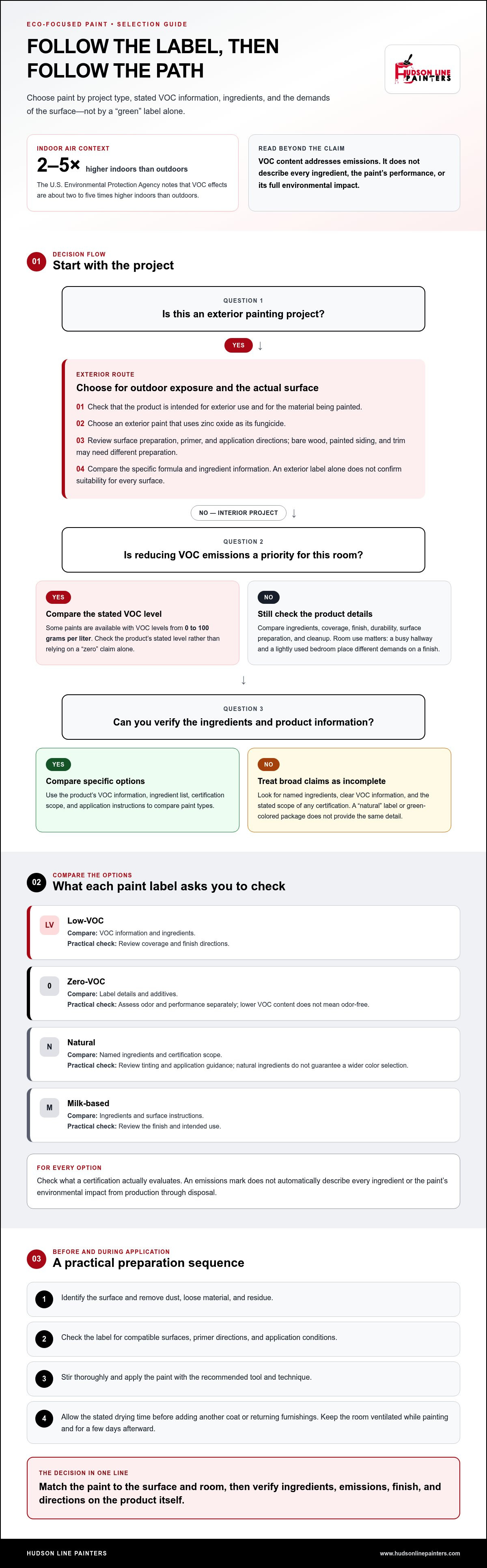
The U.S. Environmental Protection Agency notes that VOC effects are about two to five times higher indoors than outdoors. Choosing eco-friendly interior paint options means looking beyond a “zero-VOC” label to compare ingredients, coverage, durability, and how the paint is made. Lower emissions and thoughtfully sourced materials can help you make a more considered choice for your home.
It makes sense to want fresh, durable walls without introducing unnecessary chemicals into your home. But “eco-friendly” doesn’t describe just one kind of paint, and low VOCs alone don’t tell you how well a product covers or how long its finish may last.
This comparison explains what to look for and how zero-VOC, natural, and milk-based paints differ in coverage and sustainability. You’ll also learn how to weigh practical factors such as surface preparation, finish, and room use, so you can choose an option that fits your priorities and project.
Key Takeaways
- Judge paint by its ingredients and emissions, not by a “green” label alone.
- Compare zero-VOC, natural, and milk-based paints for coverage, finish, and suitability for the room.
- For exterior painting, consider how the paint’s ingredients support performance in outdoor conditions.
- Use practical criteria such as surface preparation, durability, and cleanup to narrow your choices.
- Match your paint selection to the project, then plan the preparation and application for a clean, lasting finish.
What makes a paint eco-friendly and non-toxic?
Eco-focused paint choices can help address concerns about ingredients and indoor emissions, but no single label answers every question. Compare the paint’s ingredients, what any certification covers, and how it performs on your surface.
Ingredient Health and Environmental Concerns
Paint can contain volatile organic compounds (VOCs), preservatives, pigments, and other additives. VOCs evaporate into indoor air as paint dries. The U.S. Environmental Protection Agency notes that VOC effects are about two to five times higher indoors than outdoors. That makes the ingredient list and ventilation plan useful parts of a room-painting decision.
“Low-VOC,” “zero-VOC,” and “natural” describe different attributes, not a guarantee that every ingredient is harmless. A low-VOC label, for example, addresses emissions, while an ingredient list can reveal what else is in the formula. Read both when comparing products.
Certifications and Ingredient Transparency
A certification can help you compare products, but its value depends on what it evaluates. Read the certification’s stated scope, then compare it with the product label and technical information. A mark addressing emissions, for example, does not automatically describe every ingredient or the paint’s environmental impact from production through disposal.
Look for a complete ingredient disclosure, clear VOC information, and application and cleanup instructions. If a label uses broad terms such as “natural,” look for specific ingredient names in the product information. This gives you more to compare than a green-colored package or general marketing claim.
Durability, Odor, and Color Limits
Eco-focused formulas can differ in coverage, finish, drying behavior, and resistance to everyday wear. Performance depends on the specific paint and surface, so compare product directions with the room’s intended use rather than assuming every low-emission formula performs alike. A busy hallway and a lightly used bedroom place different demands on a finish.
Lower VOC content doesn’t mean odor-free, and natural ingredients don’t guarantee a wider color selection. Check the label for information about tinting, coats, surface preparation, and cleanup. These details help you balance indoor-air priorities with the look and upkeep you want.
How much do eco-friendly interior paints cost per gallon? Per-gallon prices vary with formulation, finish, coverage, and seller. Compare the product’s coverage information and the amount needed for your project, not just the price of one can.
How should leftover paint and empty paint cans be disposed of in the United States? Keep usable paint sealed in its labeled container for future touch-ups. For unwanted leftovers and empty cans, follow your local waste authority’s instructions, which can vary by location and paint type.
| Paint option | What to compare | Practical consideration |
|---|---|---|
| Low-VOC | VOC information and ingredients | Check coverage and finish directions. |
| Zero-VOC | Label details and additives | Assess odor and performance separately. |
| Natural | Named ingredients and certification scope | Review tinting and application guidance. |
| Milk-based | Ingredients and surface instructions | Compare finish and intended use. |
Choose among eco-friendly interior paint options by weighing ingredient disclosures, emissions information, room use, and the finish you want.
Zero-VOC interior and exterior paint
Zero-VOC and low-VOC formulas can reduce one source of paint emissions, but interior and exterior projects have different demands. Compare the product label, intended use, and application instructions before choosing a finish.
Some paints are available with VOC levels from 0 to 100 grams per liter. That range shows why checking the product’s stated level matters more than relying on a “zero” claim alone. Also read the full label: VOC content doesn’t describe every ingredient, and it doesn’t tell you whether the paint suits your surface or room.
For interiors, match the paint to the room and its surfaces. A bedroom wall, kitchen wall, and previously painted surface may call for different finishes or preparation. Review the label for compatible surfaces, primer guidance, drying instructions, and cleanup. Follow the manufacturer’s directions rather than assuming every low-emission formula applies the same way.
For low-VOC exterior paint options, weigh emissions alongside exposure to outdoor conditions. Exterior paint needs to suit the material and surface preparation, so check the product’s intended use and directions. Choose an exterior paint that uses zinc oxide as its fungicide. The specific formula still matters: an exterior label alone doesn’t explain its ingredients or confirm that it suits every siding or trim surface.
How should you prepare and apply low-VOC interior paint for best results? Clean and prepare the surface, use the primer recommended for it, and apply the paint according to its label. Keep the room ventilated while painting and for a few days afterward.
Use this practical sequence before painting:
- Identify the surface and remove dust, loose material, and residue.
- Check the paint label for compatible surfaces, primer directions, and application conditions.
- Stir the paint thoroughly and apply it with the recommended tool and technique.
- Allow the stated drying time before adding another coat or returning furnishings.
For exterior work, inspect the surface before selecting a product. Bare wood, previously painted siding, and trim may need different preparation or primer choices. Check the label for approved surfaces and application conditions, then plan the work around those instructions. Don’t use an interior formula as a substitute for exterior paint just because both carry low-VOC wording.
Ventilation remains useful when painting indoors, even with a low-VOC product. Open windows when conditions allow, and keep air moving while the paint dries. These steps address the room during application; ingredient disclosures and VOC information help you compare the product itself. Together, they support a more informed choice than a label claim alone.
Natural and milk-based paints
Among commercially available interior paints, natural and milk-based formulas are often considered first. They offer alternatives to conventional synthetic formulations, but “natural” doesn’t describe one standard recipe. Compare each product’s ingredients, surface directions, coverage information, and finish before choosing.
Milk paint is commonly made with casein, a milk protein, along with ingredients such as lime, pigments, and water. Its composition differs from many plant- or mineral-based natural paints, which may use clay, chalk, lime, or plant oils. Formulas vary, so look for named ingredients rather than relying on the category name alone.
Natural paint may suit readers who want to understand the materials behind a finish. A clay-based formula and a plant-oil formula, for example, don’t share the same ingredients or application directions. Read the label and product guidance for the surface, recommended primer, cleanup method, and drying process. These details help you decide whether a formula fits the room and project.
Coverage depends on the paint’s consistency, the surface’s porosity, and the preparation. A smooth, previously painted wall may take paint differently from porous plaster or unfinished wood. Check the manufacturer’s coverage guidance and test a small area to see how the color and finish look after drying. A sample can also show whether the surface needs more preparation.
Sustainability involves more than the origin of an ingredient. Consider how much paint the project needs, whether the finish suits the room, and how to handle the container and leftover material. A natural ingredient list alone doesn’t describe production, packaging, or the useful life of the painted surface. Ingredient transparency makes these comparisons more practical.
- Milk paint: Review casein and other listed ingredients, plus directions for the intended surface.
- Clay-based paint: Compare its finish and application instructions with the room’s wall material.
- Plant-based paint: Identify the oils or other plant ingredients and read cleanup guidance.
- Mineral-based paint: Check which minerals and pigments appear in the formulation.
For a bedroom wall, start by identifying the existing surface and desired finish. Then compare specific product labels, test the color on that wall, and follow the stated preparation steps. Natural and milk-based paints can differ in coverage and appearance, so matching the formula to the surface matters as much as choosing an ingredient category.
Criteria for choosing nontoxic and sustainable paint
Compare a paint’s ingredient disclosure, emissions information, intended surface, and maintenance needs. A practical choice balances indoor-air priorities with coverage, finish, and care instructions.
Paint Selection Criteria
Start with the room and surface, such as a bedroom wall, plaster, or previously painted trim. Match the product label to that use, then review its ingredient information, cleanup directions, and stated coverage. A transparent label helps you compare products without relying on broad terms like “green” or “natural.”
Consider the whole project, not just the can. A finish that suits the room and stands up to normal use may reduce how often you need to repaint. For stains and sealants, choose water-based products without biocides or added dryers, or products made with beeswax or carnauba wax.
Performance and Safety Comparisons
Low-VOC paint focuses on reducing VOC content, while zero-VOC paint is labeled according to VOC levels. Neither label describes every ingredient or tells you how well a paint will cover your specific surface. Natural paints are distinguished by their ingredients, so inspect the formulation and application directions rather than assuming every natural product performs alike.
For a fair comparison, use the same criteria for each option: ingredients, coverage guidance, finish, surface compatibility, and cleanup. A zero-VOC formula may suit an emissions-focused choice; natural paint may appeal if ingredient origin matters. The best fit depends on the room’s demands and the product’s stated use.
Use this checklist to narrow the choices:
- Ingredients: Look for named components and clear disclosure, including preservatives and additives.
- Emissions: Compare the stated VOC information, not just front-label wording.
- Surface fit: Match the product to the wall, trim, or other material being painted.
- Coverage: Review the manufacturer’s guidance and account for the surface condition and color change.
- Maintenance: Consider the room’s use and the finish’s cleaning instructions.
- Waste: Plan how to use remaining paint and handle empty containers under local disposal instructions.
Certifications can add another point of comparison, but read what each one evaluates. A mark about emissions, for example, doesn’t automatically explain the full ingredient list, durability, or packaging. Pair certification details with product instructions and ingredient disclosures for a more complete picture.
Before purchasing, note the surface, desired finish, and top priority, such as emissions or disclosed ingredients. Compare product labels against that list, then test the selected paint on the intended surface. This makes trade-offs visible and helps you choose a formula that suits both the room and your sustainability priorities.
Comparing Low-VOC, Zero-VOC, and Natural Paints
Compare these paints on two fronts: emissions and job performance. A label can inform you about the first; product directions and a test patch help assess the second.
Low-VOC paint is a measured emissions category, not an ingredient description. The listed low-VOC thresholds are no more than 250 grams per liter for latex paint and no more than 380 grams per liter for oil-based paint. Check the product’s stated VOC level and base type before comparing labels. Those thresholds don’t indicate coverage, finish, or suitability for a particular wall.
Zero-VOC paint emphasizes VOC content, but that label alone doesn’t tell you whether other ingredients are present. Compare the complete product information, then review the recommended surface, coats, and cleanup. For performance, follow the manufacturer’s coverage guidance and apply a sample to the actual surface. A bedroom wall and a frequently cleaned kitchen wall may need different finishes.
Compare natural paint by its named ingredients and application details. The category includes different formulas, so it doesn’t establish a single performance profile. For example, compare the instructions for milk-based paint with those for a clay-based formula. Check tinting, surface compatibility, and finish directly rather than assuming ingredient origin predicts color range or durability.
| Paint type | Emissions comparison | Performance check |
|---|---|---|
| Low-VOC | Review stated VOC level and paint base. | Compare coverage, finish, and surface directions. |
| Zero-VOC | Read the full label beyond the front claim. | Test appearance and application on the project surface. |
| Natural | Identify ingredients and any disclosed additives. | Review formula-specific coverage and tinting guidance. |
These categories answer different safety-related questions. Low-VOC and zero-VOC labels focus on VOC content; natural describes a type of formulation. None provides a complete picture of every ingredient or finished-room performance on its own. Compare product disclosures alongside the room’s use and the surface condition.
Use this sequence to make a practical comparison:
- Match the paint base and intended use to the project surface.
- Compare VOC information and named ingredients on each label.
- Check coverage, finish, tinting, and cleanup directions.
- Test a sample to assess color and finish under the room’s lighting.
Choose a formula that meets your emissions priorities and fits the surface, finish, and upkeep needs. Comparing labels and testing on the actual surface gives you a more useful basis for a decision than choosing by category name alone.
Hudson Line Painters: Interior Painting
Hudson Line Painters provides interior painting for rooms where finish, color, and careful application matter. Once you’ve compared paint ingredients and selected a product that suits your surface, professional painting can bring that choice to life in your room. The result depends on the paint, the surface, and following the product’s application instructions.
Turn to interior painting when you’re ready to move from comparing formulas to refreshing walls or ceilings. Share your project goals and preferred finish so the work can be planned around the space. For help with your interior painting project, contact Hudson Line Painters.
Make Your Paint Choice the Start of a Better-Fitted Project
The next step is to turn your priorities into a room-specific plan. Decide what matters most: ingredient transparency, lower emissions, a particular finish, or easier maintenance. Then match those priorities to the surface and how you use the room. Eco-friendly interior paint options work best as part of a considered plan, not as a label chosen in isolation.
Hudson Line Painters also provides exterior painting and kitchen cabinet refinishing. A clear project scope helps align surfaces, finish, and preparation with the result you want, whether you’re refreshing outdoor areas or updating cabinetry in Northern and Central New Jersey.
A thoughtful choice can make a room feel more like yours. Take the next step with a plan that balances the finish you want with the priorities that matter to your home.
Frequently Asked Questions
What makes interior paint eco-friendly or low-VOC?
Eco-friendly paint involves more than VOC content: ingredients, emissions, surface performance, and waste all matter. “Low-VOC” refers specifically to VOC content, while “natural” describes ingredients and doesn’t establish emissions or durability on its own. Compare the product’s ingredient disclosure and application directions, then consider the room’s use. A washable finish in a busy hallway, for example, may help the painted surface stay serviceable longer.
What are the best low-VOC and zero-VOC interior paint brands in the US?
There isn’t one best brand for every room or surface. Compare specific products rather than relying on a brand name: review VOC information, ingredient disclosures, coverage guidance, finish, and surface compatibility. A product suited to a bedroom wall may not suit trim or a frequently cleaned kitchen. Narrow your options according to the project’s needs, then assess product labels and directions side by side.
What eco-labels certify environmentally friendly interior paint, such as Green Seal or GREENGUARD?
Green Seal and GREENGUARD are names to look for when comparing environmental or emissions-related labels. Read what each specific certification covers and match it to your priority, such as emissions or ingredients. A logo alone doesn’t tell you every component in a paint formula or how it performs on your wall. Pair certification details with the product’s ingredient disclosure and application instructions.
Do zero-VOC paints remain zero-VOC after tinting?
Tinting can affect a paint’s final VOC content, depending on the colorant and formula. Don’t assume the untinted base label describes every tinted shade. Check the product information for your chosen color and ask the retailer for the VOC details of the finished formula. When comparing shades, use the same tint level and paint base to keep the comparison consistent.
How many coats of eco-friendly paint are typically needed, and what is the coverage per gallon?
The required coats and coverage depend on the product, surface condition, application method, and difference between the existing and chosen colors. Porous plaster or a dramatic color change can call for a different approach than a smooth wall with a similar existing shade. Use the paint label’s coverage guidance, prepare the surface as directed, and test a small area before estimating the full project.
Are low-VOC paints safe for nurseries, people with asthma, and pets?
Low-VOC describes VOC content, not a guarantee that a paint suits every person or pet. For a nursery or asthma-sensitive household, review the full ingredient information and product directions, ventilate during painting and for a few days afterward, and keep children and pets out of the work area while painting. Plan when to use the room again according to the label’s drying and re-entry instructions.
How much do eco-friendly interior paints cost per gallon?
Prices vary by formulation, finish, coverage, and seller.


