
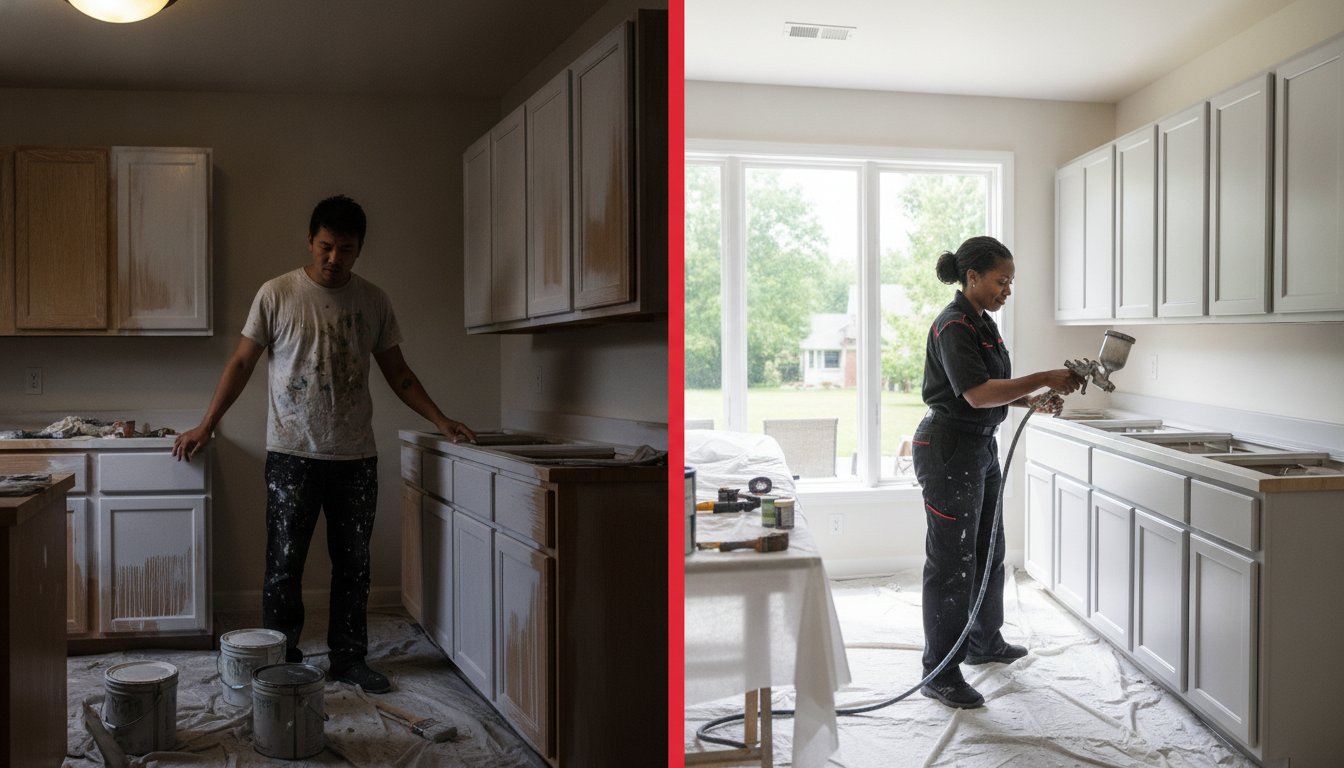
If you think the most expensive part of a kitchen remodel is the labor, you might be overlooking the hidden tax of a failed DIY project. Most homeowners look at their dated cabinets and wonder, is it cheaper to paint kitchen cabinets myself? It is a logical question when you're staring down the high cost of a full kitchen replacement and want to save your budget for other upgrades. You want a fresh look without the stress of a kitchen being out of commission for weeks or the fear of a streaky, peeling finish.
We understand that property maintenance is a significant investment, and you deserve a result that provides long-term peace of mind. This guide breaks down the true financial and temporal costs of DIY versus professional refinishing to help you decide which path actually preserves your home's value. We'll explore the material expenses, which can range from $200 to $1,250 for a DIY setup, and the 20 to 40 hours of hands-on labor required for a factory-like finish. We also examine the common technical pitfalls that often lead to costly repairs just months after the paint dries.
Key Takeaways
- Calculate the true math behind the question "is it cheaper to paint kitchen cabinets myself" by factoring in professional-grade materials, specialty tools, and the significant time investment required for a lasting finish.
- Learn how to conduct a realistic time audit for your project, accounting for the 40 to 60 hours of meticulous labor that often leaves your kitchen out of commission for weeks.
- Discover why standard retail paints frequently lead to adhesion failure and peeling, and how professional refinishing achieves a factory-like durability that lasts five times longer than DIY efforts.
- Evaluate the long-term impact on your home's resale value, contrasting the temporary look of a DIY project with the premium, market-ready appeal of a professional transformation.
- Identify the specific "red light" indicators that signal your cabinetry requires expert intervention to avoid the double expense of stripping and re-doing a failed paint job.
The Upfront Math: Calculating the Real Cost of DIY Materials
Many homeowners ask themselves, "is it cheaper to paint kitchen cabinets myself?" while walking through the aisles of a local home improvement store. At first glance, the math seems simple. A few gallons of paint and a couple of brushes appear much more affordable than a professional refinishing service. However, achieving a durable finish that doesn't chip within six months requires a sophisticated inventory of supplies that goes far beyond a simple bucket of paint. To do the job correctly, you'll need to invest in orbital sanders, high-grit abrasives, tack cloths, and industrial-strength degreasers to strip away years of accumulated cooking oils.
Research suggests a typical DIY cabinet painting project costs between $200 and $600 for basic materials, though higher-end setups involving professional-grade tools can easily reach $1,250. It's vital to account for the "hidden" items that quickly inflate your budget:
- Surface Preparation: Gallons of TSP (trisodium phosphate) and dozens of sheets of 120 to 220-grit sandpaper.
- Protection: Heavy-duty drop cloths, delicate-surface painter's tape, and plastic sheeting to create a makeshift spray booth.
- Safety Gear: NIOSH-approved respirators, safety goggles, and nitrile gloves for handling chemical cleaners.
- Application Tools: High-quality synthetic brushes for tight corners or a dedicated HVLP sprayer for the main panels.
The Paint Quality Gap: Why Cheap Paint Costs More
Standard "off-the-shelf" latex paint is designed for drywall, not the high-impact environment of a kitchen. Kitchen cabinet materials and construction vary significantly, and applying wall paint to these surfaces is a recipe for adhesion failure. Professional-grade wood coatings are chemically different; they're harder and more flexible. If you use cheap paint, you'll likely need three times the amount you anticipated because the wood absorbs the product unevenly. Without a specialized primer to block tannin bleed, those beautiful white cabinets will likely turn yellow or brown within weeks as the wood's natural oils seep through the finish.
Tool Investment: Buying vs. Renting Professional Gear
If you want a factory-smooth result, a brush and roller won't suffice. You'll need a High Volume Low Pressure (HVLP) sprayer. While you can rent this equipment, it's often a risky choice. Rental units frequently contain dried flakes of old paint from previous jobs that can clog the nozzle or, worse, end up embedded in your wet cabinet doors. For NJ indoor painting projects, you also have to consider the cost of high-grade ventilation and filtration. Buying your own equipment ensures cleanliness and precision, but it also means the answer to whether is it cheaper to paint kitchen cabinets myself becomes much more complex when the tool bill arrives.
The Hidden Costs: Time, Labor, and Kitchen Downtime
When calculating if is it cheaper to paint kitchen cabinets myself, many homeowners only look at the receipt from the paint store. They often fail to account for the massive investment of personal time. A high-quality DIY cabinet transformation is rarely a weekend project. In reality, a standard kitchen requires between 40 and 60 hours of focused, hands-on labor to achieve a result that won't peel. If you value your time at a median wage of approximately $23 per hour, that labor alone represents nearly $1,400 in opportunity cost. This is time spent away from your family, your career, or your rest.
The logistics of a DIY project also mean your kitchen will likely be a "dead zone" for 10 to 14 days. Unlike a professional team that works in a sequential, highly efficient rhythm, a homeowner must balance the project with daily life. This extended downtime creates a ripple effect of secondary costs. You'll likely spend more on takeout and restaurant meals because your stove and sink are masked off or covered in fine sanding dust. By the time you reach the final 10% of the job, which involves the meticulous task of rehanging doors and aligning hinges, you'll find it often consumes 50% of your remaining energy.
The Labor of Prep: 75% of the Project
The secret to a factory-like finish isn't the paint; it's the preparation. In high-use kitchens across New Jersey, cabinets accumulate a thick layer of invisible cooking grease and oils. Deep degreasing alone can take a full day of scrubbing. Following this, every nook, cranny, and bevel must be sanded to ensure the new coating bonds correctly. Meticulous organization is also vital. If you don't label every hinge and screw with surgical precision, the reassembly phase becomes a nightmare of misaligned doors and stripped wood. If the logistical burden of a DIY project seems too high, consider how a specialized refinishing team can streamline the process and handle these technical details for you.
Downtime Impact on Your Household
Living in a construction zone is a significant stressor for families in Hudson and Bergen County. DIY projects often lack the industrial-grade dust extraction systems used by professionals, meaning fine particulates can migrate into your living areas and HVAC system. Managing the fumes from primers and topcoats requires constant vigilance, especially in homes with children or pets. This physical and emotional strain is why many industry professionals jokingly refer to cabinet painting as a "DIY divorce" project. The frustration of a kitchen being out of commission for two weeks, combined with the physical exhaustion of sanding, can quickly outweigh the initial perceived savings.
Why DIY Cabinet Painting Fails (and What It Costs to Fix)
While the initial math suggests is it cheaper to paint kitchen cabinets myself, the calculation changes when a finish begins to flake off near the dishwasher or stove within months. DIY projects often face catastrophic adhesion failure because retail-grade paints cannot withstand the unique stresses of a kitchen environment. High heat from ovens and constant steam from boiling water cause standard coatings to soften and swell. When you combine this with the natural oils from your hands, the paint around handles and knobs quickly becomes gummy and begins to peel away in unsightly strips.
The financial risk of a failed project is significant. If a DIY finish fails, a professional cannot simply paint over the mistake. Every inch of the failing paint must be chemically stripped or sanded down to the bare wood before a new coating can be applied. This corrective labor often makes the restoration twice as expensive as the original project would have been. Additionally, local environmental factors play a massive role in success. In New Jersey, high summer humidity levels can trap moisture beneath the surface of the paint, leading to bubbles and a finish that never truly hardens. Understanding the difference between a surface that is "dry to the touch" and one that is fully cured is the difference between a project that lasts two years and one that lasts a decade.
The Chemistry of Kitchen Grease
Standard household cleaners are rarely enough to prepare a surface for professional-grade coatings. Microscopic cooking oils embed themselves into the wood grain over time, creating a barrier that prevents paint from bonding. If even a trace of this residue remains, the new paint will pull away from the surface as it dries, creating small dimples known as "fisheyes" that ruin the aesthetic. Curing represents a deep chemical bond where the coating fully hardens and attaches to the substrate, while drying only refers to the surface moisture evaporating.
The Professional Equipment Advantage
A major reason is it cheaper to paint kitchen cabinets myself often turns into a regret is the lack of industrial-grade containment and application tools. Professional refinishers utilize HEPA-filtered, dust-free sanding systems that capture 99% of particulates before they can enter your home's air supply. This level of cleanliness is impossible to replicate with a handheld sander and a shop vac. Furthermore, the precision of a controlled spray environment ensures a factory-like finish that resists chips and scratches. This technical discipline results in a surface that is not only beautiful but also durable enough to withstand the daily rigors of a busy household.

Professional Refinishing: The Value-Added Alternative
While the upfront savings of a DIY project seem attractive, the question of is it cheaper to paint kitchen cabinets myself must be viewed through the lens of longevity and property value. A typical homeowner-applied finish often shows signs of wear, chipping, or yellowing within 24 months. In contrast, a professional application is engineered to last 10 years or more. This durability comes from the use of industrial-grade coatings and high-precision application methods that simply aren't available at big-box retailers. By choosing an expert service, you gain the peace of mind that comes with professional accountability and a result that stands up to daily use.
Positioning cabinet refinishing as a strategic investment is about more than just aesthetics. In the competitive New Jersey real estate market, a factory-like finish on your cabinetry can significantly boost your home’s resale value. Potential buyers in areas like Jersey City or Westfield prioritize quality; they can spot a DIY "brush and roller" job immediately. A professional finish suggests a well-maintained home, whereas a peeling DIY project can actually decrease your home's market appeal and lead to lower offers.
The Hudson Line Painters Process
We approach every project with a proprietary 8-step preparation and finishing protocol. This systematic approach ensures that every surface is chemically decontaminated, mechanically profiled, and coated with surgical precision. By using specialized equipment and advanced coatings, we minimize disruption to your Hudson or Union County home. Our craftsmen are not just painters; they are disciplined professionals who respect your environment and value operational discipline. This process allows us to deliver a safe and guaranteed transformation that far exceeds the results of a typical garage-based DIY setup.
Cost vs. Replacement
Many homeowners consider a full structural remodel when their cabinets look dated. However, professional refinishing is typically 60-70% cheaper than total cabinet replacement. This massive cost difference allows you to allocate your budget toward other high-impact upgrades. You might combine your cabinet project with our home painting services for a comprehensive kitchen refresh that feels entirely new. When you look at the lifecycle cost, the answer to is it cheaper to paint kitchen cabinets myself often shifts. Investing in a professional finish today prevents the need for a total replacement tomorrow. For a result that adds genuine value to your space, request a professional refinishing consultation today.
Making the Decision: Is DIY Right for You?
Deciding whether is it cheaper to paint kitchen cabinets myself involves weighing the immediate cash savings against the long-term value of your property. If you're working on a secondary space, such as a rental unit or a basement kitchenette, a DIY approach can be a practical way to manage costs. However, for the primary kitchen in your home, the "red light" for a self-performed project is often the sheer visibility of the result. A streaky or uneven finish in a high-traffic area is a constant reminder of a project that didn't quite meet professional standards. We believe in providing peace of mind through technical precision, ensuring your investment yields a durable, factory-like result.
Before you clear your schedule and buy your materials, take a moment to evaluate your readiness. This quick audit will help you determine if the DIY path aligns with your expectations for quality and durability.
A 5-Question DIY Readiness Quiz
- Do you have 50+ hours of focused time available? This project requires a significant commitment that often extends well beyond a single weekend.
- Is your kitchen the "heart of the home" or a secondary space? High-visibility areas demand a level of precision that is difficult to achieve without professional-grade equipment.
- Are you comfortable with the technical learning curve of a sprayer? Achieving a smooth finish without runs or drips takes significant practice and high-end tools.
- Do you have a dust-free space to lay out 20 to 40 doors? Proper curing requires a controlled environment away from pets, children, and household debris.
- Are you prepared for the 10 to 14 day kitchen downtime? Managing household meals without a functional kitchen can be a major stressor for busy families.
Next Steps for NJ Homeowners
For homeowners in Bergen, Union, or Hudson County, the next step is often gathering professional data to compare against your estimated DIY budget. When reviewing a professional cabinet refinishing contract, ensure it details the specific preparation steps, the exact paint products used, and a clear project timeline. Transparency is a hallmark of a reliable contractor. A well-defined agreement protects your home and ensures the final aesthetic matches your vision. The final verdict depends on your priorities. While you may still wonder if is it cheaper to paint kitchen cabinets myself, you must balance those immediate savings with the risk of a finish that fails prematurely. If you value your time and seek a finish that lasts a decade, the professional route is a smart financial choice that preserves your kitchen's value. To start your transformation, Get a professional cabinet refinishing quote from Hudson Line Painters.
Secure Your Kitchen’s Long-Term Value
Determining if is it cheaper to paint kitchen cabinets myself requires looking past the initial receipt at the local hardware store. While you might save on immediate labor costs, the 40 to 60 hours of intense preparation and the risk of a failing finish often lead to a higher total cost over time. A durable, factory-like result depends on meticulous chemical decontamination and industrial application methods that are difficult to replicate in a home environment. Choosing a professional path ensures that your kitchen remains functional and beautiful without the stress of constant touch-ups.
With over 8 years of local NJ expertise, Hudson Line Painters provides a safe and guaranteed transformation for your cabinetry. We utilize specialized industrial-grade coating systems and a meticulous dust-containment process to protect your home’s environment and your family's peace of mind. You deserve a space that reflects your pride in your home without sacrificing your personal time or long-term property value. Save your weekend and your kitchen—request a professional refinishing quote today. We look forward to helping you create a kitchen that provides genuine comfort and lasting quality for years to come.
Frequently Asked Questions
Is it really cheaper to paint cabinets myself if I already own tools?
Yes, the initial cash outlay is typically lower if you already own basic tools like sanders and brushes. However, the calculation of whether is it cheaper to paint kitchen cabinets myself must include the cost of premium, cabinet-grade coatings and high-performance primers. When you factor in the 40 to 60 hours of personal labor required, many homeowners find that the "savings" are offset by the loss of their free time and the risk of a finish that may require professional correction later.
How long does a DIY cabinet painting project typically take?
A standard DIY project for a medium-sized kitchen usually requires between 40 and 60 hours of hands-on work. This timeframe covers the entire process from deep degreasing and hardware removal to the final reinstallation and hinge alignment. Because most homeowners must balance the work with their daily careers and family life, the kitchen often remains out of commission for 10 to 14 days while the various coats of primer and paint properly dry and cure.
What is the best paint to use if I decide to DIY my kitchen cabinets?
The best choice for a DIYer is a high-quality water-borne alkyd or a dedicated cabinet enamel specifically formulated for trim and woodwork. You should never use standard latex wall paint, as it is too soft to withstand the heat, humidity, and hand oils present in a kitchen. Using a product designed for cabinetry ensures a harder finish that resists "blocking" or sticking when the doors are closed and provides better leveling to minimize visible brush marks.
Will painting my cabinets myself lower my home’s resale value?
A DIY project can lower your home's resale value if the finish appears amateur, showing visible brush strokes, drips, or uneven sheen. In the sophisticated New Jersey real estate market, buyers look for a factory-smooth result that suggests the home has been professionally maintained. If a buyer perceives the cabinets as a "project" they will eventually have to fix, they may lower their offer or request credits to cover the cost of a professional refinishing service.
Can I paint over laminate or thermofoil cabinets myself?
You can paint over these surfaces, but it requires a specialized high-adhesion bonding primer designed for non-porous materials. Standard primers will not stick to the plastic-like surface of laminate or thermofoil, leading to immediate peeling. The preparation must be perfect; every trace of grease must be removed, and the surface must be meticulously scuff-sanded to create a mechanical bond. Even with these steps, achieving a durable result on these materials is significantly more difficult than on solid wood.
What happens if the DIY paint starts peeling after a few months?
If a DIY finish begins to peel, the failing paint must be completely stripped or sanded down to the substrate before a new coating can be applied. You cannot simply paint over the peeling areas, as the underlying adhesion failure will continue to spread. This corrective labor is often twice as expensive as a standard refinishing job. This hidden risk is a major factor when homeowners ask is it cheaper to paint kitchen cabinets myself, as a single failure can double the total investment.
How much does Hudson Line Painters charge for cabinet refinishing in NJ?
Our pricing is determined by the size of your kitchen, the total number of doors and drawers, and the current condition of the cabinet surfaces. We provide clear, detailed quotes that reflect our proprietary 8-step preparation and finishing protocol. Because every kitchen in Hudson or Bergen County presents unique technical requirements, we recommend a local consultation to provide an accurate estimate that ensures a safe and guaranteed transformation for your specific home.
Do I need to sand my cabinets before painting them?
Yes, sanding is an essential step that cannot be skipped if you want the finish to last. Scuff-sanding breaks the surface tension of the old finish and creates a "profile" that allows the new primer to bond mechanically to the wood. Even if a paint product claims to require no sanding, professional standards always include this step. Skipping it is the primary reason why DIY finishes fail to adhere and begin to chip around high-use areas like handles and drawers.


