
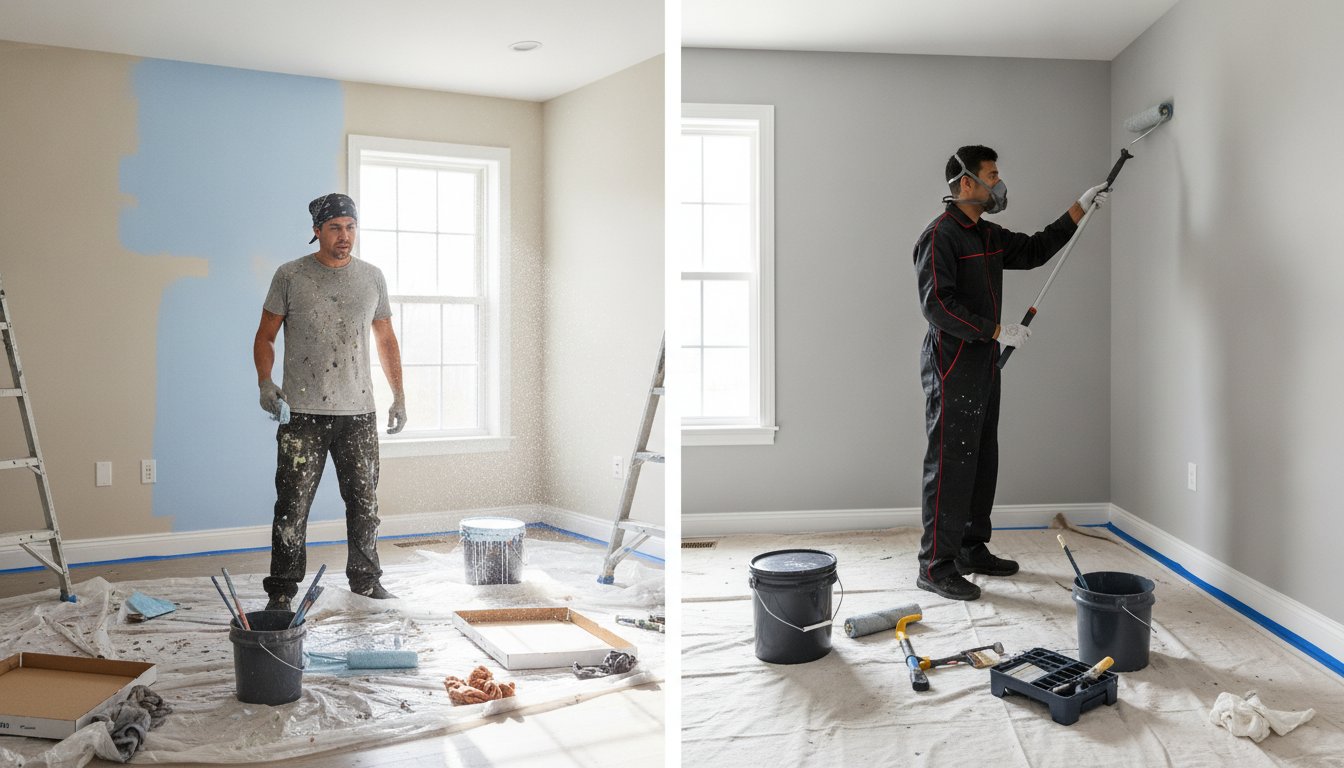
The "affordable" DIY weekend project often turns into a surprisingly steep investment once you tally the hidden expenses of professional-grade equipment and the value of your own time. You likely want to refresh your New Jersey home without overspending, yet the fear of an amateur finish or a project that drags on for weeks is a valid concern. It's common to feel confused by the total cost of tools, primers, and premium paints, especially when you want a result that lasts for years rather than months.
This guide provides a transparent look at the DIY vs professional interior painting cost so you can choose the best value for your space. You'll discover the true price comparison between handling the brushes yourself and hiring seasoned experts. We will preview the breakdown of material expenses, the critical importance of meticulous prep work, and how to identify when a project is too complex for a solo effort. By the end, you'll have the confidence to make a decision that protects both your schedule and your home's aesthetic appeal.
Key Takeaways
- Understand why a professional estimate includes meticulous surface preparation and high-grade materials that often outlast budget-friendly DIY alternatives.
- Accurately calculate the true DIY vs professional interior painting cost by factoring in the value of your personal time and the specialized tools required for a flawless finish.
- Identify when structural issues like cracked plaster or peeling paint in older New Jersey properties necessitate the specialized intervention of a skilled craftsman to prevent future damage.
- Learn how professional application techniques extend the life of your interior surfaces by 5 to 10 years, offering a long-term financial benefit that exceeds initial labor savings.
- Discover how to evaluate a professional quote for hidden value, ensuring your investment includes site protection and a guarantee of technical precision.
The Initial Math: DIY vs. Professional Interior Painting Estimates
Calculating the true DIY vs professional interior painting cost requires looking beyond the sticker price of a single gallon of paint. A complete estimate for any interior project encompasses three distinct pillars: high-quality materials, professional-grade labor, and the intensive preparation time that dictates the longevity of the finish. In the New Jersey market, professional interior painting services typically range from $2.00 to $7.00 per square foot, a price point that reflects the local cost of skilled labor and the use of premium architectural coatings.
The DIY Material Checklist
For a standard 12x12 room, your material costs vary significantly based on the quality of the finish you desire. While builder-grade paint might save you money upfront, premium options like Benjamin Moore Aura or Sherwin-Williams Emerald provide superior hide and durability. Choosing "budget" brushes often results in visible streaks and shed bristles, which forces you to buy more paint to cover mistakes. Beyond the paint itself, you must account for "one-time" investments including sturdy ladders, canvas drop cloths, and ergonomic roller frames. Understanding different painting media helps you realize that specialized primers and high-solids paints require specific application tools to achieve the same look you see in professional portfolios. A DIYer can expect to spend between $80 and $350 for paint and supplies for a single room, depending on the tier of materials chosen.
What You Pay for in a Professional Quote
When you receive a professional quote, you're paying for a systematic process that prioritizes site etiquette and technical precision. A significant portion of the quote covers skilled labor, which usually accounts for 75% to 95% of the total project investment. Professionals utilize advanced equipment such as HEPA-filtered dust extraction systems and high-pressure airless sprayers to ensure a uniform, factory-like texture on every wall. This investment also secures your home through comprehensive liability insurance and project warranties. These protections provide a level of financial security that a DIY project simply cannot offer. The cost reflects a disciplined approach where site protection and professional-grade preparation are standard, ensuring the final result adds genuine value and comfort to your living space without the stress of managing the logistics yourself. Just as Clear Lake Movers, Inc. streamlines the complex logistics of a household move, hiring professional painters ensures that every technical detail of your home’s interior is handled with precision and care.
Hidden Costs and the "DIY Tax" You Might Overlook
The financial appeal of a self-managed project often diminishes once you account for the "DIY tax," a collection of hidden expenses and lost time that homeowners rarely include in their initial budget. When evaluating the DIY vs professional interior painting cost, you must quantify your opportunity cost. If you spend two full weekends on a single living room, you aren't just paying for paint; you're sacrificing forty hours of personal time. For a New Jersey professional earning a typical mid-career salary, that time investment can represent over $2,000 in lost leisure or productive hours, a figure that often exceeds the labor portion of a professional quote.
Mistake mitigation is another variable that inflates the DIY price tag. Amateur application often leads to lap marks, uneven sheen, or poor coverage, forcing you to purchase additional gallons of premium paint to correct the finish. While a professional crew achieves full opacity in two coats through disciplined technique, a DIYer might struggle with three or four. You also face the cost of high-tier prep materials that professionals use by default. Standard masking tape often bleeds, requiring you to invest in specialized edge-locking tapes and professional-grade wood fillers to achieve a result that doesn't look amateur.
The Time Commitment Reality Check
A professional crew typically completes a standard room in one to two days, whereas a solo homeowner often stretches the same project across three consecutive weekends. This creates a "construction zone" environment that disrupts your daily routine and home comfort. It's a common misconception that the actual painting is the bulk of the work. In reality, meticulous preparation—including cleaning surfaces, sanding imperfections, and masking fixtures—consumes approximately 70% of the total project timeline. Skipping these steps to save time invariably leads to a finish that peels or fails within a few years.
Equipment Rental vs. Ownership
Specialized architecture in many New Jersey homes, such as high vaulted foyers or intricate stairwells, requires equipment that most homeowners don't own. Renting scaffolding or industrial-grade ladders adds a daily fee that quickly compounds. Furthermore, older properties require specific safety protocols; if your home was built before 1978, you must adhere to lead-safe work practices to protect your family from dust exposure. Professionals arrive with amortized industrial gear, including HEPA-shielded sanders and respirators, which are expensive for a one-time user to purchase. If the logistical burden of sourcing this equipment feels overwhelming, exploring professional home painting services is a practical way to ensure a safe and efficient transformation without the equipment-related headaches.
Complexity and Condition: When the Math Shifts
The physical condition of your home often dictates whether the DIY vs professional interior painting cost remains a saving or becomes a liability. While a fresh gallon of paint covers many flaws, it cannot hide structural instability or poor surface integrity. New Jersey homes, particularly those in historic pockets of Bergen and Union counties, frequently feature aged plaster that requires expert stabilization before a brush ever touches the wall. Professional drywall and plaster repair is the foundation of a lasting paint job, ensuring that your investment doesn't flake or crack within the first year.
Architectural details add significant complexity to the "math" of your project. Intricate crown molding, wainscoting, and high-vaulted foyers demand a level of precision that most DIYers find exhausting. Every linear foot of trim requires careful sanding and steady-handed cutting-in. If your home features ceilings taller than ten feet, the difficulty level spikes, often requiring specialized scaffolding rather than a standard stepladder. These details aren't just aesthetic; they're technical hurdles that can quadruple the time a non-professional spends on a single room.
The Difficulty of Specialized Surfaces
Kitchen cabinets represent the most challenging interior surface for any homeowner. Achieving a factory-smooth, durable finish on cabinetry involves a multi-step process of degreasing, mechanical sanding, and high-solids priming. This is almost never a recommended DIY project for cost-savings because the risk of a sticky, peeling finish is too high. For these high-traffic areas, professional cabinet refinishing ensures a result that withstands daily use. Technical precision is also vital for dark-to-light color transitions, where improper priming leads to "ghosting" and requires expensive extra coats of paint to correct.
Safety Risks and Liability
Safety is a tangible cost factor that many homeowners overlook until an accident occurs. Working on high interior walls or stairwells involves significant physical risk without professional-grade ladders and fall protection. Beyond physical falls, environmental safety is paramount in older NJ properties. If your home was built before 1978, you must follow Lead-Safe Work Practices to avoid contaminating your living space with toxic dust. Professionals manage these risks through industrial-strength HEPA filtration and strict VOC management, protecting your indoor air quality and providing peace of mind that a DIY approach simply can't guarantee.

The Quality Quotient: Why Professional Craftsmanship Pays Off
Professional results aren't just about straight lines; they're about chemical bonding and surface mechanical integrity. When you analyze the DIY vs professional interior painting cost, the most significant variable is often the "cost of failure." A botched DIY job, characterized by peeling, visible brush marks, or poor adhesion, often requires a professional to strip the previous work entirely. This corrective labor is significantly more expensive than a standard painting project because it involves intensive mechanical sanding and chemical stripping to restore the surface. Investing in professional craftsmanship means you only pay for the project once, avoiding the double-cost of a failed attempt.
Durability is a direct result of specialized application techniques that go beyond the capabilities of basic retail tools. Professionals often utilize a "spray and back-roll" method. This ensures the paint deeply penetrates the wall texture while maintaining a uniform, factory-smooth appearance. This technique, combined with high-solids architectural coatings, creates a finish that can last 5 to 10 years longer than a standard DIY application. A professional crew also provides a "Clean Site" guarantee. This means every inch of your New Jersey home's flooring and furniture is meticulously protected with heavy-duty drop cloths and precision masking, preventing the accidental damage often seen in hurried weekend projects.
The Meticulous Prep Process
At Hudson Line Painters, we view surface preparation as a disciplined, multi-step framework rather than a chore to be rushed. We don't just fill holes; we perform a comprehensive assessment of the wall's substrate to ensure long-term stability. Our process includes:
- Mechanical Sanding: We sand between every coat to remove micro-imperfections and ensure a glass-smooth finish.
- Specialized Primers: We use high-adhesion primers that act as a bridge between the wall and the finish, preventing future bubbling or peeling.
- Industrial Dust Extraction: We utilize HEPA-shielded equipment to ensure no particles are trapped under the paint film.
This technical precision is the secret to a high-end feel that you can actually sense when you run your hand along the wall. It's a standard of care that transforms a simple color change into a structural improvement.
Aesthetic Results and Home Value
In competitive New Jersey real estate markets, a flawless interior finish provides a measurable boost to resale value. Prospective buyers can immediately distinguish between a "good enough" DIY project and a professional transformation. A flawless finish in high-traffic areas suggests a home that has been maintained with meticulous care and discipline. Beyond the financial return, there's a profound sense of peace of mind that comes from partnering with a trusted local contractor who stands behind their work. Ready to ensure your home reflects the quality it deserves? Explore our professional interior painting services to see how we deliver results that last.
Making the Smart Choice for Your NJ Home
Deciding between a self-managed project and a professional crew ultimately comes down to your personal priorities for your property. While the DIY vs professional interior painting cost might look different on an initial spreadsheet, the long-term return on investment often favors the craftsman approach. A hybrid strategy serves as a practical middle ground for many New Jersey homeowners. You might choose to handle low-visibility spaces like small closets or basement utility rooms yourself while delegating high-traffic living areas and complex architectural features to a professional team. This allows you to manage your budget without compromising the visual integrity of your home's most prominent rooms.
When you evaluate a professional quote, look beyond the final number to find the hidden value that protects your investment. A transparent estimate should detail the specific preparation steps, the number of coats, and the exact paint lines being used. Local expertise in Hudson, Union, and Bergen counties is vital for material selection. Our regional humidity levels and the specific age of our housing stock require high-performance architectural coatings that a national retail chain might not prioritize. A professional who understands the nuances of the local climate ensures that your finish doesn't just look good today but stands up to the unique environmental demands of the Garden State for years to come.
Questions to Ask Yourself Before Grabbing a Brush
Before you commit to a major interior project, take a moment for a pragmatic self-assessment. Painting is physically demanding work that requires consistent precision over many consecutive hours. Ask yourself these three questions to determine if the DIY route is truly the best choice for your lifestyle:
- Stamina: Do I have the physical endurance for 16 or more hours of repetitive manual labor, including reaching, bending, and climbing?
- Tool Investment: Is the total cost of professional-grade tools I'll only use once actually higher than the labor gap in a professional quote?
- Longevity: Am I prepared to live with visible lap marks, uneven sheen, or an amateur finish for the next five to ten years?
Partnering with Hudson Line Painters
At Hudson Line Painters, we view every project as a partnership rooted in technical precision and meticulous care. We understand that your home is your most significant investment. Our disciplined process is designed to provide a safe and guaranteed transformation that respects both your environment and your schedule. By choosing a professional team, you aren't just buying paint on a wall; you're securing a refined aesthetic and a result that adds genuine, lasting value to your space. Don't spend your limited free time struggling with ladders and drop cloths. Get a professional quote from Hudson Line Painters today and save your weekends for what matters most.
Transform Your Space with Confidence
Choosing the right path for your home refresh involves balancing your budget with the value of your limited free time. The total DIY vs professional interior painting cost often shifts significantly once you account for industrial-grade equipment and the intensive labor required for a flawless finish. By prioritizing professional preparation and high-durability coatings, you ensure that your investment adds genuine value to your property for years to come. Whether you're tackling a simple guest room or require specialized cabinet refinishing, the disciplined approach of a seasoned craftsman provides peace of mind that a weekend project simply cannot match.
Our team brings deep local expertise to every home in Hudson, Union, and Bergen Counties, ensuring meticulous site etiquette and the highest standards of protection for your environment. We take pride in delivering a safe and guaranteed transformation that respects your space and your schedule. Ready to see the difference that professional craftsmanship makes? Request a Free Estimate from Hudson Line Painters and let us handle the technical precision while you enjoy your reclaimed weekends. Your home deserves a result that reflects your standards and stands the test of time.
Frequently Asked Questions
Is it cheaper to paint a room yourself or hire a pro?
Upfront material costs for a DIY project are lower, but the total value depends on your opportunity cost and the desired longevity of the finish. When evaluating the DIY vs professional interior painting cost, you must consider that professionals deliver a result that often lasts twice as long. This durability reduces the frequency of repainting, which saves you significant money on materials and labor over the next decade.
How much does it cost to paint a 12x12 room in New Jersey?
Professional rates in New Jersey vary based on ceiling height, the complexity of the trim, and the number of doors. While DIY supplies for a standard room can range significantly based on the tier of paint you select, a professional quote provides a comprehensive price. This includes all high-end materials, meticulous site protection, and the skilled labor required to achieve a flawless, factory-smooth finish.
What are the hidden costs of DIY painting projects?
Hidden expenses often include specialized tools like extension poles, high-quality masking tape, and the "mistake tax" of buying extra paint to fix uneven coats. You must also account for the value of your personal time. For many homeowners, spending forty hours on a single room represents a larger financial sacrifice than the labor portion of a professional painting contract.
Can I save money by doing the prep work myself and hiring a pro for the paint?
Most reputable contractors prefer to handle their own preparation to guarantee the bond and durability of the final finish. Inconsistent DIY prep can lead to premature peeling or bubbling, which often voids professional warranties. It's usually more cost-effective to let experts manage the entire lifecycle of the project to ensure a safe and guaranteed transformation of your space.
How long does a professional interior paint job typically last?
A high-quality professional application typically lasts between 7 and 10 years in most New Jersey homes. This extended lifespan is achieved through meticulous surface mechanical sanding and the use of premium architectural coatings. These high-solids paints resist fading and scuffing much better than the budget alternatives frequently used in DIY projects, providing a better long-term return on investment.
Is professional kitchen cabinet refinishing worth the cost compared to DIY?
Professional refinishing is a superior investment because it utilizes industrial-grade spray equipment and specialized primers that retail tools cannot replicate. Kitchen surfaces endure high heat and grease, requiring a chemical bond that DIY kits rarely provide. A failed DIY cabinet project often requires a complete, costly strip-and-sand process to fix sticky or peeling surfaces, doubling your eventual costs.
What tools do I need to buy if I decide to paint my interior myself?
You'll need a comprehensive kit including sturdy ladders, canvas drop cloths, ergonomic roller frames, and high-quality angled brushes. You may also want to explore Painters workwear to find apparel with specialized pockets that keep your most-used tools within reach. To accurately compare the DIY vs professional interior painting cost, you should tally the price of these professional-grade tools and safety gear. Purchasing quality equipment is essential if you want to approach the level of technical precision found in a standard professional portfolio.
How do I know if my walls need professional drywall repair before painting?
If you notice deep cracks, water stains, or crumbling plaster, professional intervention is necessary to ensure a stable substrate for the paint. Painting over compromised walls without addressing the underlying structural issues will lead to immediate cracking and finish failure. Experts can stabilize these surfaces through disciplined repair techniques, ensuring your new color looks seamless and stays intact for years.


