

What if the reason your deck peels every two years isn't the quality of the product you're buying, but the New Jersey climate you're fighting? From the heavy snows in Summit to the humid summers in Hoboken, our local weather puts immense pressure on outdoor wood. Most homeowners are tired of the cycle of visible wood rot and failing finishes that seem to vanish after a single winter. Professional deck sealing and staining is the only way to break this cycle, but it requires more than just a brush and a bucket.
We know you're looking for a beautiful, low-maintenance outdoor space that stands up to the elements while boosting your home's curb appeal. It's frustrating to navigate technical jargon or worry about the structural integrity of your stairs and railings. This 2026 guide promises to clear that confusion by providing a professional roadmap for deck preparation and product selection that meets current environmental standards. We will preview the essential steps of power washing, light carpentry repairs, and the precise application techniques that turn a standard refinishing project into a smart, long-term financial investment for your property.
Key Takeaways
- Understand the technical differences between clear sealants and pigmented stains to select the best UV protection for your home's specific exposure.
- Learn why professional power washing and light carpentry are the essential first steps to prevent finish failure and structural rot.
- Discover how professional deck sealing and staining acts as a smart financial choice by extending the life of your wood for a fraction of the cost of replacement.
- Identify the ideal weather windows in New Jersey to ensure proper moisture levels and optimal product performance.
- Find the perfect stain opacity to balance your aesthetic goals with the durability needed to survive harsh NJ winters and high humidity.
Deck Sealing vs. Staining: Understanding the Difference for NJ Homes
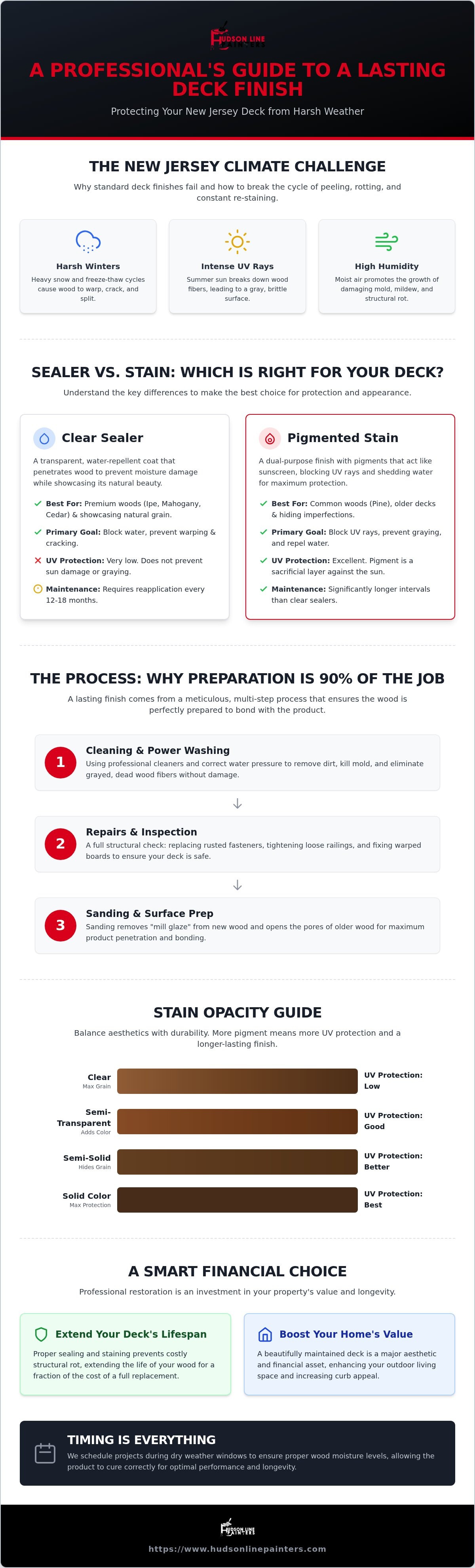
Choosing the right finish for your outdoor space often starts with a simple question: do you want to see the wood or the color? While the terms are frequently used interchangeably, deck sealing and staining serve two distinct technical purposes. A clear sealer acts as a water-repellent coating. Its primary job is to penetrate the wood fibers and prevent moisture from soaking in, which is vital for preventing the warping and cracking caused by New Jersey's freeze-thaw cycles. However, clear sealers offer very little protection against the sun.
Wood staining introduces pigments that act like a high-SPF sunscreen for your deck. These pigments block ultraviolet (UV) rays that break down lignin, the "glue" that holds wood fibers together. In high-humidity areas like Hoboken or Summit, the combination of intense summer sun and heavy winter snow creates a punishing environment. Most modern professional-grade products are actually hybrids. They provide the water-shedding properties of a sealer with the UV-blocking power of a stain. Our team utilizes 2026-compliant low-VOC formulations that meet strict New Jersey environmental regulations while providing maximum penetration. We typically recommend these dual-purpose finishes to ensure your investment survives the local climate without recurring peeling every two seasons.
When to Choose a Clear Sealer
A clear sealer is the best choice if you've invested in premium, high-density lumber such as Ipe, Mahogany, or high-grade Western Red Cedar. These woods possess beautiful natural grains and oils that many homeowners want to showcase. If you prefer the natural "silvering" or graying process that occurs as wood ages but still want to prevent structural rot and water damage, a clear coat is ideal. You should be aware that clear sealers require a disciplined maintenance schedule. Because they lack pigment, they break down faster under NJ's sun, typically requiring a professional reapplication every 12 to 18 months to remain effective.
When to Choose a Wood Stain
For the majority of residential decks in Bergen County, particularly those built with pressure-treated Southern Yellow Pine, a pigmented wood stain is the superior option. The pigment provides a "sacrificial layer" that wears away slowly over time, protecting the wood underneath from turning brittle or gray. Stains come in various opacities, from semi-transparent to solid. They are excellent for older decks where you might want to hide minor imperfections or previous sanding marks. Beyond the aesthetic benefits, a professional stain application offers significantly longer maintenance intervals than clear sealers. This makes it a smart financial choice for busy homeowners who value both durability and curb appeal. Before any application, we always perform professional power washing to ensure the deck sealing and staining bond deeply with the wood fibers.
The Professional Process: Why Preparation is 90% of the Job
Many homeowners make the mistake of applying product to a surface that looks clean but isn't. Staining over dirt, pollen, or old grayed wood fibers is the fastest way to ensure your deck peels within a single season. Professional deck sealing and staining requires a surface that's chemically clean and structurally sound. Without proper preparation, the most expensive stain on the market will simply sit on top of the wood rather than bonding with the fibers. This leads to a patchy, flaking appearance that's difficult and costly to fix later.
We don't just rinse the surface; we ensure the grain is open and ready for absorption. New lumber often has "mill glaze," a waxy residue from the manufacturing process that blocks product penetration. Older decks often have dead, grayed fibers that act like a barrier. Sanding and professional cleaning remove these obstacles, creating a smooth, receptive surface. We also take this time to inspect the structural integrity of your space. We check for rusted fasteners, loose railings, and boards that have begun to warp, ensuring the foundation is safe before we focus on the aesthetics.
Professional Power Washing and Chemical Cleaning
Using high pressure is a common DIY error that often results in "furring," where the wood fibers shred and become fuzzy. Our team uses the correct PSI and professional-grade oxygen bleach cleaners to kill mold and mildew spores at the root. This is far more effective than water alone, especially in the humid North Jersey climate. For a deeper look at our methods, you can read about professional power washing in New Jersey to see how we protect your wood while cleaning it.
Light Carpentry: Fixing Wood Rot Before Staining
In Union County and the surrounding areas, persistent moisture often leads to "soft spots" in deck joists or stair treads. Staining over rotted wood is a waste of resources because the rot will continue to spread beneath the finish. It's also a significant safety hazard for your family and guests. Hudson Line Painters integrates light carpentry into the restoration process to replace compromised boards before the finishing begins. This comprehensive approach extends the life of your deck and ensures a uniform look across the entire structure. If you're concerned about the condition of your wood, you can contact us for a professional assessment of your outdoor living space.
Choosing the Right Stain Opacity: A 2026 Comparison
The level of opacity you choose is more than just a style preference; it's a strategic decision based on the age and condition of your wood. Opacity refers to the concentration of solids and pigments within the finish. The more pigment a product contains, the more UV light it blocks. In 2026, the debate between oil-based and water-based technology has largely been settled by performance and local regulation. Modern water-based stains now utilize advanced acrylic resins that expand and contract with the wood. This flexibility is crucial for New Jersey decks that face extreme temperature swings between January and July. When planning your deck sealing and staining project, matching the opacity to your wood's current state ensures the finish lasts as long as possible.
Transparent stains are the purest way to highlight the grain of expensive, new lumber. They offer a "wet look" that celebrates the wood's natural character. However, as wood ages and develops imperfections, moving toward a higher opacity becomes necessary. By 2026, low-VOC water-borne stains have become the industry standard in our region. These products offer the deep penetration once only found in oils, but with much better color retention and environmental safety. They don't trap moisture, which is the primary cause of rot in the humid North Jersey climate.
The Semi-Transparent Advantage
Semi-transparent stains strike a perfect balance for the majority of residential homes in our area. They provide a rich tint that enhances the wood's natural hues without masking the grain. This level of protection is ideal for decks that receive moderate sun exposure, as the pigments act as a physical barrier against graying. We often recommend this for properties in Hoboken or Jersey City where outdoor spaces are frequently used for entertaining and homeowners want a high-end, furniture-grade look. Because these stains are designed to erode slowly over time rather than peeling, your future maintenance visits will be much simpler and more cost-effective.
Solid Stains for Maximum Protection
For decks that have seen better days, solid stains offer a transformative solution. They are particularly effective at concealing the deep imperfections and sanding marks common in older pressure-treated lumber. If your deck has undergone repairs or has mismatched boards from various years, a solid stain provides a cohesive, opaque finish that looks intentional and polished. This is the preferred choice for maximum durability in high-traffic areas or decks with full southern exposure. For homeowners in historic districts of NJ where wood has aged over decades, solid stains provide the highest level of UV protection available. This creates a uniform, high-end appearance that can completely revitalize a weathered structure while adding years to its functional life.
Timing and Maintenance: When to Stain Your NJ Deck
New Jersey weather is notoriously fickle, making the timing of your project just as important as the product choice. We often refer to late spring and early fall as the "Goldilocks Zone" for deck sealing and staining. During these windows, temperatures typically stay between 60 and 80 degrees, and humidity levels are manageable. If you try to apply a finish in the direct 90-degree heat of a Jersey July, the product will "flash dry." This prevents it from penetrating the wood fibers and leaves behind unsightly lap marks and a brittle surface that's likely to fail before the first frost.
A fresh deck sealing and staining application in the fall is particularly strategic for homeowners in Bergen County. The autumn coat acts as a vital shield against the upcoming winter snowmelt and ice. When snow sits on a deck for weeks, the moisture can seep into unprotected wood, causing it to swell and eventually rot. By ensuring your deck is sealed before the first snowflake falls, you create a waterproof barrier that allows moisture to bead and roll off rather than soaking into the structure.
The Moisture Meter Test
Professional contractors don't guess about wood readiness; we use technical tools to ensure success. Our team utilizes moisture meters to verify that the wood's internal moisture content is below 15% before we begin. Even if the surface feels dry to the touch, deep-seated moisture can be trapped inside. Applying a sealer over wet wood effectively locks that moisture in, which triggers rapid wood rot and causes the finish to bubble and peel. We strictly follow the 48-hour rule, ensuring the wood has had at least two full days of dry weather following a rainstorm or professional cleaning.
Long-Term Maintenance Schedules
Your deck doesn't need to be fully stripped and re-stained every year, but it does require a disciplined maintenance rhythm. We recommend an annual professional cleaning to remove organic growth and environmental pollutants. You can check the health of your finish with a simple "splash test." Drop a small amount of water onto the boards; if it beads up, your protection is still active. If the water soaks in and darkens the wood, it's a clear sign that you need immediate attention to prevent splintering and structural damage. Staying ahead of these signs is a smart financial choice that avoids the high cost of board replacement.
Find a professional deck specialist in your New Jersey neighborhood
Why Professional Deck Restoration is a Smart Financial Choice
Investing in professional maintenance is a defensive financial strategy that protects one of your home's most significant assets. While a complete deck replacement in New Jersey can frequently exceed $15,000, consistent restoration keeps your existing structure sound for decades. Professional deck sealing and staining prevents the structural decay that necessitates those massive capital outlays. Our process ensures results that typically last two to three times longer than a standard DIY attempt. This longevity is backed by our commitment to technical precision and premium materials that are specifically formulated for the local climate.
Beyond saving on replacement costs, professional restoration directly impacts your home's marketability. In competitive North Jersey real estate markets like Hoboken or Fort Lee, outdoor living spaces are high-value assets. A gray, splintering deck suggests neglect to a potential buyer, whereas a rich, professionally finished surface increases curb appeal and perceived property value. There's also the significant value of your own time. A professional crew can execute a full restoration in just two days, while a homeowner often spends three consecutive weekends struggling with equipment rentals, preparation errors, and unpredictable weather delays.
The Risk of DIY Failure
The most expensive project is the one that has to be done twice. We find that the number one request for professional assistance involves stripping away a failed DIY stain. When product is applied too thickly or over improper preparation, it creates a peeling mess that's incredibly difficult and costly to remove. Our team uses professional-grade equipment and high-volume, low-pressure sprayers to ensure an even finish that penetrates deep into the wood grain. This disciplined approach eliminates the risk of lap marks and ensures a uniform appearance across every board. We've completed numerous deck transformations across Bergen and Hudson Counties, where local homeowners have traded recurring maintenance stress for long-term peace of mind.
Get Your Custom Deck Assessment
Every project begins with a transparent evaluation of your unique environment. Our experts assess your wood species, the age of the structure, and the specific sun exposure patterns of your yard. As local Hudson County experts, we understand the architectural styles and environmental challenges specific to our region. This technical assessment allows us to recommend the precise opacity and product formulation that will provide the best return on your investment. We prioritize operational discipline and site etiquette, ensuring your property is respected throughout the entire transformation.
Contact Hudson Line Painters for a Professional Deck Quote
Secure the Future of Your New Jersey Outdoor Space
Your deck is more than just wood and nails; it's a valuable extension of your home that deserves meticulous care. We've explored how proper preparation, from expert power washing to specialized light carpentry, ensures your finish survives the local climate. By choosing the right opacity and timing, you can avoid the cycle of recurring peeling and protect your structure from the harsh humidity and snow common across Hudson, Union, and Bergen Counties.
Since 2018, we've helped local homeowners make the smart financial choice of restoration over replacement. Our disciplined approach to deck sealing and staining includes wood rot repair and technical moisture testing to guarantee a transformation that lasts. You don't have to spend your weekends fighting the elements or worrying about the integrity of your stairs and railings.
We're ready to partner with you to create a beautiful, low-maintenance outdoor space that adds genuine value to your property. Let's ensure your deck remains a safe and stunning centerpiece for your home for years to come.
Frequently Asked Questions
How long does deck staining usually last in New Jersey?
Professional deck staining typically lasts between two and five years in New Jersey, depending on the opacity of the product used. Clear sealers often require reapplication every 12 to 18 months; however, semi-transparent stains usually last two to three years. Solid stains provide the longest protection, often remaining intact for up to five years. Factors like heavy snow in Bergen County or high humidity in Hoboken impact this timeline significantly.
Should I power wash my deck myself before staining?
We generally advise against DIY power washing because improper pressure can easily shred soft wood fibers, a condition known as furring. Professional power washing uses specific PSI settings and specialized chemical cleaners to kill mold spores without damaging the structure. This ensures a clean surface for the deck sealing and staining process. Our crew handles this preparation phase with technical precision to guarantee the best possible adhesion for your finish.
Is it better to use oil-based or water-based stain in 2026?
In 2026, modern water-based acrylic stains are the preferred choice for New Jersey homes due to their durability and VOC compliance. These products offer superior flexibility, allowing the finish to expand and contract during extreme temperature shifts without cracking. Unlike traditional oils, high-quality water-borne stains provide excellent UV protection and don't trap moisture. This is vital for preventing rot in humid environments like Jersey City or Edgewater while maintaining safety standards.
How long do I need to wait for a new deck to dry before staining?
You should wait at least 48 hours after rain or cleaning before applying any product, but the internal moisture content is the most accurate metric. We use moisture meters to ensure the wood is below 15% moisture before starting a project. For brand-new decks, it's also necessary to remove mill glaze, a waxy residue from manufacturing. This ensures the deck sealing and staining products can penetrate deeply into the wood fibers rather than sitting on top.
What is the best temperature for deck staining in NJ?
The ideal temperature range for application in our region is between 60 and 80 degrees Fahrenheit. You should avoid staining in direct 90-degree summer heat, as the product can flash dry before it has a chance to soak into the wood. This leads to lap marks and premature peeling. We carefully schedule projects in the late spring and early fall to ensure optimal conditions for the finish to cure properly.
Can I stain over an old, existing deck finish?
You can stain over an existing finish, but only if the surface is properly prepared through professional cleaning or stripping. Applying new stain over a failing, peeling finish will result in the new layer failing almost immediately. If you're switching from an oil-based to a water-based product, the old finish must be completely removed. We evaluate your current finish during our initial assessment to determine the most efficient preparation path.
How much does professional deck staining cost in Bergen County?
Professional deck staining costs vary based on the size of the structure, the level of preparation required, and the current condition of the wood. Factors such as the need for light carpentry or extensive sanding will influence the final investment. While we don't provide flat rates, we position our services as a smart financial choice compared to the high cost of total deck replacement. We provide custom assessments for Bergen County homeowners.
Does deck staining protect against wood rot and termites?
While staining provides a vital moisture barrier that prevents wood rot, it isn't a primary defense against termites. The water-repellent properties of a professional finish keep the wood dry, which naturally makes it less attractive to many wood-destroying organisms. If rot is already present, our team integrates light carpentry to replace compromised boards before the staining begins. This holistic approach ensures the structural integrity of your outdoor living space in North Jersey for years.


