

What if the secret to a ten-year paint job isn't the premium brand of paint you buy, but the specific humidity level on a random Tuesday in October? Most New Jersey homeowners understand the frustration of watching a fresh coat of paint begin to peel or blister after just a few seasons. It's stressful to invest in your property only to have the Garden State's volatile climate undo the work. Finding the best time of year to paint house exterior in NJ is more than just picking a sunny week; it's about mastering the science of local weather windows.
We promise that by understanding these atmospheric patterns, you can secure a finish that lasts for a decade or more while avoiding common issues like solar blistering. This 2026 guide provides a clear look at the critical 48-hour stability windows required for professional success. You'll learn how to navigate New Jersey's unique humidity levels, the benefits of the latest 2026 coating technologies, and exactly when you need to reach out to a quality contractor to ensure your home is protected for the long term.
Key Takeaways
- Learn the "50-90 Rule" to ensure paint cures as a durable chemical bond rather than just drying on the surface.
- Identify why May and June represent the best time of year to paint house exterior in NJ by avoiding the high humidity of late summer.
- Master the technical checklist for a "perfect day," including keeping humidity below 70% and monitoring the dew point for maximum adhesion.
- Discover why scheduling your project as early as February is essential for securing a spot during North Jersey’s optimal weather windows.
- Understand how integrating power washing and light carpentry into your timeline creates a professional foundation for a finish that lasts a decade.
The Science of Curing: Why Timing Matters for NJ House Painting
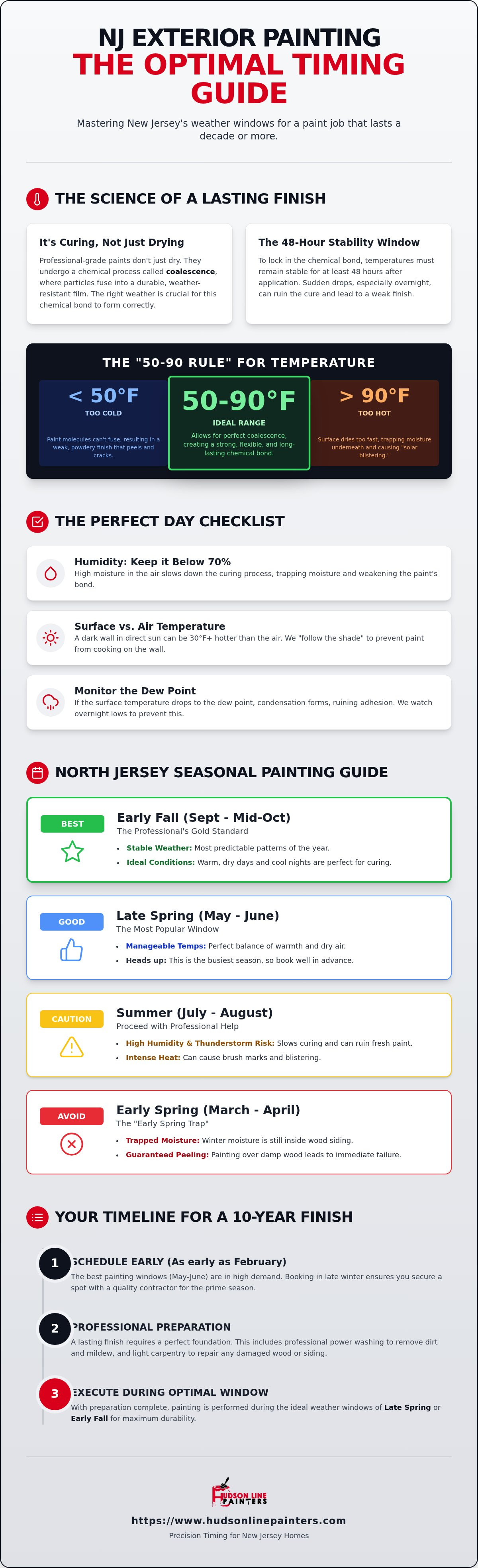
Understanding the chemical transition of paint from a liquid to a solid is the first step in protecting your home. Most people think paint just "dries," but The Science of Curing is actually a complex process called coalescence. For professional-grade acrylic latex paints, this means the water evaporates at a precise rate so the binder particles can fuse together into a durable, weather-resistant film. If this process is interrupted by a sudden drop in temperature or high humidity, the paint won't reach its full strength. This is why identifying the best time of year to paint house exterior in NJ is a matter of chemistry, not just convenience.
We follow the "50-90 Rule" religiously to ensure every coat we apply is set for success. Applying paint when it's colder than 50°F or hotter than 90°F leads to brittle finishes that crack under the pressure of New Jersey’s seasonal shifts. In North Jersey, siding materials like cedar and vinyl are constantly expanding and contracting. If the paint hasn't cured properly, it cannot move with the siding. This failure often presents as "surfactant leaching," where ingredients in the paint rise to the surface as unsightly brown streaks because the curing window was too short. When we evaluate the best time of year to paint house exterior in NJ, we look for a 48-hour window where temperatures remain stable to lock in that chemical bond.
The 50-Degree Threshold for Acrylic Latex
Modern paints are formulated to perform best at 50°F and above. When temperatures dip below this magic number, the paint molecules cannot fuse. They stay separated, leaving a powdery, weak finish that will peel within a year. In regions like Bergen or Hudson County, October nights are notorious for "flash freezing." Even if the day was beautiful, a sharp drop in temperature before the paint is fully cured can ruin the entire project. We monitor overnight lows just as closely as daytime highs to protect your investment.
Surface Temperature vs. Air Temperature
Air temperature is only half the story for a successful exterior painting project. On a clear 75°F day, a dark-colored wall in direct sunlight can easily reach 110°F. This intense heat causes the paint to dry too quickly on the surface while remaining wet underneath, leading to "solar blistering." Our crews often "follow the shade" around a property to ensure the siding stays within the safe zone. This meticulous approach prevents the paint from cooking on the wall, ensuring a smooth and professional result every time.
The North Jersey Seasonal Breakdown: Spring, Summer, and Fall
North Jersey presents a unique set of challenges for homeowners. Between the urban heat islands of Jersey City and the sprawling estates of Bergen County, the weather behaves differently than it does in the southern part of the state. Determining the best time of year to paint house exterior in NJ requires a localized understanding of these shifts. While many residents feel the urge to start as soon as the first tulip pops up, rushing into a project in March or April is often a mistake. This "Early Spring Trap" is a common pitfall. Winter moisture remains trapped inside wood siding well into April. Painting over damp wood leads to immediate peeling, regardless of the paint quality.
Late Spring: The Most Popular Window
May and June are frequently cited as the optimal months for exterior painting. During this window, humidity levels haven't yet reached the oppressive heights of the "Jersey Summer." The days are longer. This gives our crews more time to inspect every detail under natural light. This productivity is a major benefit for complex historical homes in places like Englewood or Hoboken. Because of these ideal conditions, May is typically the busiest month on our calendar. It provides the perfect balance of manageable temperatures and dry air.
Summer brings its own set of hurdles. July and August in Hudson County are often thick with river humidity. High moisture in the air slows down the curing process. Afternoon thunderstorms are another risk. A sudden downpour can wash away fresh paint if it hasn't had at least a few hours to set. We constantly track these "pop-up" cells to ensure we never get caught in a storm. High heat can also cause the paint to dry too quickly, leading to brush marks or a textured finish.
Early Fall: The Professional’s Favorite
Most experienced contractors will tell you that September through mid-October is the gold standard. The weather patterns are significantly more stable than in the spring. You get warm, dry days paired with cool nights that aren't yet reaching the freezing mark. This consistency allows paint molecules to bond perfectly to the surface. It is also a premier time for property maintenance after the summer heat. If you want a finish that truly lasts a decade, early fall is the best time of year to paint house exterior in NJ. If you're planning a project for the upcoming season, it's wise to check local availability before the schedule fills up.
The "Perfect Day" Checklist: Humidity, Dew, and Rain
Selecting the right month is only the first half of the battle. Even during the best time of year to paint house exterior in NJ, individual days can be treacherous. We use a technical checklist to evaluate the atmospheric conditions every single morning before a brush touches your siding. The most overlooked factor is the relationship between surface temperature and the dew point. If the wall temperature isn't at least 5°F above the dew point, moisture will condense on the surface. This microscopic layer of water prevents paint from sticking. In the deep shadows of Hoboken's brownstones or the shaded valleys of Bergen County, walls stay cool long after the sun comes up. Starting too early in these conditions is a leading cause of premature adhesion failure.
Navigating the "Jersey Humidity"
Humidity is a silent project killer. When relative humidity exceeds 70%, professional painters stop. High moisture levels in the air slow down the evaporation of water from the paint film. This keeps the coating "open" or wet for too long. While the paint sits wet, it becomes a magnet for dust, pollen, and insects. Relative humidity in New Jersey acts as a barrier to evaporation, preventing paint resins from fusing properly and leaving the finish vulnerable to moisture damage. If the water can't leave the paint, the chemical bond never fully matures. This results in a soft finish that's prone to scuffing and mildew growth.
The 48-Hour Rain Rule
Rain management requires a strict 24-hour buffer both before and after application. You need dry siding before you start, and the paint needs time to become rain-resistant after it's applied. If a sudden storm hits just 4 hours after a coat is applied, the water can wash away the binders, leaving a streaky, ruined mess. Different materials have different recovery times. Fiber cement siding dries relatively quickly, but traditional wood is a sponge. Wood siding often needs two full days of dry weather after a heavy rain to reach a safe moisture level. Painting over damp wood traps moisture inside. When the sun hits that wall, the trapped water turns to steam and pushes the paint off, creating large, unsightly blisters. Our weather-monitoring protocol ensures we never take these risks with your home.
We believe in transparency. By following these strict environmental limits, we eliminate the guesswork that leads to peeling. It’s about more than just a forecast; it’s about the specific micro-climate of your property. If you're ready to see how professional timing changes the result, you can explore our exterior painting process to see our standards in action.
How to Prepare and Schedule Your NJ Exterior Project
Successful projects aren't just about the weather on the day of application. They're about a logical sequence of preparation that starts months in advance. To hit the Late Spring Sweet Spot we discussed earlier, you should ideally reach out to a professional in February. By the time the best time of year to paint house exterior in NJ arrives in May, top-tier contractors in North Jersey are already booked through July. Planning ahead ensures you aren't forced to settle for a "best price" painter who has immediate availability in peak season. This is often a red flag for rushed work or a lack of proper Home Improvement Contractor (HIC) registration, which is required by the New Jersey Division of Consumer Affairs.
The Pre-Painting Maintenance Sequence
Preparation is a multi-step process that builds the foundation for a ten-year finish. We start with a thorough inspection of your home's envelope. In historic Bergen and Hudson County homes, we often find hidden wood rot or structural issues in the trim. This requires light carpentry to replace damaged boards before a single drop of paint is applied. Once the structure is sound, we perform a professional power washing to strip away the accumulated salt, pollutants, and mildew that thrive in the Jersey humidity. This step is essential for ensuring the new coat of paint actually bonds to the surface rather than sitting on a layer of grit.
The "Dry-Out" period is where many DIY projects fail. After a deep power wash, your siding is saturated. We require at least 48 hours of full sun for the wood or fiber cement to reach a safe moisture level. Painting too soon traps that water, leading to the blistering we mentioned in section three. Following the wash, our craftsmen move into the meticulous scraping and sanding phase, ensuring every surface is smooth and ready for primer. This sequence is non-negotiable for a professional, long-lasting result.
Managing Contractor Lead Times
Securing your preferred window requires understanding the local rhythm. The "Back to School" rush in September is another peak period where schedules fill up fast. We recommend booking your Fall project by June or July to ensure you get on the calendar. A reliable contractor will offer a flexible scheduling window rather than a fixed date. Because we are weather-dependent, we prioritize the "Right Window" over a rigid calendar. This transparency gives you peace of mind that we won't rush your project during a damp week just to hit a deadline.
Schedule your 2026 exterior consultation today
The Hudson Line Advantage: Precision Timing for NJ Homes
Hudson Line Painters operates on a foundation of technical precision and local accountability. We understand that identifying the best time of year to paint house exterior in NJ is just the beginning. Our proprietary weather-monitoring protocol serves as a hallmark of our transparency; it ensures we only apply coatings when atmospheric conditions are perfect for long-term adhesion. We don't rush projects to meet artificial deadlines. If the data suggests that humidity levels or dew point margins are unsafe, we delay. This commitment to "The Right Window" provides our clients with the peace of mind that their investment is protected from the common failures of rushed contracting.
Local Expertise in Hudson and Bergen Counties
Our expertise is deeply rooted in the specific architectural needs of North Jersey. Whether we're working on a historic brownstone in Hoboken or a sprawling estate in Alpine, we adapt our methodology to the environment. Homes near the Hudson River face unique salt-air challenges that accelerate paint degradation if the preparation isn't handled with meticulous care. We also navigate the complex urban logistics of Jersey City and Fort Lee with ease, ensuring our presence is respectful of your neighborhood and efficient in its execution. By integrating light carpentry into our workflow, we provide a comprehensive restoration that addresses structural vulnerabilities before they're sealed under a fresh coat of premium paint.
Choosing Hudson Line Painters means choosing a partner who values the craft as much as the final aesthetic. We view every project through the lens of longevity and value. While some contractors might offer a lower initial price by skipping dry-out periods or ignoring humidity spikes, our disciplined approach ensures you won't be paying for a repainting job in three years. This focus on durability positions our services as a smart financial choice, contrasting the cost of professional maintenance against the much higher expense of full siding replacement.
Start Your Transformation Today
Your home’s transformation begins with a professional site evaluation. We take the stress out of property maintenance by providing a clear, sequential plan tailored to your home’s specific needs and the best time of year to paint house exterior in NJ. Our team is proud of our professional standing and ready to bring a craftsman’s eye to your next exterior project. You can trust that we'll treat your home with the same care and technical precision we would our own.
Contact Hudson Line Painters for a Free Exterior Estimate
Secure a Finish That Stands the Test of Time
Mastering the best time of year to paint house exterior in NJ is the most effective way to ensure your property remains beautiful and protected for years to come. By respecting the 50-90 degree rule and the essential 48-hour dry-out period after power washing, you avoid the common pitfalls of peeling and blistering. Hudson Line Painters has provided 5-star rated local craftsmanship to Hudson, Bergen, and Union Counties since 2018. We specialize in the meticulous restoration of historical homes, combining light carpentry with precision timing to deliver results that last.
Our proprietary weather-monitoring protocol removes the stress of property maintenance. It's our way of ensuring that we never compromise on quality by rushing during a damp window. We take pride in a craftsman's approach that prioritizes technical precision and long-term value for every North Jersey homeowner. We don't just apply paint; we provide a durable transformation that enhances your home's envelope.
Your home deserves a finish that stands up to the New Jersey climate. We look forward to helping you achieve a durable, professional transformation that you can be proud of for a decade or more.
Frequently Asked Questions
Can you paint a house in the winter in New Jersey?
No, we generally don't recommend exterior painting during a New Jersey winter. Most professional-grade paints require a consistent temperature of at least 50°F to cure properly. While some specialized low-temperature products can be applied down to 35°F, the sharp drops in overnight temperatures common in Bergen and Hudson counties create a high risk of flash freezing. This destroys the paint's chemical bond before it can fully set.
What is the absolute best month to paint a house in NJ?
September is widely considered the best month for exterior painting due to its stable weather patterns and lower humidity. While May and June are popular, September offers warm days and cool, non-freezing nights that provide the ideal environment for paint to cure. Identifying the best time of year to paint house exterior in NJ often comes down to this specific window of atmospheric stability and predictable dry spells.
How long does exterior paint need to dry before it rains?
We prefer a 24-hour dry window after application for maximum safety. While many modern acrylic latex paints become rain-resistant within 4 to 8 hours, a heavy North Jersey downpour can still damage a fresh coat if it hasn't fully set. If rain is in the forecast within 12 hours of our scheduled window, we typically delay the project to ensure a flawless, streak-free finish that lasts a decade.
Is it better to paint in the morning or the afternoon?
Late morning to early afternoon is the optimal time to start. You must wait for the morning dew to evaporate completely and for the surface temperature to rise at least 5°F above the dew point. However, we avoid painting in the direct, peak afternoon sun on extremely hot days. This prevents solar blistering, where the paint surface dries too quickly and traps moisture underneath, leading to premature failure.
What temperature is too cold for exterior house paint in NJ?
Anything below 50°F is generally too cold for standard exterior coatings. If the temperature drops below this threshold before the paint has finished its chemical curing process, the finish will become brittle and prone to peeling. For homeowners in North Jersey, monitoring the overnight lows is just as critical as checking the daytime high to ensure the paint molecules fuse correctly into a durable film.
How much does humidity affect exterior painting results?
Humidity is a major factor that can compromise your home's finish. When relative humidity exceeds 70%, the air is too saturated for the water in the paint to evaporate efficiently. This keeps the paint wet for an extended period, making it a magnet for dust, pollen, and insects. Proper humidity management is a key part of determining the best time of year to paint house exterior in NJ for long-term results.
How long should I wait to paint after power washing my house?
You should wait at least 48 hours after a professional power washing before applying any paint. This dry-out period is essential, especially for porous materials like wood siding which can trap significant moisture. Painting over damp siding is a guaranteed way to cause premature peeling and blistering, as the trapped water will eventually try to escape as vapor once the sun hits the wall surface.
Does the type of siding (wood vs. vinyl) change the best time to paint?
Yes, siding material influences the ideal schedule. Wood is highly porous and requires longer dry-out periods after rain or washing to prevent rot and adhesion failure. Vinyl siding is non-porous but is more sensitive to thermal expansion. For vinyl, we prioritize days with stable, moderate temperatures to ensure the paint can flex naturally with the siding as it expands and contracts throughout the day.


