

A water-repellent stain isn’t a waterproof shield. For New Jersey homeowners, choosing deck staining and waterproofing means balancing the wood’s appearance with realistic protection from moisture and everyday weather. The right finish depends on the deck’s condition, so the option that looks most protective isn’t automatically the best fit.
Rain, summer humidity, and winter temperature swings can all affect an outdoor finish. These conditions can wear down a coating, which makes thorough preparation and a suitable finish important parts of the project, not minor details.
This guide explains what stains and water-repellent finishes can realistically do, how transparent, semi-transparent, and solid finishes differ in appearance and upkeep, and what to consider before choosing one for your deck. You’ll also learn what careful preparation involves and what a professional staining project should include, so you can plan a durable result with confidence.
Key Takeaways
- Deck staining and waterproofing serve related but different purposes. Choose a finish based on the protection and appearance your deck needs.
- Compare finishes by how much wood grain they show, their water-repellent properties, and the upkeep they require.
- Assess the existing coating and wood condition before choosing a finish. Preparation helps set the project up for a durable result.
- Plan around a clean, properly dried surface and follow the selected product’s label for suitable application conditions.
- A project-specific approach can match preparation and finish selection to decks in Hudson, Bergen, or Union County.
Why Deck Staining and Waterproofing Matter for New Jersey Wood Decks
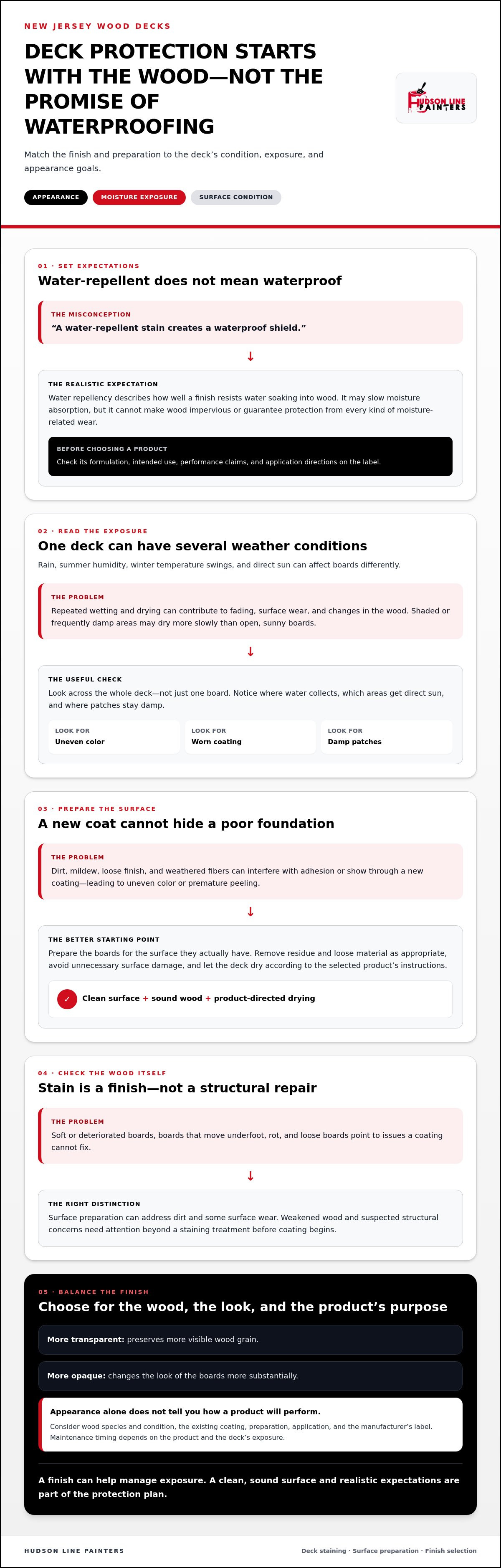
A deck finish does more than change the color of the boards. Staining adds color and can help limit surface exposure to sun and moisture. Water repellency describes how well a finish resists water soaking into the wood. These functions can overlap, but they aren’t identical. Protection depends on the finish’s formulation and intended use, how it is applied, and the condition of the wood beneath it.
That distinction matters for deck staining and waterproofing in New Jersey, where decks face changing outdoor conditions throughout the year. Repeated wetting and drying can contribute to fading, surface wear, and changes in the wood. A finish can help manage exposure, but it can’t prevent every effect of weather or replace an inspection of the deck’s condition.
What does waterproofing mean when you stain a deck?
A water-repellent deck finish helps slow moisture absorption, but it doesn’t make wood impervious to water. Stains vary in how much water repellency they provide, so check the product’s intended use and label. As the Wood stain overview explains, stains can serve decorative and protective purposes. A coating is still a surface treatment, not a repair for loose boards, decay, or other structural damage. It can’t guarantee a completely waterproof deck.
How can weather affect a New Jersey wood deck?
Sun can fade color and weather exposed surfaces. Rain and humidity can keep boards wet for longer, while seasonal temperature changes can add stress as wood responds to its surroundings. Shaded or frequently damp areas may dry more slowly and show wear differently from open, sunny boards. Look across the whole deck: uneven color, worn coating, and patches that stay damp can indicate that exposure varies across the surface.
Plan maintenance around the deck’s condition, not just a calendar reminder. Before choosing a finish, note where water collects, which boards receive direct sun, and whether the existing coating is intact. A faded surface may need a different preparation approach from peeling finish or rough, weathered boards. Match the work to what the wood actually needs.
Coatings can reduce direct exposure, but they don’t correct underlying problems. If boards feel soft, move underfoot, or show signs of rot, staining alone won’t restore their strength. Address the deck’s condition before applying a finish. Treating staining as home maintenance, rather than a quick color refresh, helps set realistic expectations for the result.
How Deck Stains and Water-Repellent Finishes Protect Wood
Wood is porous: it takes in moisture and releases it as conditions change. Repeated wetting and drying can contribute to movement, surface checking, and wear. A deck finish helps manage exposure at the surface, but performance depends on more than the product alone. Wood species and condition, the existing coating, surface preparation, application, and label directions all matter.
That’s why deck staining and waterproofing should be planned around the deck itself. A clean, sound surface gives a coating a better chance to adhere evenly. Dirt, mildew, loose finish, and weathered fibers can interfere with adhesion or show through a new coating, resulting in uneven color or premature peeling. Cleaning and preparation should suit the surface rather than relying on a new coat to cover what’s underneath.
Why wood condition matters before applying a finish
Weathered fibers are rough or faded material at the surface. Deeper damage may involve soft, deteriorated, or unstable boards, and these conditions call for different responses. Careful surface preparation can address dirt and some surface wear, but stain won’t restore weakened wood or secure a loose board. Suspected structural concerns need attention beyond a staining treatment before coating begins.
Preparation is more than a preliminary chore. A finish can only perform as well as the surface it’s applied to. Remove residue and loose material as appropriate, then allow the surface to dry according to the selected product’s instructions. Applying a coating over damp wood or poorly bonded old finish can compromise appearance and adhesion. Cleaning methods matter too: prepare the boards without causing avoidable surface damage.
What water resistance can and cannot promise
Some finishes are formulated to repel water, and beading can be a visible sign of that effect. It isn’t proof that protection is permanent or that water can’t enter through worn areas, board ends, joints, or gaps. The USDA Forest Service research on deck finishes examines finish systems in relation to wood-deck weathering, including the role of water repellency. Treat repellency as one part of a finish’s performance, not a guarantee against all moisture-related wear.
Appearance and protection goals can involve trade-offs. A more transparent finish preserves more visible grain, while a more opaque one changes the look of the boards more substantially. Appearance alone doesn’t tell you how a product will perform. Match the finish to the wood and existing coating, then use the manufacturer’s label to check intended surfaces, application directions, performance claims, and care guidance. As weather and foot traffic wear a coating, maintenance may be needed. Timing depends on the product and the deck’s exposure.
Hudson Line Painters’ deck and fence staining service considers surface condition, preparation needs, and the desired finish together.
Choosing a Deck Stain and Waterproofing Finish for Your Home
The right finish balances the look you want with the condition and exposure of your deck. A transparent stain may preserve more of the wood’s natural character, while a solid finish creates a more uniform color. Water repellency and upkeep depend on the specific formulation, so appearance alone doesn’t show how a product will perform. For deck staining and waterproofing, compare the finish’s intended use with the existing coating and the boards’ condition.
How do transparent, semi-transparent, and solid finishes differ?
These categories generally describe how much color and opacity a finish adds, and how much grain remains visible. Exact coverage and performance vary by product. Before choosing, identify what’s already on the deck because an existing coating can affect adhesion and compatibility. Check the manufacturer’s directions to confirm that the surface is suitable and learn what preparation it needs.
| Finish type | Appearance and wood visibility | Water protection | Upkeep considerations |
|---|---|---|---|
| Transparent | Usually adds little color and leaves much of the grain visible. | Water repellency depends on the product. Check its stated purpose and performance. | Natural variation and surface wear may remain noticeable. |
| Semi-transparent | Adds color while allowing some grain and wood character to show. | Protection varies by formulation and application, not just opacity. | Consider how fading or uneven wear may look against the chosen color. |
| Solid | Provides more uniform color and conceals more of the grain. | Opacity alone doesn’t establish water resistance. Follow product claims and directions. | Plan future maintenance around the existing coating and its condition. |
Which finish considerations matter most for a New Jersey deck?
Assess the deck in exposure zones. Open boards may receive more direct sun, while shaded corners or areas that stay damp can show wear differently. Match the appearance you want to those conditions, then consider how much ongoing care you’re prepared to give the finish. No finish category can promise to withstand every combination of weather and use.
Before settling on a color or opacity, consider these decision points:
- Existing coating: Identify whether the surface is bare, stained, or covered by a different finish. Confirm compatibility and preparation requirements.
- Wood condition: Choose a finish for the actual surface, not simply the appearance you hope a fresh coat will create.
- Exposure: Note which areas receive strong sun, remain shaded, or are frequently exposed to moisture.
- Maintenance preference: Consider how visible fading or wear might be, and follow the product label for care guidance.
A clear selection process connects these details instead of treating color as the only decision. Hudson Line Painters provides deck and fence staining as a project-specific service, considering the surface, preparation, and desired appearance together. That helps homeowners choose a finish with realistic expectations for its look and role in protecting the wood.
Planning Deck Staining and Waterproofing Around Preparation and Weather
A durable finish depends on an orderly process, not just the day the stain goes on. For deck staining and waterproofing, assess the boards, prepare the surface, wait for suitable conditions, apply the finish according to its label, and plan for ongoing care. Each step helps prevent avoidable problems, such as uneven coverage or coating applied before the wood is ready.
What should happen before deck stain is applied?
Start with a close inspection. Look for loose finish, grime, splintering, and visibly damaged areas. Then determine what cleaning and surface preparation the deck needs. Removing dirt and residue helps create a more even surface. Choose cleaning methods that suit the wood and finish without damaging the boards.
Hudson Line Painters offers professional power washing, which can be part of preparing a deck for staining. The right preparation depends on the surface and existing coating. If the project has minor repair needs, light carpentry may also be useful. Cleaning and staining are not substitutes for addressing deeper damage.
How do you plan around rain, humidity, and drying?
Follow the selected manufacturer’s instructions for application and drying conditions. Check the forecast and the deck before scheduling. Recent rain, damp boards, or conditions that don’t match the product directions may mean the surface isn’t ready. Don’t rely on a fixed number of hours or a general weather rule; requirements vary by product.
A peeling finish can point to preparation or application issues, among other causes. Use the product label and surface condition to guide next steps, alongside the related guide on preventing deck stain from peeling.
Use this sequence to organize the work:
- 1. Assess: Check the whole deck for loose coating, dirt, splinters, and visibly damaged boards. Note areas that stay damp or receive more sun.
- 2. Prepare: Clean the surface and address appropriate minor preparation or repair needs. Select a method that suits the wood and existing finish.
- 3. Allow suitable conditions: Confirm that the surface and forecast align with the product’s stated application requirements. Let the deck dry as directed.
- 4. Coat: Apply the chosen finish according to its label, including directions for coverage and any additional coats.
- 5. Maintain: Monitor how the finish wears and follow the manufacturer’s care guidance when maintenance is needed.
Preparation and scheduling work together. A surface that looks dry on top may still be damp in shaded areas, while a clean, properly prepared deck can accept a more consistent application. Keeping the sequence clear helps you plan carefully without guessing about product-specific timing.
What to Expect From Professional Deck Staining in Hudson, Bergen, and Union Counties
A deck-staining project should begin with the deck itself, not a one-size-fits-all finish choice. Hudson Line Painters provides deck and fence staining in Hudson County, Union County, and Bergen County, including Hoboken, Edgewater, Fort Lee, Teaneck, Hackensack, Englewood, Cliffside Park, Leonia, Palisades Park, and Ridgefield. The project plan considers the wood’s condition, current finish, desired appearance, and preparation needs.
How a professional deck-staining project is planned
Start with a practical discussion of what you’re seeing and what you want the finished deck to look like. Is the current coating worn, uneven, or peeling? Do you want more of the wood grain to remain visible, or a more consistent color? Are there areas with grime, splintering, or visible damage? These details help clarify the scope and priorities before work begins.
Next, the surface and existing coating guide preparation and finish choices. A deck with sound boards and an intact finish may need a different approach from one with loose coating or weathered areas. Consider cleaning, surface preparation, and finish selection together so the chosen product suits the deck rather than simply covering its current appearance. If the project involves minor repair needs, light carpentry may also be relevant. Staining won’t correct deeper damage.
Product selection and application details depend on the surface and the manufacturer’s directions. Product labels guide suitable conditions, preparation, and care. Plan timing and finish details around the actual project rather than assuming they are the same for every deck. That sequence helps set realistic expectations for appearance and maintenance.
How to take the next step with Hudson Line Painters
To start a useful conversation, share your town, a description of the deck’s condition, and the appearance you hope to achieve. Mention the existing finish if you know what it is, and point out any areas that concern you. These details focus the discussion on the deck’s needs and preparation.
Hudson Line Painters serves homeowners in Hudson County, Union County, and Bergen County, including Hoboken, Edgewater, Fort Lee, Teaneck, Hackensack, Englewood, Cliffside Park, Leonia, Palisades Park, and Ridgefield. Decks can differ in sun exposure, shade, and how long surfaces stay damp, so include those details when discussing the project.
For deck staining and waterproofing, treat water protection as one consideration alongside wood condition, finish appearance, and product guidance. The goal is a clear plan tailored to your home, not a blanket promise about how every deck will look or perform.
Planning deck staining in Hudson, Bergen, or Union County? Share your project details with Hudson Line Painters to discuss a finish and preparation approach suited to your deck.
Plan a Deck That Fits the Way You Live
A deck project is an opportunity to shape an outdoor space around how you want to use it. Before choosing a direction for deck staining and waterproofing, consider what would make the deck more inviting: a comfortable place for morning coffee, room to gather with family, or a calm spot to unwind at the end of the day. Knowing how you want to use the space gives the project a practical starting point.
That bigger picture can help make finish decisions part of a thoughtful home-improvement plan. Discuss your priorities with Hudson Line Painters and explore an approach that fits your home and your vision. You don’t need every detail decided before starting the conversation.
A well-planned deck can feel like a natural extension of your home. Contact Hudson Line Painters to discuss your deck staining project and plan a finish and preparation approach that suits your space.
Frequently Asked Questions
Does deck stain waterproof a wood deck?
Some deck stains repel water, but stain doesn’t make wood completely waterproof. Check the product label for its stated water-resistance properties and intended use. In deck staining and waterproofing, the finish helps limit moisture exposure, but water can still reach worn spots, seams, and board ends. If water stops beading on an older finish, inspect the coating rather than treating beading as a stand-alone measure of the deck’s overall condition.
Can you apply deck stain over an existing waterproofing sealer?
Only if the stain is compatible with the existing sealer and the surface is prepared as directed. A water-repellent sealer may prevent a new stain from adhering or absorbing evenly. Check the sealer’s product information and the stain label, and test a small, inconspicuous area if the directions allow. If water beads on the boards, the old coating may still be repelling moisture, so applying stain directly could produce an uneven result.
How long should a deck stay dry after staining?
Follow the selected stain’s label for how long the deck must stay dry after application. There isn’t one reliable interval for every formula or set of conditions, and the stated drying time may differ from the time needed before rain exposure. Check the forecast for the full period specified by the manufacturer, and allow for slower drying if conditions are cool or humid. Keep furniture and foot traffic off the surface for the time stated on the label.
Can you stain a deck that is still damp?
Don’t apply stain to damp boards unless the product instructions specifically allow it. Moisture can interfere with penetration or adhesion and affect the final appearance. A deck can look dry on top but remain damp in shaded spaces or between boards after rain or washing. Wait until the surface meets the product’s dryness requirements, and check the label for any recommended way to assess readiness before coating.
How often does a deck need to be restained?
As a general New Jersey guideline, a wood deck may need restaining every two to three years, but exposure and the finish’s condition matter more than a fixed date. Sun-facing boards, busy walkways, and areas that stay damp may wear at different rates. Inspect the surface for fading, worn patches, or water no longer beading, then follow the stain manufacturer’s maintenance guidance to decide when to recoat.
Can you waterproof a composite deck with wood stain?
No. Wood stain is intended for wood and shouldn’t be used on composite decking unless the decking and stain manufacturers explicitly approve that use. Composite boards have different surface materials and may not absorb stain like natural wood, which can lead to poor adhesion or an unwanted finish. Follow the decking manufacturer’s care instructions for cleaning and protection methods designed for that specific composite surface.
What should I do if the deck has soft or rotting boards?
Address soft or rotting boards before staining. A coating may change their appearance, but it won’t restore strength or make a damaged board safe. Don’t treat the affected area as a routine finish issue, especially if boards flex, crumble, or feel unstable underfoot. Have the condition assessed and any needed repairs completed before planning a finish. For minor repair needs, light carpentry may be part of the project. Staining should come after the deck is sound.


