
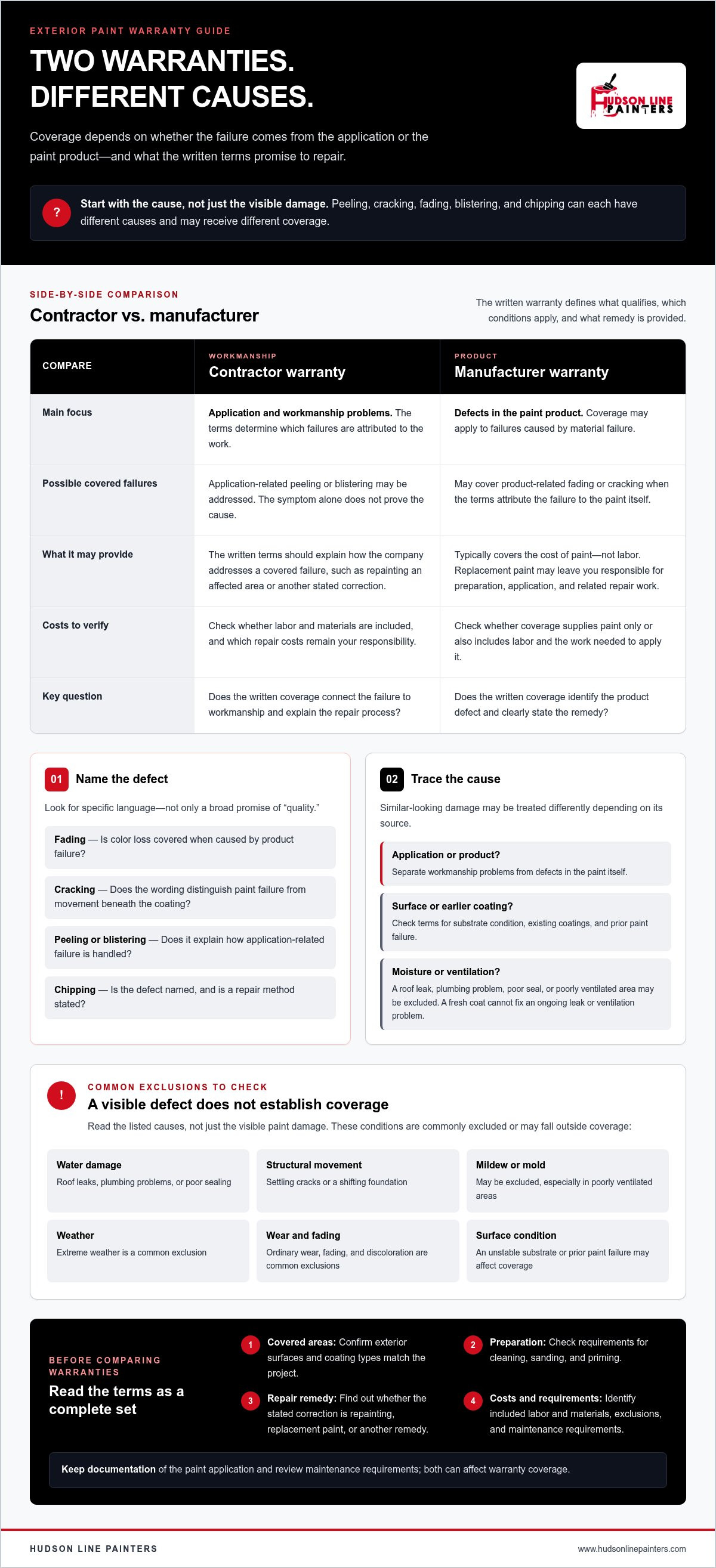
What to expect from a warranty on an exterior paint job depends on whether a problem is caused by the application or the paint itself. Contractor warranties generally cover workmanship issues, while manufacturer warranties may cover product defects. Check which failures qualify and what remedy the written terms provide.
A fresh exterior finish should protect your home, so it’s reasonable to want clear answers if the paint fails. To understand what to expect from a warranty on an exterior paint job, look beyond its duration to covered causes, exclusions, and repair terms.
This guide explains which paint problems may be covered, how contractor and manufacturer warranties differ, and which terms deserve close attention. It also covers how preparation, maintenance, and the cause of a failure can affect coverage.
Key Takeaways
- Separate application problems from paint-product defects to understand which warranty may apply.
- Look for exclusions involving water intrusion, structural movement, mildew, weather, fading, and routine wear.
- Compare the remedy and covered costs, not just the warranty’s duration; manufacturer coverage typically pays for paint, not labor.
- Check how the terms define peeling, cracking, chipping, and fading, and whether they explain the repair process.
- Keep documentation of the paint application and review maintenance requirements, since both can affect warranty coverage.
What Does a House Painting Warranty Cover?
A house painting warranty may cover application problems, product defects, or both, depending on its terms. When exterior paint fails, the cause often matters as much as the visible damage.
Conditions and Common Exclusions
A paint warranty defines which failures qualify, what conditions apply, and which causes are excluded. That distinction matters because peeling can result from workmanship, moisture, or an existing surface problem, and each cause may be treated differently.
Common exclusions include water damage from roof leaks, plumbing problems, or poor sealing. Structural movement, such as settling cracks or a shifting foundation, is also commonly excluded. Mildew or mold may be excluded, especially in poorly ventilated areas. Ordinary wear, extreme weather, fading, and discoloration are common exclusions as well. Read the listed causes, not just the visible defects.
Substrate and Prior Paint Failures
The substrate is the surface beneath the new coating. Prior paint failure is damage that existed before the latest application. Both matter because a new coat may not fix an unstable or damaged base.
For example, peeling that continues from an older coating may have a different cause than peeling on a properly prepared surface. Warranty terms may distinguish a fresh application failure from a problem tied to the substrate or earlier paint. Look for wording about existing coatings, surface condition, and preparation. These details clarify what the coverage addresses.
Pay close attention to moisture, because its source can affect how a claim is assessed. Water entering through a roof leak, plumbing problem, or poor seal may cause bubbling, peeling, or other paint damage, but these causes are commonly excluded. Mildew or mold may also fall outside coverage, particularly in poorly ventilated areas. A fresh coat cannot fix an ongoing leak or ventilation problem. If trim is not cleaned or sealed, early paint failure may also fall outside the painter’s warranty. Visible damage alone does not establish its cause.
Surface and finish terms define the physical scope of a warranty. Check whether the written coverage identifies the exterior areas and coating types included, then compare those terms with the areas painted. A warranty limited to particular surfaces or finishes may not apply to every part of a home. This matters when a project includes different materials or separately treated areas. Clear wording distinguishes a covered painted surface from an excluded one without relying on assumptions.
Preparation can also shape whether a failure is treated as an application problem. Proper painting preparation includes cleaning, sanding, and priming surfaces. These steps create a prepared base for the coating, while skipped or incomplete preparation can affect adhesion and durability. A service warranty for house painting implies that paint application is included, but exclusions still define the limits. Read the preparation requirements alongside the coverage language, especially when a claim involves peeling or cracking. Together, those terms show whether the warranty addresses the application or excludes the underlying cause.
Coverage for fading, cracking, peeling, and chipping
Visible paint damage can have different causes, and warranty wording determines which qualify. Before hiring, review the written coverage, exclusions, covered defects, repair remedy, and whether labor and materials are included.
Covered Paint Defects
Covered paint defects are failures the warranty attributes to the paint product or its application. This distinction matters because fading, cracking, peeling, blistering, and chipping can have different causes and may receive different coverage.
A paint manufacturer’s warranty may cover defects in the product itself, including fading or cracking caused by material failure. A contractor warranty typically addresses workmanship problems. Peeling or blistering may result from the application, the product, or conditions beneath the paint, so the visible symptom alone does not establish coverage.
A useful warranty names the paint failures it covers and explains the remedy. Look for specific terms rather than a broad promise of “quality.” Check, for example, whether it addresses cracking across a painted surface, localized peeling, or chipping at an edge. Note whether fading is covered only when attributed to product failure. Terms that identify both the defect and its cause give you a clearer understanding of the coverage.
- Fading: Check whether the terms address color loss caused by product failure.
- Cracking: Look for language distinguishing paint failure from movement beneath the coating.
- Peeling or blistering: See whether the warranty explains how application-related failure is handled.
- Chipping: Check whether the terms identify this defect and the repair method.
Labor, Materials, and Repair Costs
Labor, materials, and repair costs describe what the warranty provides after a covered defect is accepted. This matters because product coverage may pay for paint without covering the work needed to apply it.
Paint manufacturer warranties typically cover the cost of the paint, not labor. A product warranty may provide replacement paint while leaving you responsible for other expenses, including labor. Read the remedy carefully: replacement material does not necessarily include surface preparation, application, or related repair work.
A painting warranty should explain how the company will address each covered failure. Check whether the remedy involves repainting an affected area, supplying paint, or another stated correction. The terms should clarify which materials and labor are covered and which repair costs remain your responsibility. This helps you compare the practical value of warranties, not just their lists of defects.
Compare written warranties using the same questions: Which defects qualify? What cause must be established? What repair will be provided? Are both paint and labor included? Clear answers make differences easier to identify.
For a planned repaint, explore professional exterior painting with the coverage terms you’ve reviewed in mind.
What is the difference between a manufacturer and a contractor warranty?
A contractor warranty generally addresses workmanship, while a manufacturer warranty addresses defects in the paint product. Their durations may differ, so compare coverage and eligibility, not just the years stated.
Warranty Duration and Performance
Warranty duration is the period when stated coverage may apply, not a measure of how long paint will perform. This matters because a longer term can still exclude the failure you experience.
Professional painting contractor warranties often last between 1 and 3 years. House painting contractor warranties in the United States typically last two to eight years, depending on the paint chosen. These reported ranges differ, so the written warranty for the specific project matters more than a general expectation.
Painting warranty durations may range from 15, 20, or 25 years to a lifetime. Such long periods don’t mean every paint problem qualifies throughout that time. The covered defect, cause, application conditions, and remedy still shape the protection. A brief workmanship term and a longer product term may address entirely different failures.
Typical Contractor Warranty Duration
A contractor warranty typically covers problems caused by the painter’s workmanship. Its duration indicates how long that coverage applies, but the term alone does not explain which failures qualify.
Compare the contractor’s written coverage with the paint manufacturer’s product warranty. For example, peeling linked to application may fit workmanship coverage, while cracking caused by paint material failure may fall under product coverage. The warranty should identify covered failures and the remedy. Read the start date and scope stated in the document instead of assuming all painted areas receive the same coverage.
Duration and Eligibility
Eligibility describes whether a particular defect meets the warranty’s conditions during its coverage period. A claim made within the stated term may still fall outside coverage if its cause is excluded.
Manufacturer terms may also depend on ownership. Benjamin Moore and Sherwin-Williams define a limited lifetime paint warranty as lasting while the purchaser owns the home; it is not transferable to a new owner. This condition matters if a home changes hands before the warranty period ends.
For a clear comparison, note who issued each warranty, what failure it covers, how long it lasts, and what remedy it provides. Then match an example, such as peeling from workmanship or cracking from product failure, to the relevant wording. A longer term is useful only when the defect and homeowner meet its stated conditions.
Contractor and paint manufacturer warranties
A contractor warranty and a paint manufacturer warranty cover different parts of an exterior paint job. Compare who is responsible, which failures are covered, and what remedy is provided to understand what each promise offers.
Manufacturer and Contractor Warranty Differences
A contractor warranty typically covers problems caused by workmanship, while a manufacturer warranty addresses defects in the paint product. This distinction matters because similar-looking failures can have different causes and coverage.
For example, paint peeling linked to application may fall under a contractor’s workmanship terms. A product defect, such as cracking caused by material failure, may fit the manufacturer’s warranty. Manufacturer warranties often require proof that the paint was applied properly, so product eligibility may depend on application records. Review both documents together to see which party addresses each type of failure.
Limits of a Two-Year Contractor Warranty
A two-year limited contractor warranty sets a time period and scope for specified workmanship issues. The two-year term does not mean every paint problem or repair is covered.
Some leading exterior painting contractors provide a standard two-year limited warranty. The word “limited” signals that the written terms still define which failures qualify and what correction is offered. A defect caused by workmanship may fit; damage from an excluded cause may not. Compare the covered failures and remedies, rather than treating two years as a promise of complete protection.
The two warranties may also differ in what they provide after a covered claim. A product warranty may provide paint while leaving you responsible for other expenses, including labor. Replacement material may not cover the work required to prepare and repaint an affected surface. A contractor warranty, by contrast, typically concerns workmanship problems. Read the remedy in each document to distinguish paint replacement from labor or corrective work.
Duration alone does not make the two forms of coverage interchangeable. Benjamin Moore and Sherwin-Williams define a limited lifetime paint warranty as lasting while the purchaser owns the home, and it is not transferable to a new owner. A long product term therefore has an ownership condition, while a contractor term focuses on workmanship within its stated period. Practical coverage depends on the specific failure, the responsible party, and the warranty’s eligibility terms.
Keep the paint product details and application records with both warranty documents. If cracking appears, for example, the manufacturer may require proof of proper application before considering a product claim. The contractor’s terms may instead address whether workmanship caused the problem. Matching the observed failure to the right warranty helps clarify which remedy applies and whether paint, labor, or both are covered.
Exterior paint warranty terms
Yes. Warranty wording varies by issuer, and weather exclusions may differ. Local consumer-protection laws may also affect your rights, so distinguish written coverage from legal protections.
Read the warranty as a set of conditions, not simply a promise that lasts for a stated period. The terms should explain which surfaces and paint failures qualify, what causes are excluded, and what remedy follows. For example, wording that covers peeling caused by application failure is more useful than a broad statement about “paint protection.”
Start with the scope. Identify the painted surfaces and coatings covered, then compare them with the work completed. If a home has painted siding and trim, terms covering siding alone may leave the trim outside the stated protection. Look for a clear description of covered areas and any separate conditions for particular surfaces or finishes.
Next, check how the warranty defines a qualifying failure. A paint manufacturer may cover product defects, while a contractor warranty typically addresses workmanship. Fading, cracking, peeling, or chipping may be treated differently depending on the stated cause. Useful terms link the visible defect to a covered cause and explain the correction the issuer will provide.
Read the weather wording carefully. Extreme weather is commonly excluded, but the document determines how that exclusion applies. Check whether it describes weather-related damage, fading, or discoloration, and do not assume those problems are covered simply because the paint has failed. Weather exposure can affect an exterior surface without proving a product or application defect.
Application and maintenance conditions can also affect eligibility. Manufacturer warranties often require proof that the paint was applied properly. Keep product details and application records together, and read any stated care conditions. Neglecting to clean or seal exterior trim can lead to early paint failure that may not be covered by the painter’s warranty. The terms should clarify how these conditions affect a claim.
Finally, find the claim and remedy terms. Note who receives the claim, what information the warranty requires, and whether the response is paint, repainting, or another correction. Manufacturer warranties typically cover paint, not labor, so replacement material may not cover the work of applying it. Compare duration, exclusions, proof requirements, and costs left to you.
The takeaway: assess an exterior paint warranty by the specific failures it covers, the conditions attached, and the repair it provides. A long term alone does not show whether a particular paint problem qualifies.
Explore exterior painting services
Hudson Line Painters: Interior Painting
Hudson Line Painters helps homeowners turn warranty questions into a clear plan for painting work. If your exterior needs a carefully prepared finish, its Exterior Painting service is a natural next step. For interior rooms, Interior Painting can refresh walls and ceilings as part of a separate or broader home project.
Share which areas you want painted and any concerns about existing peeling, cracking, or fading. Clear project details help define the scope and provide a practical starting point for discussing preparation, surfaces, and finish expectations. If you’re planning an update inside or outside your home, contact Hudson Line Painters to discuss your project.
Plan Your Next Paint Project With Confidence
Understanding what to expect from a warranty on an exterior paint job can help you set priorities for your next home update. Decide which spaces need attention and how you want your home to feel when the work is complete. A short list of goals, such as refreshing exterior surfaces or updating interior rooms, gives you a focused starting point.
Hudson Line Painters offers Exterior Painting, Interior Painting, and Kitchen Cabinet Refinishing. With warranty expectations in mind, consider which project best fits your home’s needs and discuss your priorities with the painting team.
Start with the area that matters most, then take the next step toward a home refresh that feels right for you.
Frequently Asked Questions
Are touch-ups or damage from storms and accidents covered?
Touch-ups and accidental damage are not automatically covered; the written warranty defines eligible defects and remedies. For example, a scratch from moving outdoor furniture differs from peeling caused by workmanship. Extreme weather damage is commonly excluded, so storm-related chipping or paint loss may not qualify. Photograph the affected area and note what happened. This record can help distinguish a covered paint failure from impact damage or weather exposure when you review the warranty terms.
Can I transfer the warranty if I sell my home?
Transferability depends on the specific warranty, and some warranties end when a home changes owners. Benjamin Moore and Sherwin-Williams define a limited lifetime paint warranty as lasting while the purchaser owns the home; it is not transferable to a new owner. Before a sale, locate the paint product and contractor documents and check their ownership conditions. A long warranty duration alone does not establish that a buyer can use it.
How do I schedule an inspection or make a warranty claim?
Follow the claim instructions in the applicable warranty and describe the defect, its location, and when it appeared. Take clear photos and keep the project paperwork and paint details together. Hudson Line Painters provides a one-year workmanship warranty, and workmanship issues must be reported within 14 days of project completion. Include the completion date and a concise description when contacting the company, so the issue can be matched to the stated warranty terms.
What are the requirements to keep the warranty active?
Keep the warranty document, project records, and paint product details, since manufacturers often require proof of proper application. Follow any maintenance conditions in the terms. For instance, neglected exterior trim that needs cleaning or sealing can contribute to early paint failure that may fall outside a painter’s coverage. If you notice a new defect, record its location and appearance promptly, then compare the details with the warranty’s reporting and eligibility requirements.
What warranty length is typical for an exterior house paint job?
Professional painting contractor warranties often last between 1 and 3 years. House-painting contractor warranties in the United States are also described as typically lasting two to eight years, depending on the paint chosen. These ranges reflect different warranty terms, not a single standard for every project. Compare the written start date, covered failures, and remedy. A longer period doesn’t necessarily provide broader protection against a particular paint problem.
What does an exterior painting warranty usually cover?
An exterior painting warranty typically addresses specified application problems, product defects, or both, depending on who issued it. Contractor coverage generally concerns workmanship, while a manufacturer’s terms address paint product defects. The document should identify covered failures and the remedy. Check whether it covers the affected surface and whether the remedy includes labor, materials, or only replacement paint. These details clarify what the warranty offers if a qualifying defect appears.
What issues are commonly excluded from exterior paint warranties?
Common exclusions include water damage from roof leaks, plumbing problems, or poor sealing; structural movement such as settling cracks; mildew or mold, especially where ventilation is poor; and damage from ordinary wear or extreme weather. Fading and discoloration are commonly excluded too. Neglecting to clean or seal exterior trim can lead to early failure outside the painter’s coverage. Read each exclusion alongside the defect description to understand how the warranty treats its cause.
Does a paint warranty cover peeling, blistering, fading, or cracking?
Coverage depends on the cause of the failure and the warranty’s wording. A manufacturer’s warranty may address fading or cracking caused by a paint defect. A contractor warranty typically addresses workmanship problems. Peeling or blistering alone does not show which warranty applies. Look for terms that name the defect, identify its covered cause, and describe the correction. Manufacturer coverage typically pays for paint, not labor, so repair work may involve separate expenses.


