

In New Jersey, your deck isn't just a place for summer barbecues; it's a structural investment currently fighting a three-front war against humid summers, heavy pollen, and the brutal freeze-thaw cycles of winter. You've likely noticed the telltale signs of this battle, such as visible peeling, that dull graying of the wood, or the unsettling feeling that moisture is soaking in rather than beading up. It's natural to feel concerned about wood rot leading to an expensive structural replacement. One of the most common questions we hear is exactly how often to stain a deck in New Jersey to avoid those catastrophic repair bills.
This guide provides the definitive 2026 maintenance schedule tailored specifically for Garden State homeowners. We'll break down the local climate factors that dictate your timing, explain why professional preparation is your best defense against rot, and show you how to achieve a finish that looks brand new while lasting through the coldest months. By the end, you'll have a clear plan to protect your home's value and your peace of mind through every season.
Key Takeaways
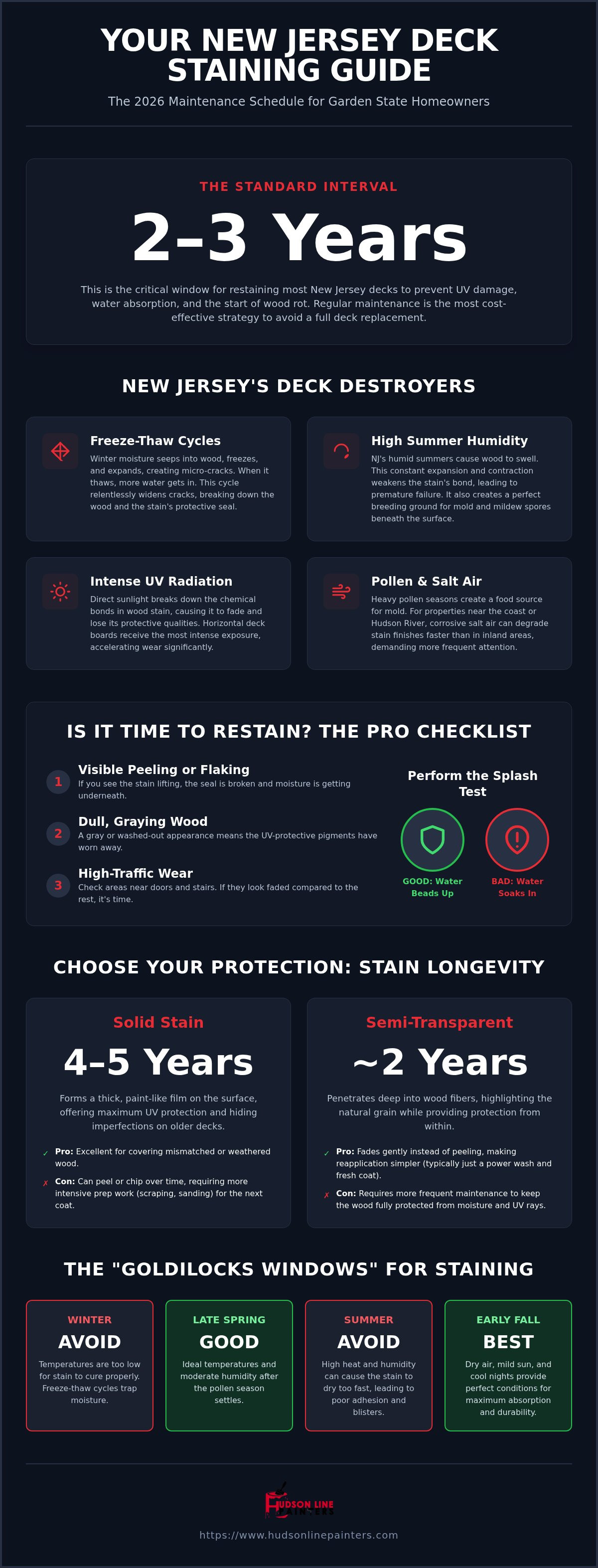
- Learn how often to stain a deck in New Jersey by understanding why the typical 2–3 year interval is dictated by our local climate rather than just the calendar.
- Discover how New Jersey’s unique "Freeze-Thaw" cycle and high summer humidity impact wood pores, making professional-grade protection essential for longevity.
- Master the "Splash Test" and other visual cues to determine if your deck’s sealant is still effective or if your wood is at risk for rot.
- Identify the "Goldilocks Windows" for staining in late spring and early fall to ensure the best possible adhesion and durability.
- Understand why professional preparation, including power washing and light carpentry, is a smarter financial strategy than costly deck replacement.
The Standard Interval: Why Most NJ Decks Need Staining Every 2–3 Years
For homeowners in Bergen or Hudson County, the question of how often to stain a deck in New Jersey usually finds its answer in the "three-year rule." While a high-quality wood stain provides beautiful color, its primary job is structural preservation. It acts as a sacrificial layer, absorbing UV damage and repelling moisture that would otherwise cause wood fibers to swell and rot. Without this protection, your deck becomes vulnerable to New Jersey’s fluctuating temperatures, which can turn a small crack into a major structural repair within a single season.
Horizontal surfaces like your deck boards bear the brunt of this environmental stress. Unlike vertical railings, where water can easily run off, deck boards allow water to pool. This standing water, combined with direct sunlight, breaks down the chemical bonds of the sealant much faster than on vertical posts. This is why you might see your railings looking pristine while your floorboards appear gray and weathered. Maintaining this barrier is a smart financial strategy that avoids the massive cost of a full deck replacement.
The Role of Traffic and Usage
Physical wear is just as damaging as the weather. High-traffic areas, particularly near sliding doors or the top of the stairs, lose their protective coating much faster due to constant friction. Every step acts like light sandpaper, slowly wearing away the finish. Similarly, moving patio furniture or the presence of pets can create microscopic scratches in the sealant. We recommend regular spot maintenance in these zones to prevent moisture from finding a foothold. If you notice water no longer beading up in these high-use areas, it’s a clear sign that the maintenance window is closing.
Solid vs. Semi-Transparent Longevity
The type of product you choose significantly impacts your maintenance schedule. Solid stains offer the longest visible life, often lasting four to five years because they form a thick, paint-like film on the surface. They’re excellent for older decks with significant imperfections or mismatched wood. However, they are prone to peeling once the bond breaks, which requires more labor-intensive preparation later.
Semi-transparent stains are often the preferred choice for maintaining wood health. They penetrate deep into the fibers rather than sitting on top, which prevents the peeling associated with solid products. Because they are thinner, they typically require a fresh coat every two years. To ensure these products bond correctly, professional power washing is a mandatory first step to clear away old debris and open the wood's pores. Choosing between these depends on whether you value a longer interval or a more natural wood aesthetic.
Local Factors That Accelerate Deck Wear in the Garden State
New Jersey weather is uniquely aggressive toward outdoor wood structures. In the Garden State, the "Freeze-Thaw" cycle and high humidity act as a relentless tag team against your deck's finish. When considering how often to stain a deck in New Jersey, you must look beyond the generic advice found on stain cans and evaluate these local environmental stressors. Open-exposure yards in Bergen and Union counties face intense UV radiation that dries out wood fibers, while properties closer to the Hudson River deal with corrosive salt air that can degrade even high-quality stains faster than inland areas.
According to the USDA Forest Service's Wood Handbook, the finishing of wood is a complex science involving moisture management and microbial control. In our region, the high moisture content in the air during July and August forces wood to expand. When the air dries out in the autumn, the wood contracts. This constant movement eventually causes the protective film of the stain to crack, allowing water to seep into the grain. This is why a deck that looked perfect in June might show significant wear by the following April.
New Jersey’s Humidity and Mold Growth
The thick humidity common in North Jersey creates a perfect breeding ground for mildew and mold. These organisms often thrive underneath an old, failing stain, essentially eating the wood from the inside out. This makes professional power washing a non-negotiable prerequisite before any new application. Without a deep clean to remove these spores, you are simply sealing the decay into your deck, which will lead to peeling within months. If you are unsure about the current state of your wood, it's often best to consult with a local expert who understands these specific regional challenges.
Winter Stress and Snow Accumulation
Winter brings a different set of problems for New Jersey decks. When snow sits on your deck boards for weeks during a cold February, it creates a "water logging" effect. As this moisture freezes, it expands inside the wood pores, widening existing cracks and prying the stain away from the surface. Additionally, many homeowners accidentally damage their decks by using harsh salt or ice-melt chemicals to clear paths. These chemicals can strip the finish and leave permanent chemical burns on the wood. We recommend a thorough post-winter inspection every April. Checking for "alligatoring" or graying fibers early in the spring allows you to address issues before the summer humidity sets in, ensuring your deck remains a safe and beautiful space for your family.
Signs Your Deck Needs a Fresh Coat: The Pro Checklist
Identifying the right moment for maintenance is the difference between a simple refinishing project and a total structural overhaul. While we recommend a general two to three year cycle, your specific deck might need attention sooner based on its unique exposure. Knowing how often to stain a deck in New Jersey requires a regular inspection of visual cues. Graying wood fibers indicate that UV rays have stripped away the lignin, leaving the wood brittle and prone to splintering. If you have an older solid stain, look for "alligatoring," where the finish cracks into a pattern resembling reptile skin. Another subtle sign is "fuzzing," where tiny wood fibers stand up because the sealant has worn away, leaving the grain unprotected from moisture.
We also look closely at the joints and corners where moisture tends to sit. Identifying wood rot in these hidden areas before it spreads is vital for the safety of your family. If you notice the wood looks dark or feels soft in these spots, the protective barrier has likely failed. Catching these issues early allows for minor repairs rather than a full-scale replacement, protecting your long-term financial investment.
Performing the Water Bead Test
The most reliable way to determine how often to stain a deck in New Jersey is the 30-second "Splash Test." This simple diagnostic check reveals whether your current sealant is still repelling water or if the wood is beginning to absorb moisture. Follow these three steps for an accurate reading:
- Step 1: Choose several high-traffic areas near the house and high-sun areas on the outer edges of the deck.
- Step 2: Pour a tablespoon of water directly onto the boards in each of these locations.
- Step 3: Observe the reaction. If the water beads up into tight droplets, your protection is intact. If it soaks in within seconds, leaving a dark wet spot, your wood is vulnerable.
The "Screwdriver Test" for Wood Rot
Structural integrity is our primary concern during any inspection. We use the "Screwdriver Test" to identify soft spots in corners, joints, and where the deck meets the house. Gently press a flathead screwdriver into any suspicious or darkened areas. If the wood feels spongy or the tool sinks in easily, you have active wood rot that requires immediate carpentry repair. Staining over rot is a waste of money; it merely masks a problem that will eventually accelerate damage.
Before applying a fresh coat, we often perform light carpentry to replace these compromised sections. Maintaining a sound foundation is as critical for your deck as Expert Drywall and Plaster Repair is for your home's interior walls. Both services ensure that the final aesthetic finish is supported by a healthy, durable structure. By catching these signs early, you ensure your deck remains a safe, beautiful environment for years to come.
Timing Your Project: The Best (and Worst) Months for NJ Deck Staining
Choosing the correct calendar window is just as vital as knowing how often to stain a deck in New Jersey. Even the highest-quality professional stain will fail if applied under the wrong atmospheric conditions. To achieve a finish that lasts, we look for "Goldilocks Windows" where temperature and humidity remain stable. A successful project requires a strict 48-hour dry-weather rule: the wood must be dry for at least 24 hours before application, and the stain needs another 24 hours of clear weather to cure properly. While many homeowners feel the urge to stain during the hottest parts of the year, July and August are often the worst months. High humidity levels in the Garden State prevent the wood from fully releasing moisture, which stops the stain from penetrating deep into the grain.
We also advise extreme caution during the late autumn months. While it's tempting to squeeze in a project in November, overnight frost is a major risk. If the temperature drops below freezing before the stain has fully cured, it can cause the product to crystallize and flake off by spring. This results in a wasted investment and a difficult cleanup process the following year.
Spring Staining (April–June)
Spring is a fantastic time to revitalize your outdoor space before the summer barbecue season begins. By staining between April and June, you provide a fresh shield against the intense UV rays of the coming summer. However, this window comes with specific North Jersey challenges. High pollen counts can be problematic; if heavy oak or pine pollen settles on wet stain, it creates a gritty, sandpaper-like texture that is difficult to fix. Additionally, you must be patient with the frequent rain showers typical of a Jersey spring. We always wait for a clear three-day forecast after the ground has fully dried to ensure the wood's moisture content is low enough for a professional bond.
Fall Staining (September–October)
Many professional contractors consider September the absolute best month for deck staining in New Jersey. The oppressive summer humidity usually breaks, and temperatures remain consistently moderate during both day and night. This stability allows the stain to dry slowly and evenly, creating a more durable protective layer. The primary goal here is to seal the wood before the harsh winter freeze-thaw cycles begin. The only major drawback is the falling leaves. If you have large maple or oak trees overhanging your deck, we must be meticulous about clearing debris until the surface is tack-free. Despite the shorter daylight hours, the long-term protection gained during this window is unmatched.
Schedule your seasonal deck inspection today
Beyond the Brush: Professional Preparation for a Long-Lasting Finish
The "Hudson Line Process" is built on a simple reality: preparation accounts for 75% of a project's success. While many homeowners focus on the color, the technical steps taken before the brush touches the wood determine how often to stain a deck in New Jersey. A poorly prepared surface will reject even the most expensive products, leading to premature peeling and wood rot. We approach every deck as a unique craft project, moving through a disciplined sequence of cleaning, repairing, and refining to ensure the new finish bonds permanently with the wood fibers.
A major differentiator in our process is the integrated carpentry check. We don't just stain over structural issues. Our team performs light carpentry to replace split, warped, or soft boards before the application begins. This ensures that the final result is uniform and that the wood's integrity is preserved. Additionally, professional application prevents "lapping" marks. These dark, unsightly streaks occur when stain is applied unevenly or dries too quickly, a common issue in DIY projects that we avoid through meticulous wet-edge techniques and technical precision.
For older decks in Bergen or Hudson County, we must also decide between mechanical sanding and chemical stripping. If your deck has layers of old, failing solid stain, chemical strippers are often necessary to reach the raw wood without damaging the grain. Sanding follows this to smooth the surface and remove any "fuzz" left behind by the stripping process. This combination creates a perfectly receptive surface that looks brand new and stays protected far longer than a simple "spray and go" service.
The Importance of Power Washing and Sanding
A thorough power washing is the only way to remove dead wood cells and the stubborn organic growth that thrives in the Jersey humidity. This step clears the path for the stain, but it often raises the wood grain. Light sanding is the crucial follow-up that "opens" the wood pores, allowing the stain to penetrate deeply into the heartwood rather than just sitting on the surface. To see how these steps fit into a complete maintenance plan, read The Ultimate Guide to Deck & Fence Staining.
Why Professional Staining is a Smart Investment
Maintaining your deck is a sophisticated financial strategy. While a full deck replacement in our area can easily exceed $15,000, a consistent staining schedule costs a small fraction of that price. We utilize high-grade commercial stains that aren't available in local big-box stores. These professional formulas contain superior UV inhibitors and advanced resins designed specifically for the aggressive "Freeze-Thaw" cycles of the Northeast. By investing in professional craftsmanship, you're choosing long-term durability and peace of mind over temporary aesthetic fixes.
Get a professional quote for your NJ deck staining project
Protecting Your Outdoor Living Space for the Years Ahead
Maintaining a deck in the Northeast requires more than just a calendar reminder. It's a strategic commitment to preserving your home's structural integrity against an aggressive local climate. By now, you understand that the answer to how often to stain a deck in New Jersey is dictated by the specific freeze-thaw cycles and high humidity that define our region. A consistent two to three year maintenance cycle, supported by professional preparation and light carpentry, ensures your wood remains healthy and vibrant.
Hudson Line Painters has served homeowners across Hudson, Bergen, and Union Counties since 2018. We specialize in weather-resistant finishes tailored to the unique challenges of the Garden State. Our team is A+ rated for meticulous site etiquette and technical precision, ensuring your property receives the highest level of craftsman-like care during every phase of the project.
Let's work together to transform your deck into a safe, durable, and inviting space for your family to enjoy through every season. We look forward to providing the peace of mind that comes with a professionally protected home.
Frequently Asked Questions
How long does deck stain take to dry in New Jersey humidity?
Deck stain typically takes 24 to 48 hours to dry completely in the New Jersey humidity. While the surface might feel tack-free within a few hours, the internal curing process depends heavily on local moisture levels. In coastal areas like Edgewater or Cliffside Park, we recommend waiting a full 48 hours before replacing heavy patio furniture. This ensures the protective barrier has hardened sufficiently to resist scratches and pressure marks from your outdoor decor.
Can I stain my deck if it rained yesterday?
You should not stain your deck if it rained yesterday. Wood acts like a sponge, and even if the surface looks dry, the internal fibers are likely still saturated. Applying stain to damp wood prevents proper penetration and leads to premature peeling. For the best results in Bergen County, we wait for at least 24 to 48 hours of dry weather to ensure the wood's moisture content is low enough for a successful application.
Is it better to paint or stain a deck in Bergen County?
Staining is generally superior to painting for the long-term health of your wood. While paint offers a thick, opaque look, it often traps moisture inside the wood fibers, which can lead to hidden rot in the humid North Jersey climate. Stains penetrate the grain and allow the wood to breathe. When deciding how often to stain a deck in New Jersey, remember that quality stains are easier to maintain and won't peel as aggressively as paint.
Do new decks in NJ need to be stained immediately?
New decks in NJ rarely need staining immediately. Most pressure-treated lumber used in towns like Teaneck or Hackensack contains high moisture and factory-applied chemicals that prevent stain from bonding. We typically recommend a weathering period of 30 to 90 days. This allows the wood to dry out and the pores to open up. Performing a water splash test is the most reliable way to confirm your new deck is ready for its first professional coat.
What happens if I wait too long to restain my deck?
Waiting too long to restain your deck allows UV rays and moisture to destroy the wood's lignin, leading to graying and splintering. Once the protective seal fails, water seeps into the joints, which triggers structural wood rot. This neglect often transforms a simple maintenance project into a much more expensive structural replacement. Regular staining is a proactive financial strategy that keeps your outdoor space safe and avoids the high costs of major structural repairs or light carpentry.
How do I know if my deck wood is rotten or just needs stain?
You can distinguish between rot and a need for stain by using the screwdriver test. Press a flathead screwdriver into any darkened areas near the joints. If the wood feels spongy or the tool sinks in easily, you have active wood rot that requires carpentry repair. If the wood is simply gray, brittle, or fails the water splash test, it is likely healthy but needs a fresh coat of professional-grade stain to stay protected through the winter.
Does power washing damage the wood before staining?
Professional power washing is an essential preparation step that does not damage wood when performed with the correct technique. It effectively removes dead wood fibers, mold, and old debris that prevent stain adhesion. However, DIY attempts with excessive pressure can gouge the wood. Our team uses a controlled approach to clean the surface safely, often following up with light sanding to ensure the pores are perfectly open to receive the new finish for long-lasting results.


