

Did you know that construction costs in New Jersey are currently 30% higher than the national average? This reality makes the process of learning how to budget for a whole house painting project more than just a simple calculation; it's a strategic financial decision for your property. We understand the frustration of receiving three different quotes that vary by thousands of dollars, leaving you to wonder about hidden costs like drywall repair or the true impact of NJ labor rates on your bottom line.
You deserve a transparent roadmap that turns a complex renovation into a manageable plan. This guide provides a professional framework to help you master the art of estimating costs while accounting for the specific architectural needs of Garden State homes. We'll walk you through a clear line-item checklist, explaining the vital difference between a low initial price and long-term value. By the end of this guide, you'll have the technical knowledge and local insights needed to select your contractor with absolute confidence.
Key Takeaways
- Learn why calculating wall surface area, rather than floor square footage, is the critical first step in determining your total investment.
- Discover how to budget for a whole house painting project using the "70/30 rule," where meticulous preparation and labor account for the majority of a professional quote.
- Identify the specific architectural factors, such as historic plaster and drywall repair, that unique New Jersey homes require for a long-lasting finish.
- Unlock strategic ways to maximize your budget, including the "Public to Private" phasing model and seasonal timing to secure local professional discounts.
- Understand how to evaluate quotes based on technical scope and professional credentials rather than just the bottom-line price.
The Foundation of a Whole House Painting Budget
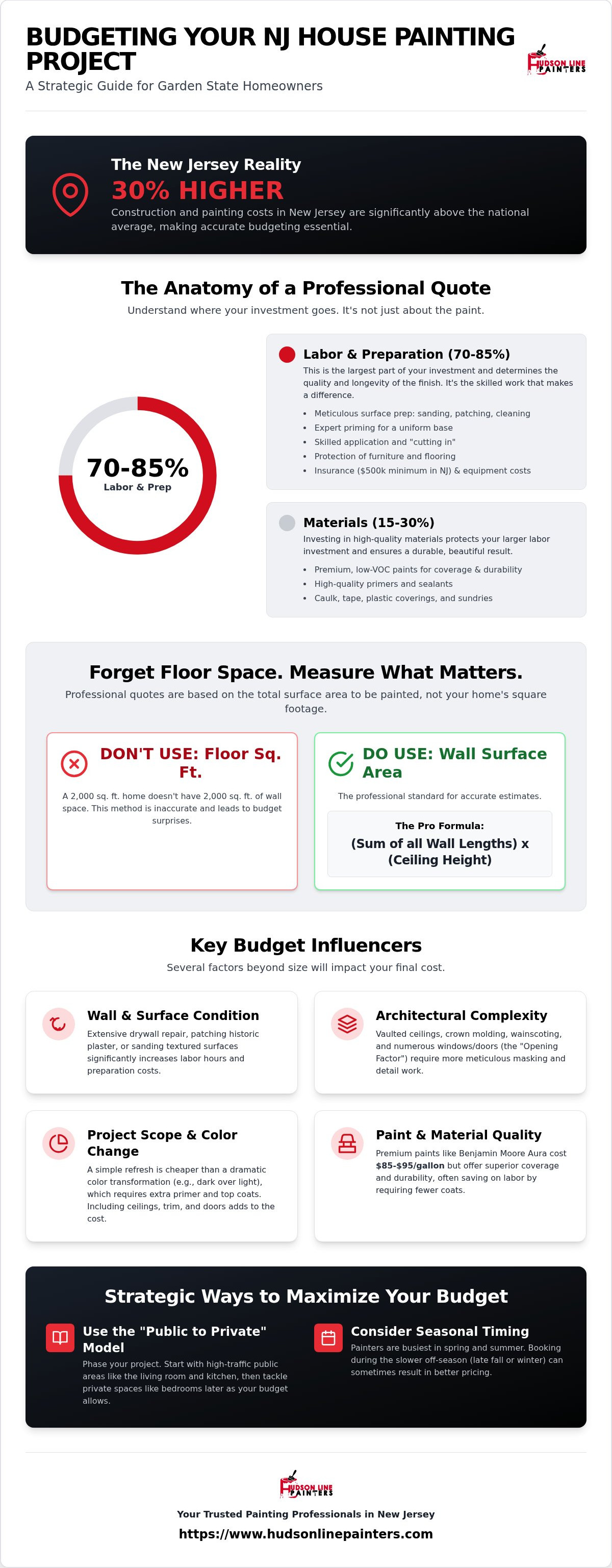
Understanding how to budget for a whole house painting project starts with a clear definition of scope. A "whole house" project rarely means just the walls. To create an accurate financial plan, you must decide if your budget includes ceilings, baseboards, window casings, doors, and the interiors of closets. In the high-demand Hudson and Bergen County corridor, construction costs are approximately 30% higher than the national average. This regional reality means your budget must be grounded in local market data rather than generic online calculators. Most homeowners find that labor and preparation dominate their investment, typically accounting for 70% to 85% of a professional quote. This "70/30 rule" exists because the longevity of your finish depends entirely on the hours spent sanding, patching, and priming before a single drop of color is applied.
Material costs have also shifted as we move through 2026. Premium, low-VOC and zero-VOC paints like Benjamin Moore Aura or Sherwin-Williams Emerald now retail between $85 and $95 per gallon. While these high-durability finishes represent a higher upfront cost, they provide superior coverage and washability, which often reduces the total volume of paint required for the job. When you account for the skilled labor rate in New Jersey, which averages approximately $70 per hour for experienced trades, it becomes clear that investing in high-quality materials is the most pragmatic way to protect your labor investment.
Labor vs. Materials: Breaking Down the Split
A professional house painter provides more than just manual labor; they provide risk mitigation and technical expertise. A professional quote includes the cost of general liability insurance, which is required to be at least $500,000 in New Jersey, and the specialized equipment needed for a flawless finish. For instance, if your project includes cabinet refinishing, the budget must account for high-volume, low-pressure (HVLP) sprayers and dust containment systems. These tools ensure a factory-like finish that traditional brushes cannot replicate. Remember that skilled labor is a fixed cost based on time; choosing "contractor grade" paint rarely saves money because inferior products often require additional coats, increasing the hours spent on the job.
Defining Your Project Scope Early
The complexity of your interior painting project heavily influences the final number. A simple "refresh," where you apply a single coat of the same color, is significantly more budget-friendly than a "transformation" involving a dramatic color change. Dark colors covering light walls, or vice versa, often require a dedicated primer coat and two top coats to ensure color depth and uniformity. Additionally, painting an empty home before you move in is more efficient for the crew. If the home is occupied, your budget should include time for the meticulous protection of your belongings. Professionals spend significant time installing heavy-duty floor coverings and moving furniture to ensure your environment remains pristine throughout the process.
Calculating the Math: Square Footage vs. Room Complexity
A common mistake when learning how to budget for a whole house painting project is relying on your home’s total floor square footage. If you have a 2,000 square foot home, that number describes the floor, not the surfaces a professional will actually touch. To get an accurate estimate, you must calculate the total wall surface area using the "Perimeter x Height" formula. For a standard room, you add the length of all four walls and multiply that total by the ceiling height. This provides the raw square footage that dictates the volume of paint required and the hours of labor needed. In the New Jersey market, where labor typically accounts for 70% to 85% of your quote, these dimensions are the primary driver of your total investment.
Complexity factors quickly shift these baseline numbers. Vaulted ceilings, intricate wainscoting, and crown molding require significantly more detail work and equipment than flat, standard walls. We also account for the "Opening Factor," which refers to the number of windows and doors in a room. While these openings technically reduce the amount of paint used, they increase the labor time due to the meticulous masking and "cutting in" required around the frames. Understanding these variables is essential when planning popular home upgrades that actually add value to your property.
Standard Room Benchmarks for 2026
Budgeting for a standard 12x12 bedroom involves a predictable amount of prep and paint. However, a great room with open-concept walls and high ceilings can double the labor requirements. Kitchens and bathrooms also demand a higher material budget because they require specialized, moisture-resistant paints designed to prevent mildew and withstand frequent cleaning. Don't overlook the impact of trim. Painting baseboards, window casings, and door frames can add up to 30% to your labor costs because of the precision required for these surfaces. If you're uncertain about your specific room dimensions, our team can provide a detailed on-site assessment to ensure every inch is accounted for.
The Ceiling and Closet Trap
Homeowners often forget to budget for the "fifth wall," or the ceiling. If your ceilings have water stains or require a color change, this adds another significant surface area to the project. Closets are another area where you can strategically manage costs; you might choose a full paint for a walk-in master closet but opt for a simple refresh in smaller linen closets to save funds. In the context of our local market, a Complexity Surcharge is a standard budget adjustment for the ornate trim and high-relief plaster details found in NJ’s historic Victorian and Colonial Revival architecture. By identifying these needs early, you avoid the "surprise" costs that often derail a renovation budget.
Factoring in Wall Condition and Specialty Services
Your "State of the Walls" assessment is the most significant variable when determining how to budget for a whole house painting project. In Northern New Jersey, where historic architecture is a hallmark of the landscape, walls rarely arrive in a "paint-ready" state. We often encounter settling cracks, deep gouges, or moisture damage that require professional intervention before the aesthetic work begins. Ignoring these structural imperfections results in a finish that fails prematurely, wasting your investment. Professional drywall and plaster repair is a mandatory budget line for NJ's older homes to ensure a seamless, durable surface.
Safety regulations also dictate specific financial considerations for homes built before 1978. According to the EPA’s Renovation, Repair, and Painting (RRP) Rule, any contractor disturbing more than six square feet of interior paint or twenty square feet of exterior paint in these older properties must be EPA-certified. This requirement ensures lead-safe work practices, including specialized containment and HEPA-filtered cleanup. While these safety measures add to the initial labor cost, they protect your family's health and ensure your project complies with New Jersey state law.
The Wallpaper Removal Variable
Stripping away the past can be an unpredictable process. The total wallpaper removal cost per room varies based on the adhesive type used and the number of layers present. If the original installer failed to prime the drywall properly, the removal process can damage the underlying surface. You should budget for skim coating, a technical process where a craftsman applies a thin layer of joint compound to restore the wall to a perfectly smooth state. Warning signs of high-labor removal include bubbling edges or wallpaper that was applied directly over unpainted drywall.
Light Carpentry and Exterior Prep
For exterior projects, your budget must extend beyond the brush. A comprehensive exterior painting service starts with professional power washing to remove oxidation, mildew, and pollutants. We frequently identify wood rot in soffits or window sills that requires light carpentry before painting. Addressing these repairs early prevents water infiltration and protects your home’s structural integrity. Additionally, factoring in fresh window glazing and high-grade caulking improves your home's energy efficiency, providing long-term financial benefits that far outweigh the upfront cost of the materials.
Strategic Budgeting: Phasing Your Project for Maximum Value
Managing a large-scale renovation often requires a phased approach to maintain healthy cash flow. If you're learning how to budget for a whole house painting project, we recommend the "Public to Private" model. This strategy prioritizes common areas like the kitchen, foyer, and living room before moving into private bedrooms and bathrooms. While splitting a project helps with immediate costs, bundling multiple rooms into a single contract is ultimately more cost-effective. You save on repetitive travel fees and the labor hours spent on "setup and teardown" that occur when a crew has to mobilize for several small visits over several years.
Timing your project can lead to significant savings. In the New Jersey market, scheduling interior work during the "off-season" months of January through March can often secure a 10-15% winter discount. This is a strategic way to maximize the ROI of residential painting without compromising on craftsmanship. By aligning your project with a contractor’s slower season, you gain the same high-end results while keeping more of your capital for other home improvements.
Request a customized phasing plan for your home
The High-Impact Phase: Kitchens and Entryways
Focusing your budget on the kitchen provides the highest aesthetic return. Specialized kitchen cabinet refinishing serves as the ultimate budget-saver; it transforms the space for a fraction of the cost of a full cabinet replacement. We also suggest prioritizing the entryway to ensure a perfect first impression for guests. Because NJ homes often feature unique structural quirks, we advise setting aside a 10-15% contingency fund. This buffer covers unexpected needs, such as minor light carpentry or specialized priming for stubborn stains, without derailing your financial plan.
The Efficiency of the 'Empty House' Budget
If you're painting a new home before moving in, you can expect noticeable savings on labor. A vacant property allows for a continuous, uninterrupted workflow that significantly maximizes contractor efficiency and reduces total billable hours. Without the need to move heavy furniture or meticulously wrap every household item, crews can move from room to room with steady momentum. This efficiency translates directly into a lower quote, as the risk of accidental damage is eliminated and the time spent on daily site protection is greatly reduced.
Choosing a Local NJ Contractor: Value vs. Bottom-Line Cost
When you analyze how to budget for a whole house painting project, the lowest number on the page is often the most expensive choice. In high-cost markets like Bergen and Hudson counties, a "bargain" quote usually signals a compromise in preparation or professional credentials. A contractor who skips the mandatory registration with the New Jersey Division of Consumer Affairs or lacks the state-mandated $500,000 in general liability insurance leaves you financially vulnerable. If an accident occurs on your property, a low-cost quote can quickly transform into a significant financial liability. True value lies in a craftsman who respects both your home and the legal requirements of the trade.
During the initial walkthrough, your questions should focus on technical precision rather than just the final price. Ask about the specific brands of paint they intend to use and the number of coats included in the scope. A professional, fixed-price quote should clearly account for the hours of meticulous sanding and priming required for a long-lasting finish. This transparency prevents the "surprise" change orders that often plague lower-end estimates. Additionally, a professional warranty provides a long-term budget safeguard. It ensures that the artisan stands behind their work, protecting you from the cost of premature failure or aesthetic defects.
Comparing Quotes: Apples to Apples
To evaluate estimates fairly, you must ensure every contractor is bidding on the exact same scope of work. Use this checklist to identify hidden gaps in a proposal:
- Paint Specifications: Are they using premium, high-durability finishes or a lower "contractor grade" product?
- Specific Surfaces: Does the quote include the "fifth wall" (ceilings), baseboards, and the interiors of closets?
- Repair Scope: Is minor drywall and plaster repair included, or will these be billed as extras later?
The most detailed quote is often your most accurate budgeting tool. It reflects a thorough understanding of your home’s unique architectural needs and the labor hours required to meet professional standards. When labor accounts for up to 85% of your investment, you want to ensure those hours are spent on quality execution.
The Hudson Line Painters Difference
Our approach is rooted in technical precision and absolute transparency. Our meticulous interior painting process is designed to prevent the costly re-dos that result from poor preparation. We believe that a successful project begins with an honest, upfront budget that accounts for every technical requirement of your New Jersey home. This disciplined methodology ensures that the final result adds genuine comfort and long-term value to your space.
Ready to start? Request a detailed estimate for your project and experience the peace of mind that comes with professional craftsmanship.
Secure Your Home’s Aesthetic Future
Mastering how to budget for a whole house painting project ensures that your property receives the technical care it requires without financial surprises. By focusing on the "70/30 rule" of labor and preparation, you're investing in a finish that withstands the unique environmental demands of the Hudson and Bergen County corridor. Whether you choose to phase your project or complete a full transformation before moving in, prioritizing professional credentials and detailed scope assessments will always protect your bottom line.
As a fully insured and licensed NJ contractor, we specialize in the meticulous restoration of historic homes across Hudson, Bergen, and Union Counties. Our procedural framework turns complex estimates into transparent roadmaps for our neighbors, ensuring every crack is repaired and every surface is primed for longevity. We view every project as a partnership rooted in technical precision and operational discipline.
Get a Transparent, Professional Quote for Your NJ Home
We look forward to partnering with you to bring lasting value and technical precision to your living space.
Frequently Asked Questions
How much does it cost to paint a 2,500 sq. ft. house interior in NJ?
Based on 2026 market data, painting a 2,500 square foot interior in New Jersey typically ranges between $7,500 and $17,500 depending on the project scope. This estimate generally covers walls, ceilings, and trim throughout the home. Factors such as ceiling height, the number of doors, and the complexity of the molding will influence the final figure. Labor remains the primary driver of this cost, especially in high-demand areas like Bergen County where construction costs are 30% above the national average.
Is it cheaper to buy the paint myself or let the contractor handle it?
It's almost always more cost-effective to let your contractor manage the paint procurement. Professional painters have access to significant trade discounts at major suppliers that aren't available to the general public. When we handle the materials, we also guarantee that the correct product is selected for each specific surface, from moisture-resistant bathroom finishes to high-durability hallway paints. This prevents expensive errors where the wrong base or finish leads to premature peeling or poor coverage.
How much should I budget for drywall repair before painting starts?
You should expect drywall and plaster repair to be a specific line item in your quote based on a thorough wall assessment. For historic NJ properties, this preparation is a mandatory step for achieving a seamless, professional finish. While minor patching is often included in standard preparation, extensive repairs for water damage or settling cracks will require additional labor hours. Investing in these repairs early prevents the need for costly structural corrections after the aesthetic work is complete.
Does the color of the paint affect the total budget for the project?
Yes, dramatic color changes or very deep pigments can increase both your material and labor expenses. Darker shades like navy or charcoal often require a specialized tinted primer and up to three coats of paint to achieve full saturation. When you're learning how to budget for a whole house painting project, keep in mind that staying within a similar color family can reduce the number of coats required. This efficiency lowers the total labor time and keeps your project within its initial financial roadmap.
How can I reduce the cost of a whole house painting project without losing quality?
The most effective strategy to reduce costs without sacrificing craftsmanship is to paint a vacant property before you move in. An empty house allows our crews to move with maximum efficiency since they don't have to spend hours protecting furniture or navigating around household items. You can also save money by bundling all your rooms into one comprehensive project. This approach eliminates the repetitive setup and mobilization fees that occur when you split the work into several smaller visits over a year.
Should I budget for two coats of paint or is one enough?
You should almost always budget for two coats of paint to ensure long-term durability and color accuracy. While some products claim one-coat coverage, they rarely provide the resilient barrier or depth of color needed for high-traffic New Jersey homes. A two-coat application results in a finish that is significantly easier to clean and resists fading over time. This methodology offers far better long-term value than a single-coat refresh that might require a complete re-do in just a few years.
What is a reasonable contingency fund for a whole house painting project?
We recommend maintaining a 10% to 15% contingency fund to account for unforeseen structural quirks or hidden repairs. In Northern New Jersey, it's common to discover multiple layers of old wallpaper or minor wood rot once the preparation phase begins. Having this financial buffer ensures that your project continues without delay if a craftsman identifies a technical issue that needs immediate attention. This disciplined approach to how to budget for a whole house painting project provides total peace of mind throughout the renovation.
How does the time of year affect my painting budget in New Jersey?
Scheduling an interior project during the winter months of January through March can often secure a 10% to 15% seasonal discount. This period is the traditional off-season for local contractors, making it the perfect time to access high-end services at a more competitive rate. If you're planning exterior work, remember that spring and summer are the peak months. Booking those projects well in advance helps you lock in current material prices and avoid the premium rates often associated with last-minute summer requests.


