

What if a weekend painting project could refresh your space without putting weekday operations on hold? For New Jersey businesses, hiring painting contractors who work weekends can limit disruption to staff, customers, tenants, and daily workflows. A short work window still needs to account for preparation, coating and drying time, cleanup, and a realistic reopening plan.
It’s reasonable to worry that compressing a project into a weekend could mean rushed preparation or an unreliable finish. The key is operational readiness, not simply having crews available for a few days. Hudson Line Painters plans commercial work around business operations, with trained employee painters, low-odor coatings, and detailed written scopes. Its owner-led crews do not cut corners. Hudson Line Painters is licensed and insured, carries comprehensive liability insurance, and is an EPA Lead-Safe Certified firm.
This guide explains how to assess a weekend schedule, coordinate your team and space before the crew arrives, and protect workmanship without overpromising a reopening date. You’ll also learn what a clear project scope should cover so you can plan with fewer surprises and keep your business moving.
Key Takeaways
- Learn how painting contractors who work weekends can help commercial projects avoid weekday interruptions while keeping preparation and quality in view.
- Map the project from walkthrough and written scope to building access, crew work, cleanup, and final inspection.
- Compare schedules by what they include, especially surface preparation, coating steps, crew accountability, and realistic timing.
- Prepare staff, tenants, furniture, signage, access details, and business-critical rooms before the crew arrives.
- See how Hudson Line Painters coordinates commercial night and weekend work with low-odor coatings and trained employee crews.
Why Hire Painting Contractors Who Work Weekends for a Commercial Project?
Painting during business hours can interrupt more than the work happening in a room. Staff may have to navigate equipment or wet surfaces, customers may encounter closed areas, tenants may lose access to shared spaces, and services may need to pause. For a commercial property, scheduling is part of the project plan, not an afterthought.
That’s why painting contractors who work weekends can be a practical fit for offices, retail spaces, multifamily properties, and industrial environments. A weekend window may let crews work when occupancy or customer traffic is lower, reducing interference with weekday operations. It doesn’t automatically mean every task will be complete by Monday. The scope, surface condition, access, and coating requirements all affect a realistic schedule.
Commercial painting also shapes how a business presents its spaces to employees, visitors, and customers. The broader field of commercial art includes visual work intended to serve business purposes, and a well-maintained finish can support a polished impression. Explore commercial painting services planned around the needs of an active property.
Which businesses benefit most from weekend painting?
Weekend scheduling is especially useful where weekday activity makes painting disruptive, but the right window depends on how each property operates. Offices may have fewer people on site; retailers may need clear customer routes; multifamily buildings must preserve tenant access; and industrial sites may need to work around production or shipping periods. Identify busy areas and operating hours before setting the work window.
For example, a retail project might focus on a back-of-house area first, while an office refresh could be phased by floor or department. In a multifamily property, common-area work needs to account for residents moving through hallways and entrances. Industrial environments may require coordination around equipment, deliveries, and restricted zones. The site’s use and the scope determine which spaces can be worked on together and which need separate phases.
Does weekend work automatically mean less downtime?
No. A weekend schedule can reduce weekday interference, but it doesn’t eliminate operational impact or guarantee a Monday reopening. Preparation, access arrangements, drying time, and the time needed to return furniture and equipment to the space all affect when an area can be used again. Define essential operations and reopening needs early, then include them in the project discussion.
Make the plan specific: identify rooms that must remain accessible, spaces that can be temporarily closed, building entry arrangements, and who can make decisions on site. Hudson Line Painters schedules commercial crews at night and on weekends and uses low-odor coatings for commercial work. Its owner-led crews are trained employees and do not cut corners. The company is licensed and insured, carries comprehensive liability insurance, and is an EPA Lead-Safe Certified firm. The agreed scope and site conditions guide the schedule, rather than an assumed finish-by-Monday promise.
How Weekend Commercial Painting Is Planned Around Your Operations
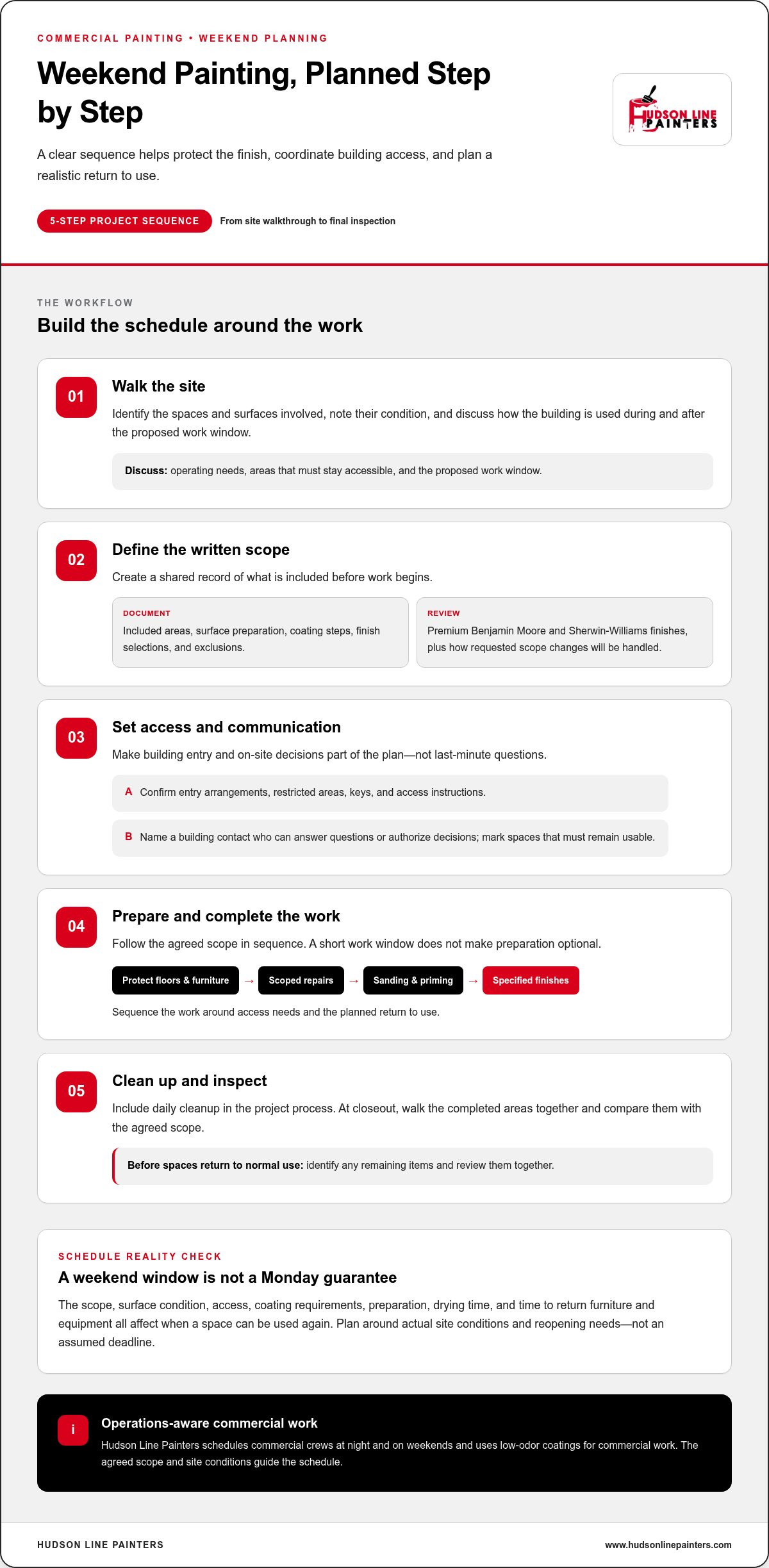
A controlled weekend project starts before the crew arrives. The walkthrough, written scope, access plan, and reopening requirements all shape what can realistically be completed. Painting contractors who work weekends still need time for preparation and coating steps. The goal is a clear sequence that protects the finish and your operations, not squeezing every task into an assumed deadline.
- Walk the site. Identify the spaces and surfaces involved, note their condition, and discuss how the building is used during and after the proposed work window.
- Define the written scope. Document included areas, surface preparation, coating steps, finish selections, and exclusions. Review premium Benjamin Moore and Sherwin-Williams finishes, and record how any requested scope changes will be handled.
- Set access and communication. Coordinate entry arrangements, restricted areas, keys or access instructions, and a building contact who can answer questions or authorize decisions. Mark spaces that must remain usable.
- Prepare and complete the work. Protect floors and furniture, then complete scoped repairs, sanding, and priming before applying the specified finishes. Sequence the work around access needs and the planned return to use.
- Clean up and inspect. Include daily cleanup in the project process. At closeout, walk the completed areas together, review the agreed scope, and identify any remaining items before spaces return to normal use.
What should be settled before the weekend begins?
Agree on which rooms, walls, trim, or other surfaces are included, and identify areas that must remain accessible. Confirm who will unlock the building, who can make site decisions, and how questions will be handled if the primary contact is unavailable. A written scope and approximate schedule create a shared reference point. Clearly defined reopening needs also help guide the work sequence without turning an estimate into a guaranteed finish date.
How do preparation and cleanup fit a compressed schedule?
A short work window doesn’t make sound preparation optional. The scope may include protecting floors and furniture, repairing wall damage, sanding, and priming. These steps support an even, well-prepared surface. Daily cleanup keeps the site orderly as work progresses, and a final walkthrough gives both sides a chance to review the finished areas. If spray painting is part of work in a marine-terminal setting, consult the relevant OSHA regulations for spray painting.
Dates and sequencing are estimates, not guarantees. Weather or unforeseen circumstances can affect the plan, and drying and reoccupation needs may influence when a space is ready. Hudson Line Painters uses owner-led, trained employee painters and detailed written scopes, and does not cut corners to force work into a narrow window. The firm is licensed and insured, carries comprehensive liability insurance, and is an EPA Lead-Safe Certified firm. For a commercial project plan tailored to your site, explore Hudson Line Painters’ commercial painting approach.
How to Compare Weekend Painting Contractors Without Sacrificing Quality
A short work window shouldn’t mean a shorter quality standard. When comparing painting contractors who work weekends, look beyond the proposed start and finish times. Review what each written proposal includes, especially surface preparation, materials, crew responsibility, cleanup, and schedule assumptions. Proposals may describe similar work windows but differ in the steps needed to deliver a lasting finish.
Written scope: Does it identify the rooms and surfaces, included work, and any exclusions?
Surface preparation: Does it describe the repairs, sanding, and priming included where needed?
Materials: Does it name the recommended finish and coating steps rather than relying on vague terms?
Crew accountability: Is responsibility clear, and is the crew trained and supervised?
Schedule and cleanup: Are dates described as estimates, with site cleanup included in the work plan?
Use this framework to compare the substance of proposals, not just their time slots. The Painting Contractors Association Industry Standards offer a reference point for professional expectations around painting work. A compressed schedule still needs to allow for the preparation and coating steps in the agreed scope. Skipping necessary work to meet an assumed reopening date can undermine the finish and create avoidable disruption later.
What should a commercial painting proposal spell out?
A useful proposal describes the work area, preparation, premium paint recommendations, approximate schedule, and flat-rate price for the agreed scope. Hudson Line Painters provides a detailed written proposal with a fixed price for that scope. If the scope changes after signing, additional work may require a change order. The proposal gives both sides a clear record of what’s included and how approved changes will be handled.
How can you assess workmanship and accountability?
Look for a clearly responsible crew, not simply an available work window. Hudson Line Painters uses owner-led, trained employee painters and does not cut corners to meet a weekend schedule. The firm is licensed and insured, carries comprehensive liability insurance, and is an EPA Lead-Safe Certified firm. A defined scope and accountable crew establish expectations before work begins.
Pay attention to closeout, too. Cleanup should be part of the plan, and the completed work should be reviewed against the agreed scope. Check whether the proposed sequence leaves room for preparation, application, and a final inspection. A realistic schedule is more useful than a fast promise that leaves no room for the work to be done properly.
For a commercial painting plan with a clear scope and defined responsibilities, learn about Hudson Line Painters.
Weekend Painting Project Checklist for New Jersey Business Owners
A little preparation from your team can make a weekend painting project easier to manage, especially in an occupied building. Before crews arrive, settle how they’ll enter, which spaces need protection, and what staff or tenants should expect. Hudson Line Painters serves businesses in Hudson County NJ, Union County NJ, Bergen County NJ, Hoboken NJ, Edgewater NJ, Fort Lee NJ, Teaneck NJ, Hackensack NJ, Englewood NJ, Cliffside Park NJ, Leonia NJ, Palisades Park NJ, and Ridgefield NJ.
What should your team prepare before the crew arrives?
Use this checklist alongside the written project scope. Decide who handles each task, and share relevant instructions with building contacts before the scheduled work window.
- Access and security: Provide agreed entry instructions, explain relevant security procedures, and name an on-site contact who can respond to questions.
- Furniture and belongings: Move or secure items as outlined in the scope. Clarify which furniture the crew will protect and which items your team must relocate.
- Signs and pathways: Plan notices for entrances, hallways, and work zones so staff, tenants, and visitors can identify restricted routes.
- Restricted areas: Mark rooms or equipment zones that must remain inaccessible, and agree on how crews will work around them.
- People and operations: Tell staff or tenants which spaces may be unavailable, when access changes, and who to contact with site questions.
- Business-critical rooms: Identify spaces essential to daily operations, such as reception, a customer service area, or a designated workroom, and agree on how they’ll be handled in the sequence.
Low-odor coatings can support commercial painting plans where a business is sensitive to disruption, but low-odor doesn’t mean odor-free. Discuss how the spaces will be used during and after painting, and include practical access and reoccupation needs in the project plan. Hudson Line Painters uses low-odor coatings for commercial work.
What should happen before the business reopens?
Set a clear handoff process, not just a target reopening time. Arrange a final walkthrough to review the completed areas against the written scope and note any concerns. Reopening depends on project-specific conditions, including the work completed and coating readiness. Don’t treat a weekend schedule as an automatic promise that every space will be ready by a fixed deadline.
Agree on who will attend the walkthrough, which rooms will be reviewed, and how any follow-up items will be recorded. Keep staff or tenant messaging aligned with the actual handoff plan, particularly if a business-critical room needs a later return to use. A realistic plan helps avoid reopening based on assumption rather than a review of the site.
For businesses planning around occupancy and access, Hudson Line Painters offers night and weekend scheduling for commercial painting projects.
What Hudson Line Painters Offers for Weekend Commercial Painting
Hudson Line Painters provides night and weekend crews for commercial projects, helping businesses schedule painting around their operations. Commercial scheduling includes zero-downtime scheduling, with low-odor coatings available for commercial work. Low-odor does not mean odor-free, so the proposed work areas and their use remain part of the planning conversation.
Projects use trained employee painters and premium Benjamin Moore and Sherwin-Williams finishes. Crews are owner-led, and Hudson Line Painters does not cut corners to meet a weekend schedule. The work window is planned around the agreed scope and preparation needs, rather than treated as a promise that every project will be finished by a particular reopening time.
What does the written proposal and project process include?
A free on-site estimate gives the team an opportunity to review the space and discuss the work. The detailed written proposal sets out the scope, paint recommendations, approximate timeline, and flat-rate price for the agreed work. Dates are estimates and may change because of weather or unforeseen circumstances. If the scope changes after approval, additional work may require a change order.
The project process includes preparation and professional application as specified in the scope, daily cleanup, and a final walkthrough. Hudson Line Painters is licensed and insured, carries comprehensive liability insurance, and is an EPA Lead-Safe Certified firm. Clear documentation and accountable crews give business owners a defined plan for coordinating work with staff, tenants, or building operations.
How can a business take the next step?
Start with a free on-site estimate. A walkthrough helps establish the areas to be painted, the preparation required, finish recommendations, access considerations, and approximate schedule. Hudson Line Painters then provides a written proposal with a fixed flat-rate price for the agreed work, so you can review what’s included before moving forward.
Businesses can also consider the company’s local track record: Hudson Line Painters has a 5.0 ★ from 83 verified Google reviews. Its commercial painting crews serve Northern New Jersey, with night and weekend scheduling available for commercial projects. If the project involves an occupied office, retail space, or shared property, bring your access and reopening priorities to the walkthrough. A practical plan begins with those details.
The workmanship warranty is 1 year and covers peeling, blistering, and chipping caused by defective workmanship. Report workmanship issues within 14 days of project completion.
Set Your Commercial Project in Motion
Your next step is to turn business priorities into a practical painting plan. Before requesting an estimate, decide which spaces matter most, when they need to be accessible, and what your team needs to keep operating. That gives the project conversation a useful starting point and helps shape a schedule around your property.
Hudson Line Painters provides night and weekend crews for commercial projects, with low-odor coatings and scheduling designed around business operations. The company’s 1-year workmanship warranty covers peeling, blistering, and chipping caused by defective workmanship. Report related issues within 14 days of project completion. The written scope and site-specific estimate establish the project plan.
If you’re considering painting contractors who work weekends, focus on a schedule that respects your operations without compromising the work. A clear starting plan can make the next step manageable.
With the right plan in place, you can move toward a refreshed space with confidence.
Frequently Asked Questions
Do painting contractors work weekends for commercial projects?
Yes. Hudson Line Painters schedules night and weekend crews for commercial painting projects, so businesses can plan work around normal operating hours. This service is for commercial properties, not a blanket statement about residential weekend scheduling. If you’re considering painting contractors who work weekends, identify which areas need attention and how your business uses them. That information helps shape a practical project plan from the outset.
Can a business stay open while painting contractors work on weekends?
Sometimes, depending on the work area, access needs, and project scope. For example, a business may be able to keep one entrance or department in use while another area is being painted, if the site plan allows it. Tell the painting team which operations must continue, including customer access, deliveries, or tenant movement. The agreed sequence should address how people can use the building while work is underway.
How do you prepare a commercial space for weekend painting?
Start by sharing building-entry instructions, security procedures, and the name of the person available to answer site questions. Notify staff or tenants about affected spaces, then move or secure belongings as agreed in the scope. For example, clear desks in a designated office area and post notices near rooms that will be closed. Before the project, identify equipment or furnishings that should remain untouched so the crew can plan around them.
Will weekend painting contractors finish the project by Monday?
Not necessarily. A weekend work window is a scheduling choice, not a promise that every project will be complete and ready for use by Monday. The scope, surface condition, preparation, coating requirements, and site conditions all affect the schedule. Hudson Line Painters provides an approximate timeline, but dates can change because of weather or unforeseen circumstances. Build flexibility into your reopening plan, especially for rooms essential to daily operations.
Do low-odor coatings mean there will be no odor during painting?
No. Low-odor coatings are used for commercial work, but low-odor doesn’t mean odor-free. How the space is used and which areas are painted are useful details to include in planning. If employees or visitors are particularly sensitive to odors, share that concern during the site discussion and plan how the work area will be managed. Don’t assume a low-odor product means a room can be occupied immediately after painting.
How can I get a quote for weekend commercial painting in Northern New Jersey?
Request a free on-site estimate from Hudson Line Painters. During the walkthrough, identify the spaces, surfaces, access needs, and any work that could affect business operations. The company then provides a written proposal with the agreed scope, paint recommendations, approximate timeline, and flat-rate price for that scope. Hudson Line Painters serves commercial clients in Northern New Jersey, including Bergen, Hudson, and Union counties.


