

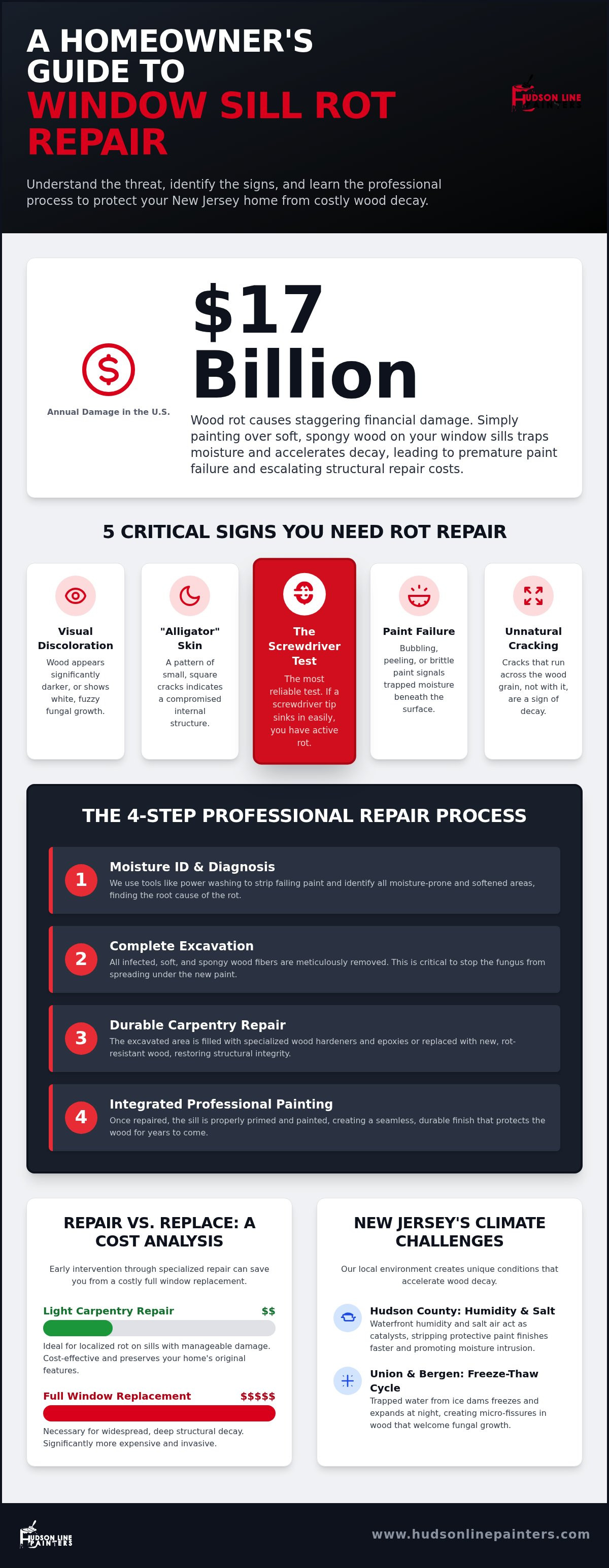
Wood rot and other decay-causing organisms cause an estimated $17 billion in damage annually across the United States, and in the humid climates of Hudson, Union, and Bergen Counties, your window sills are the front line of defense. Many homeowners assume a fresh coat of paint will hide those soft, spongy spots, but skipping professional window sill rot repair before painting is a recipe for premature peeling and escalating structural costs. You deserve a home that isn't just beautiful on the surface but is also structurally sound and protected against the elements.
It's natural to feel frustrated when high-end paint fails after only one season or to feel confused by the difference between localized wet rot and more serious decay. We understand that you want a clear, honest assessment of whether a sill can be saved through meticulous light carpentry or if it requires a full replacement. In this guide, you'll discover how to identify various stages of rot, the precise methods for durable restoration, and the long-term prevention strategies tailored for New Jersey's specific climate zones. We will provide the clear criteria you need to make smart financial decisions for your property. By the end, you'll have a roadmap for a flawless exterior finish that stands the test of time.
Key Takeaways
- Learn how to perform the "Screwdriver Test" to differentiate between surface-level discoloration and deep fungal decay that threatens your home's structural integrity.
- Understand the financial benefits of choosing specialized light carpentry repairs over expensive full-window replacements for sills with manageable levels of damage.
- Discover why professional window sill rot repair before painting requires a sequential process of moisture identification and complete excavation of infected wood fibers.
- Explore how integrated carpentry and painting services provide a single point of accountability and prevent the common issue of paint peeling after just one season.
- Gain insights into the specific moisture challenges facing homes in Hudson, Union, and Bergen Counties and how to implement long-term prevention strategies.
Understanding Wood Rot in New Jersey Homes
Wood rot isn't just a cosmetic blemish; it's a living biological invasion. Specifically, it's a Wood-decay fungus that digests the structural components of your home's exterior trim. This fungus requires a specific recipe to thrive: consistent moisture, trapped oxygen, and mild temperatures. In New Jersey, our homes provide these conditions in abundance, especially in the shaded or moisture-prone areas around your windows.
NJ homeowners typically encounter two types of rot. Wet rot is common on horizontal surfaces like decks and the flat tops of window sills where water pools after a storm. Dry rot, though less common, is far more insidious. It can travel through masonry and dry wood, effectively "mining" for moisture. Prioritizing window sill rot repair before painting is the only way to stop this cycle. If you simply apply a fresh coat of paint over soft wood, you're essentially sealing in the moisture and providing a dark, protected environment for the fungus to feast. This "masking" approach actually accelerates the decay, leading to more expensive structural repairs within a single season.
The Science of Decay: Why Rot Spreads
Fungal spores are omnipresent in the NJ air. They only need a moisture content of roughly 20 percent to begin their work. Once established, the rot doesn't stay confined to the surface. It travels along the wood grain, often moving from the visible window sill into the hidden structural sheathing or even the wall studs. This is why quick fixes often fail. Common NJ building materials like Pine are particularly vulnerable because they lack natural rot-resistant oils. While Cedar offers better protection, it still requires professional maintenance to withstand our local environment. Without a technical approach to excavation, the fungus remains dormant under the paint, waiting for the next rain cycle to resume its growth.
New Jersey’s Climate and Your Exterior
Our local geography presents unique challenges. In Hudson County, the waterfront humidity and salt air act as a catalyst for wood breakdown, stripping away protective finishes faster than in inland areas. Conversely, Bergen and Union County homes often face the "freeze-thaw" cycle. Winter ice dams trap water against the fascia and sills, forcing moisture deep into the wood fibers during the day, which then expands as it freezes at night. This process creates micro-fissures that welcome fungal growth. Utilizing professional power washing is a vital diagnostic tool in our process. It strips away failing paint and debris, allowing us to spot softened wood early. Performing a thorough window sill rot repair before painting ensures that your investment in a new exterior finish isn't wasted on a decaying foundation.
5 Signs You Need Carpentry Repairs for Wood Rot
Identifying decay early saves thousands in replacement costs. While we previously covered the biology of fungus, you need a practical way to diagnose your home's exterior. Start with visual cues. Wood that looks significantly darker than the surrounding trim or displays white, fuzzy growth is likely infected. If you see "alligatoring", which is a pattern of small, square cracks resembling reptile skin, the wood's internal structure is already compromised. This phenomenon is deeply rooted in the science of wood decay, where fungi consume the cellulose and lignin that give timber its strength.
The most reliable diagnostic tool at your disposal is the screwdriver test. Gently press a flathead screwdriver into any suspicious area. Sound wood is dense and resistant; it should feel like pressing into a hard plastic. If the tool sinks in easily or the wood feels spongy and soft, you have found active rot. This is a critical step in window sill rot repair before painting because applying a premium finish over these soft spots is a waste of resources. The paint will fail almost immediately as the underlying wood continues to crumble.
Don't ignore paint failure as a mere aesthetic issue. Bubbling, peeling, or brittle paint often indicates that moisture is trapped within the wood fibers. When water cannot escape, it creates pressure that pushes the paint film away from the surface. If you notice these signs, or if the wood displays cracking across the grain rather than with it, your home needs professional attention. Catching these texture changes early allows for a more localized repair rather than a full unit replacement.
High-Risk Zones: Where to Look First
Focus your inspection on areas where water naturally collects or transitions. Window and door frames are the most common culprits, as horizontal sills allow rain and melting snow to pool. In Bergen and Union Counties, check your fascia and soffits frequently. These are the front lines of your roof drainage system and are the first to suffer from clogged gutters. If you have a low-lying deck, inspect the joists for signs of decay caused by direct contact with ground moisture or trapped organic debris.
Surface Damage vs. Structural Rot
It's vital to distinguish between cosmetic trim damage and structural decay. If the rot is limited to the exterior trim or the window sill itself, our light carpentry services can typically restore the area to a like-new condition. However, if the decay has reached the wall studs or internal framing, a general contractor may be required for major renovations. If you've noticed interior issues, such as fixing water stains on ceilings, the moisture may have already bypassed your exterior defenses. For a professional assessment of your home's exterior integrity, reach out to our expert team to ensure your restoration is handled with technical precision.
Repairing vs. Replacing: A Cost-Benefit Analysis
Choosing between a restoration and a total replacement is a pivotal financial decision for any homeowner. While some contractors might suggest a full window unit replacement at the first sign of soft wood, a technical approach to window sill rot repair before painting often provides a more pragmatic and cost-effective path. High-performance structural epoxies and wood fillers can effectively stabilize localized decay, returning the sill to its original density without the disruption of a major renovation.
A "Dutchman" repair, where a craftsman removes a section of damaged wood and replaces it with a new, perfectly fitted piece of timber, serves as a middle ground. This method is significantly less expensive than a full window replacement, which in New Jersey can often cost double or triple the price of a localized repair when labor and interior trim work are included. By addressing the foundation of the trim early, you prevent the decay from migrating into the wall framing, where repair costs escalate into the thousands. We follow the "30 Percent Rule": if the damage covers less than a third of the sill, a professional repair is almost always the smarter investment.
When to Choose Carpentry Repair
Restoration is often the superior choice for historic homes in Bergen and Union Counties. These properties often feature unique, oversized moldings and old-growth timber that are difficult to replicate with modern off-the-shelf products. We utilize high-performance wood consolidants to penetrate and harden soft fibers, effectively fossilizing the wood before applying a final filler. This ensures the window sill rot repair before painting creates a surface that is as durable as the original wood. It preserves the home's architectural character while providing a safe and guaranteed transformation.
When Full Replacement is the Smart Choice
Safety and financial logic eventually dictate a point of no return. If the rot has compromised load-bearing elements like structural headers or corner posts, safety must take priority over restoration. Additionally, if the decay has spread through the majority of the window unit, the labor hours required for a meticulous repair may start to rival the cost of a new installation. In these cases, upgrading to rot-resistant materials like AZEK or other high-quality PVC boards is the most disciplined long-term strategy for NJ's humid climate. These synthetic materials offer a permanent solution that eliminates the risk of future fungal growth. If you are unsure which path is right for your home, our team can provide a clear assessment during an exterior painting consultation.
The Professional Process: How We Fix Wood Rot
Performing a meticulous window sill rot repair before painting is a multi-step operation that ensures the longevity of your home's exterior. It isn't enough to simply fill a hole and move on; we follow a sequential framework designed to eliminate the biological cause of decay. Our process begins with moisture identification. We investigate the source of the water intrusion, whether it's a failed window seal, a clogged gutter, or a lack of proper flashing. Fixing the wood without addressing the leak is a temporary measure that sets the stage for future failure.
Once we secure the environment, we move to excavation. We remove all soft, infected wood fibers using specialized tools. We don't stop at the surface; we continue until we reach clean, solid wood. Following excavation, we apply borate-based fungicides to the cavity. This treatment kills dormant spores and prevents the fungus from returning. For reconstruction, we utilize structural epoxies or custom-cut Dutchman patches to rebuild the sill's profile. Finally, we sand the surface to a seamless finish and apply a high-grade primer to prepare the wood for its final coat.
Specialized Tools and Materials
We often see homeowners attempt repairs with automotive fillers like Bondo. While these products are excellent for metal, they are not a permanent solution for exterior wood rot. Wood is a dynamic material that expands and contracts with NJ's temperature swings. Automotive fillers are too rigid; they eventually crack and pull away from the wood, creating new channels for moisture. We use high-grade structural epoxies specifically engineered for timber. These materials bond at a molecular level and move with the wood. We also utilize stainless steel fasteners to prevent rust bleeding, ensuring the repair remains invisible even years after the project is complete.
Request a professional window sill assessment today
Preparing for the Finish Coat
The final stage of the repair is just as critical as the excavation. We respect "dry time" as a non-negotiable requirement for paint adhesion. If we apply primer too quickly over a patch that hasn't fully cured, the gases released during the curing process will cause the paint to bubble. We also emphasize the importance of back-priming. This involves sealing every side of a new wood patch before it's installed. This creates a 360-degree moisture barrier that protects the wood from the inside out. Once the repair is stabilized and primed, your home is ready for our professional exterior painting services, resulting in a flawless finish that adds genuine value to your space.
Protecting Your NJ Home with Integrated Painting and Carpentry
Hiring separate contractors for wood repairs and finishing often leads to a cycle of blame when issues arise. By choosing a team that handles both light carpentry and residential painting, you ensure a single point of accountability for the entire project. This integrated approach is especially vital for window sill rot repair before painting because the quality of the carpentry dictates the durability of the final aesthetic. When the person swinging the hammer is also the one holding the brush, they have a personal stake in ensuring the repair is perfectly flush and painter-friendly.
We stand by the "Hudson Line Guarantee," a commitment to technical precision that ensures every surface is structurally sound before a single drop of paint is applied. This discipline protects your home from the common pitfall of paint failing after only one season. By merging these two trades, we provide a seamless transition from excavation to the final finish coat, giving you peace of mind that the underlying decay has been fully eradicated rather than just hidden.
The Financial Advantage of Single-Source Contracting
Working with a single team streamlines your project timeline and eliminates the weeks of waiting that usually occur between a carpenter finishing their work and a painter starting theirs. This efficiency reduces the exposure of raw, repaired wood to NJ’s unpredictable weather. From a financial perspective, single-source contracting prevents the "finger-pointing" that happens when separate crews disagree on surface preparation. Our craftsmen are trained in both disciplines, ensuring that carpentry repairs are performed with the final paint film in mind, resulting in a "never-there" look that preserves your home's curb appeal.
Long-Term Prevention Strategies
Maintenance shouldn't stop once the paint is dry. To protect your investment, we recommend improving ventilation in soffits and crawlspaces to reduce the ambient humidity that fuels fungal growth. High-quality elastomeric caulks are essential for sealing the joints where different materials meet, such as where the window casing hits the siding. These flexible sealants accommodate the natural expansion of wood during our humid summers and contraction during freezing winters. Additionally, professional deck & fence staining acts as a sacrificial barrier, repelling water before it can penetrate the wood grain. We suggest scheduling an annual "rot check" to inspect high-risk areas, ensuring that minor moisture issues don't escalate into a need for another window sill rot repair before painting in the future.
Securing Your Home’s Structural Future
NJ homeowners in Hudson, Bergen, and Union Counties face unique moisture challenges that demand more than a cosmetic fix. Addressing window sill rot repair before painting is the only way to ensure your restoration project survives the next humid summer or freezing winter. You've learned that identifying decay early through the screwdriver test and choosing professional epoxies over temporary fillers can save thousands in structural costs. By choosing a team that merges meticulous light carpentry with premium painting, you protect your property's value and its historic charm.
A sound home exterior starts with technical precision and ends with a flawless, durable finish. We are proud to provide the integrated expertise and reliability your home deserves. Our commitment to site etiquette and operational discipline ensures your property is treated with the utmost respect throughout the entire transformation process. Investing in proper restoration today means enjoying a beautiful, maintenance-free exterior for years to come.
Frequently Asked Questions
Can I just use wood filler on rotten window sills?
Using standard wood filler on active rot is a mistake that leads to recurring issues. You must first remove all softened fibers and treat the cavity with a fungicide. For a lasting window sill rot repair before painting, we use high-performance structural epoxies that bond with the clean wood. This creates a moisture-resistant foundation that won't crack or shrink as the seasons change in Hudson County.
How much do carpentry repairs for wood rot typically cost in NJ?
The cost of carpentry repairs varies based on the extent of the decay and the complexity of the trim profile. Generally, localized light carpentry is a smart financial alternative to the high expense of replacing an entire window unit. By addressing the rot during the preparation phase of your exterior painting project, you avoid the escalating costs associated with deep structural damage to your home's framing.
How do I know if wood rot is structural or just cosmetic?
Cosmetic rot is typically limited to the exterior trim or the window sill itself. You can identify this by probing the wood with a screwdriver; if the softness is shallow and the underlying framing feels solid, it's a candidate for light carpentry. If the decay has reached the load-bearing studs or headers, it is a structural issue that requires a general contractor rather than a restoration specialist.
Can wood rot spread to other parts of my house?
Wood rot is a fungal infection that can absolutely spread to other parts of your NJ home. Fungi thrive on moisture and will migrate from a window sill into the wall sheathing and internal framing if left unchecked. This is why we prioritize thorough excavation. Removing the source of the infection is the only way to protect the overall integrity of your property in humid areas like Edgewater or Hoboken.
Is it better to use real wood or PVC for trim replacements?
The choice between real wood and PVC depends on your home’s architectural needs. PVC products like AZEK are excellent for New Jersey's freeze-thaw cycles because they are entirely rot-resistant and hold paint well. However, for historic homes in Bergen County, we often use rot-resistant wood species like Cedar to maintain authentic profiles. Both options provide a durable foundation when integrated with professional painting techniques.
Will my homeowners insurance cover wood rot repair?
Most homeowners insurance policies don't cover wood rot repair because it's classified as a preventable maintenance issue. Insurance typically covers sudden and accidental damage, such as a burst pipe, rather than the gradual decay caused by long-term moisture exposure. Investing in regular inspections and timely window sill rot repair before painting is the best way to avoid large, out-of-pocket expenses for structural failures.
What is the best time of year in NJ to perform wood rot repairs?
The ideal time for these repairs in New Jersey is during the dry windows of late spring, summer, or early fall. Proper epoxy curing and paint adhesion require consistent temperatures and low humidity. Performing these restorations before the heavy rains of autumn or the ice dams of winter ensures that your home’s envelope is sealed and protected against the most punishing local weather cycles, ensuring the longevity of your window sill rot repair before painting.
How long does a professional wood rot repair last?
A professional repair can last as long as the window itself if the underlying moisture source is eliminated. By using structural epoxies, stainless steel fasteners, and back-priming techniques, we create a restoration that is often more durable than the original wood. Regular maintenance, such as checking the caulking and refreshing the paint every few years, will ensure your sills remain sound for decades.


