

What if the most expensive part of your next home improvement project isn't the premium gallon of paint you just bought, but the few hours of prep work you decided to skip? Many New Jersey homeowners find themselves in this exact position, watching a weekend of hard work vanish as our local humidity causes fresh coats to bubble or peel. It is frustrating to invest time and money only to end up with a finish that looks amateur or fails to protect your historic plaster walls. We understand that you want a home that reflects your high standards and meticulous care.
In this guide, you'll discover the common house painting mistakes to avoid so you can achieve professional-grade results that actually increase your property value. We believe a great transformation starts with technical precision and a deep respect for the environment of your home. We're going to walk you through the essential steps of professional preparation, explain how to choose the right primers for the NJ climate, and help you sidestep the hidden costs of DIY errors. By the end of this article, you'll have the roadmap needed for a durable, flawless finish that stands the test of time.
Key Takeaways
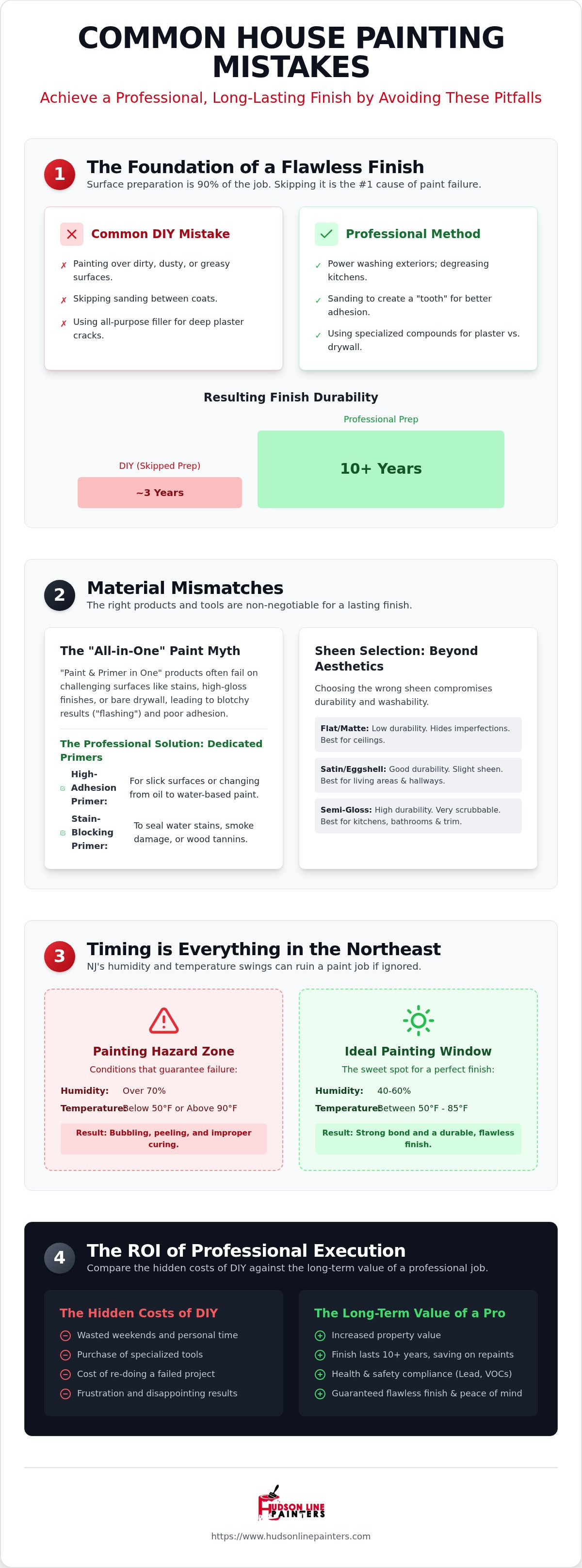
- Learn why professional surface preparation, including drywall and plaster repair, is the foundation of a finish that lasts ten years instead of three.
- Understand the technical reasons why "all-in-one" paint products often fail and how to select the right primer for historic New Jersey homes.
- Discover the specific environmental window for painting in the Northeast to prevent humidity and temperature swings from ruining your exterior.
- Identify the common house painting mistakes to avoid during application, such as over-working the paint or leaving lap marks on large walls.
- Compare the long-term ROI of professional execution against the hidden costs of DIY projects, including specialized tools and wasted weekends.
The Invisible Errors: Surface Preparation Failures
A professional house painter and decorator understands that a flawless finish is only as good as the surface beneath it. One of the most common house painting mistakes to avoid is treating your walls like a clean slate without verifying their actual condition. Dust, skin oils, and microscopic debris act as a release agent. These contaminants prevent the paint from forming a permanent bond, which eventually leads to large flakes of paint shearing off the wall. We see this often in homes where the "invisible" work was rushed to get to the color application faster.
Skipping the sanding process between coats is another frequent error that ruins an otherwise high-end project. Sanding creates a mechanical "tooth" that allows the next layer of paint to grip the previous one. Without this step, the finish might look acceptable on day one, but it won't have the durability to survive the daily wear of a busy New Jersey household. For exterior projects, professional power washing is essential. Our local climate brings salt air and high humidity that deposit layers of pollen and mildew on siding. Painting over these layers ensures the paint will bubble and fail within a single season.
The Grease Trap: Why Kitchen Cabinets Fail
Many homeowners attempt a DIY update using standard dish soap or household sprays, but these products aren't strong enough to strip deep-seated cooking oils. In professional kitchen cabinet refinishing, we utilize industrial de-glossers to break down the existing factory finish and provide a clean substrate. Oil-based residues from cooking create a slick, non-porous surface that prevents modern water-borne finishes from forming a chemical bond. If you skip this specialized cleaning, the paint will likely chip around the handles and edges of your doors within months of completion.
Drywall vs. Plaster: Different Preps for Different Eras
Hudson County is famous for its historic brownstones, yet these homes often feature traditional plaster walls that require a different approach than modern drywall. A frequent mistake is using standard "all-purpose" joint compound to fill deep cracks in old plaster. Plaster is far more rigid and moves differently than drywall as the house settles. Using the wrong material leads to recurring cracks that reappear shortly after the paint dries. You can find more detail on managing these surfaces in our guide to expert drywall and plaster repair. Taking the time to use setting-type compounds or specialized plaster washers ensures your historic home's character remains intact and your walls stay seamless for years.
Material Mismatches: Choosing the Wrong Paint and Tools
Many big-box retailers promote "all-in-one" paint and primer products as a universal solution for every project. Relying on these for surfaces with existing stains, high-gloss finishes, or fresh drywall is one of the most common house painting mistakes to avoid. A dedicated high-adhesion primer is mandatory when you're transitioning from oil-based to water-borne coatings or sealing porous materials. Skipping this specialized layer often leads to "flashing," where the final finish appears blotchy and uneven. Cheap tools yield cheap results.
Don't ignore Volatile Organic Compounds (VOCs) when selecting your materials. Modern 2026 coatings offer low-VOC and zero-VOC options that protect your indoor air quality without sacrificing the durability of the finish. If you live in an older New Jersey home built before 1978, safety is even more critical. You must always Protect Your Family from Lead by testing surfaces before you begin any sanding or scraping. Professional-grade materials ensure your home remains a healthy environment for your family.
Sheen Selection: Beyond Just Aesthetics
Choosing the wrong sheen can quickly compromise the longevity of your interior painting project. Flat paint in a bathroom is a recipe for disaster. It absorbs moisture, which leads to unsightly water stains and mildew growth. For active Bergen County households, we suggest satin or semi-gloss finishes for high-traffic hallways and kitchens. These options provide the scrub resistance needed to handle daily wear. Keep in mind that higher sheens reflect more light. This makes wall imperfections like small bumps or poor drywall patches far more visible to the eye.
The Professional Tool Kit
The difference between an amateur "DIY look" and a professional finish often comes down to the quality of your applicators. Roller nap size is vital for a uniform texture. A 3/8-inch nap is the standard for smooth walls, while a 3/4-inch nap is required for masonry or heavily textured surfaces. High-quality synthetic bristles prevent brush marks in 2026 coatings by holding the correct amount of material and releasing it smoothly across the surface. Professional-grade painter's tape is another essential investment. It delivers the sharp, clean lines that define a craftsman's work while preventing the "bleeding" common with budget masking tapes.
NJ Climate Factors: Timing and Environmental Blunders
Living in Northern New Jersey means contending with a climate that is often at odds with the chemical requirements of modern coatings. One of the most common house painting mistakes to avoid is ignoring the local atmospheric conditions during the application phase. While it's tempting to rush a project during a sunny weekend, the air's moisture content and the temperature of the substrate determine whether your paint will cure or fail. We prioritize environmental monitoring to ensure every project withstands the unique pressures of the Northeast.
Humidity and Peeling Paint
In coastal or riverside areas like Hoboken, humidity levels frequently exceed 70%. High humidity prevents the water in latex paint from evaporating at the correct rate, which compromises the film-forming process. When you apply paint in these conditions, you risk the "blistering" effect. This happens when moisture becomes trapped behind the drying paint layer, eventually forcing the coating away from the wall as it tries to escape. For those focusing on outdoor wood surfaces, we recommend reading our guide on how to prevent deck stain from peeling to understand how moisture testing prevents premature failure.
Exterior Timing Secrets
Timing is everything for a successful exterior painting project. Many homeowners make the mistake of starting too early in the morning when dew is still present on the siding. We follow the "Dew Point" rule; the surface temperature must be at least five degrees above the dew point to ensure a dry substrate. Modern 2026 latex and acrylic resins are engineered for specific temperature ranges, typically between 50 and 90 degrees Fahrenheit. If the temperature swings too wildly during the first 24 hours of curing, the paint can become brittle or lose its sheen.
Before beginning any staining or painting project, testing the moisture content of the wood is non-negotiable. We use professional moisture meters to verify that the wood is below 15% moisture. If the wood is too damp, the coating cannot penetrate the fibers, leading to a surface film that will crack and flake within months. We always look for a 48-hour clear weather window. This provides enough time for the surface to dry before application and for the coating to set before the next rainstorm hits the Garden State.
Application Errors: Technique Flaws That Show
Applying paint might seem straightforward, but the physical technique used determines whether you achieve a high-end finish or a project that looks unfinished. One of the most common house painting mistakes to avoid is over-working the paint as it dries. Modern 2026 coatings are designed with specific self-leveling resins that allow the paint to flatten out on its own. When you continue to brush or roll over an area that has already started to set, you disrupt this process. This leads to a gritty, uneven texture that no amount of additional paint can hide. Meticulous care during the application phase prevents the need for expensive corrections later.
Mastering the Wet Edge
A "wet edge" is the technical standard for professional results. It refers to the practice of always overlapping your next stroke into paint that is still wet. If you allow the edge to dry, you create "lap marks," which appear as dark, vertical seams where the two layers overlap. This is particularly difficult during large-scale interior painting in open-concept NJ homes where walls can span thirty feet or more. To maintain consistency, we recommend sectioning off large areas and working from the top down. For these expansive spaces, professional spraying is often the superior choice. It provides a perfectly uniform coat that rollers simply cannot match on a massive scale.
The Drip and Run Check
Inconsistent coating thickness is a subtle flaw that only shows up once the paint fully cures. If you load the roller or brush too heavily, gravity will pull the excess paint down into "runs" or "sags." These typically hide in corners, along baseboards, and around outlet covers. To catch these early, we use high-intensity work lights positioned at an angle to the wall. This side-lighting reveals every imperfection that standard overhead lights might miss. If you find a run that has already dried, don't try to paint over it. You must sand the area smooth, wipe away the dust, and re-apply a thin coat to ensure the color depth remains uniform across the entire wall. This level of operational discipline ensures a flawless aesthetic result.
Get a professional interior painting quote for your New Jersey home
The ROI of Professional Execution vs. DIY Fixes
When you evaluate the cost of a home project, it's easy to focus only on the price of materials. However, the true value of residential painting lies in its longevity. A typical DIY project often begins to show signs of wear, such as fading or minor peeling, within just three years. In contrast, a professional application backed by meticulous preparation can easily last ten years or more. This extended lifespan means you aren't just paying for color; you're investing in a durable shield for your home's surfaces. One of the most common house painting mistakes to avoid is overlooking the "hidden costs" of doing it yourself. Once you factor in the price of high-grade ladders, drop cloths, specialized applicators, and the value of your own limited weekend time, the financial gap between DIY and professional service narrows significantly.
In competitive New Jersey real estate markets like Bergen and Hudson counties, the quality of your home's finish directly impacts appraisal values. A flawless, professional-grade interior suggests a well-maintained property, whereas amateur lap marks or overspray can raise red flags for inspectors and buyers alike. Safety is another critical consideration that many homeowners underestimate. Navigating the heights of two-story foyers or vaulted ceilings requires specialized equipment and liability coverage that most residents simply don't possess. Entrusting these high-risk areas to a disciplined team provides peace of mind and ensures the job is completed without injury or property damage.
The "Redo" Tax
Fixing a failed DIY attempt is almost always more expensive than hiring a professional from the start. We often find that correcting common house painting mistakes to avoid costs 1.5x more than a standard job. This "redo tax" stems from the intensive labor required to scrape, sand, and chemically strip away incorrectly applied coatings. This is especially true for kitchen cabinets, where using the wrong primer can lead to a sticky, non-curing mess that is a nightmare to remove. Similarly, mistakes during wallpaper removal can lead to permanent gouges in the drywall, requiring extensive skim-coating before any paint can be applied. We handle these difficult preparation steps so you don't have to deal with the fallout of a project gone wrong.
Hudson Line Painters: Our Procedural Advantage
Our approach is built on a proprietary five-step preparation framework designed specifically for the unique substrates found in Northern NJ homes. We move through a logical sequence of cleaning, repairing, sanding, priming, and finishing to ensure every layer is chemically compatible. This systematic discipline is what allows us to offer a professional guarantee that DIY projects simply cannot match. You deserve a transformation that adds genuine comfort and value to your space without the stress of managing the technical details yourself.
Get a detailed estimate for your NJ home project today
Secure Your Home's Long-Term Transformation
Achieving a high-end finish in New Jersey requires more than just a brush and a gallon of paint. It demands a technical understanding of how local humidity affects drying times and why meticulous preparation is the only way to ensure lasting adhesion. By identifying the common house painting mistakes to avoid, you protect your property from the recurring costs of premature peeling and amateur application flaws. We believe that a successful project is rooted in the "invisible" steps that most DIYers skip. We handle the difficult prep work so you don't have to.
Since 2018, we've served homeowners across Hudson, Bergen, and Union Counties with a commitment to operational discipline and craftsman-level precision. Our expertise ranges from specialized historic home restoration to modern cabinet refinishing. We prioritize site etiquette. This ensures our presence in your home is as professional as the final result. We handle the complex drywall repairs and wallpaper removal tasks that define a truly professional finish. Our systematic approach provides the peace of mind you deserve during a home transformation.
Your home deserves a finish that stands the test of time and reflects your high standards. We are ready to help you achieve a durable, flawless result that you can be proud of for years to come.
Frequently Asked Questions
Is it really necessary to sand walls before painting?
Yes, sanding is a critical step to ensure proper adhesion and a professional-grade finish. It creates a mechanical "tooth" that allows new paint to bond with the existing surface. Without sanding, you risk the paint peeling or showing every bump from previous layers. In historic Bergen County homes, this step is also vital for leveling out years of uneven textures before applying fresh coats.
What happens if I paint over old wallpaper?
Painting over old wallpaper often leads to bubbling or peeling as the moisture in the paint reactivates the underlying adhesive. This is one of the common house painting mistakes to avoid because it creates visible seams and a textured finish that looks amateur. We recommend professional wallpaper removal to ensure the drywall is clean and stable. Skipping this step can permanently damage the wall surface and ruin your investment.
How long should I wait between coats of paint in NJ humidity?
In the high humidity of areas like Hoboken or Edgewater, you should typically wait at least four hours between coats. While paint may feel dry to the touch, the underlying layers need time to cure properly. If you apply a second coat too early, you risk trapping moisture, which leads to a gummy finish or future blistering. Always check the manufacturer's 2026 guidelines for specific environmental adjustments.
Can I skip primer if I am using a high-quality paint?
You should not skip primer even when using premium paints. Primer serves as a dedicated sealer that prevents the substrate from absorbing the paint unevenly. It is mandatory for fresh drywall repairs or when transitioning between different sheens. Using a dedicated primer ensures the final color depth is uniform and helps the paint withstand the temperature swings common in Northern New Jersey homes.
Why is my new paint peeling off the baseboards?
Peeling on baseboards is usually caused by poor surface preparation or a chemical mismatch between coatings. If you apply a modern water-borne paint over an old oil-based finish without proper de-glossing and priming, the layers will not bond. Household cleaners often leave behind wax or oils that act as a release agent. We use industrial-strength cleaners and specialized primers to ensure baseboards remain durable against vacuum strikes and foot traffic.
What is the most common mistake people make when painting kitchen cabinets?
The most frequent error in kitchen cabinet refinishing is failing to remove cooking grease and skin oils before painting. These residues prevent even the highest-quality coatings from adhering to the wood. Standard household sprays are rarely sufficient for this task. Professional refinishing requires industrial de-glossers and meticulous sanding to create a factory-smooth finish that won't chip or flake around high-touch areas like handles and drawer edges.
How do I know if my NJ home has lead paint before I start?
If your home in Teaneck or Hackensack was built before 1978, there is a high probability it contains lead-based paint. You can verify this using an EPA-recognized lead test kit available at most hardware stores. Because we do not offer lead paint abatement, we recommend homeowners consult with a certified lead specialist if a test comes back positive. Safety and compliance with local NJ lead-safe laws are paramount.
Is it better to roll or spray the interior of a house?
The choice depends on the specific environment of your Jersey City or Palisades Park home. Rolling is generally better for occupied spaces as it produces less overspray and allows for easier touch-ups. However, professional spraying is the superior method for large, open-concept homes or empty properties. Spraying provides a perfectly uniform, glass-like finish on trim and ceilings that is difficult to achieve with a traditional brush and roller.


